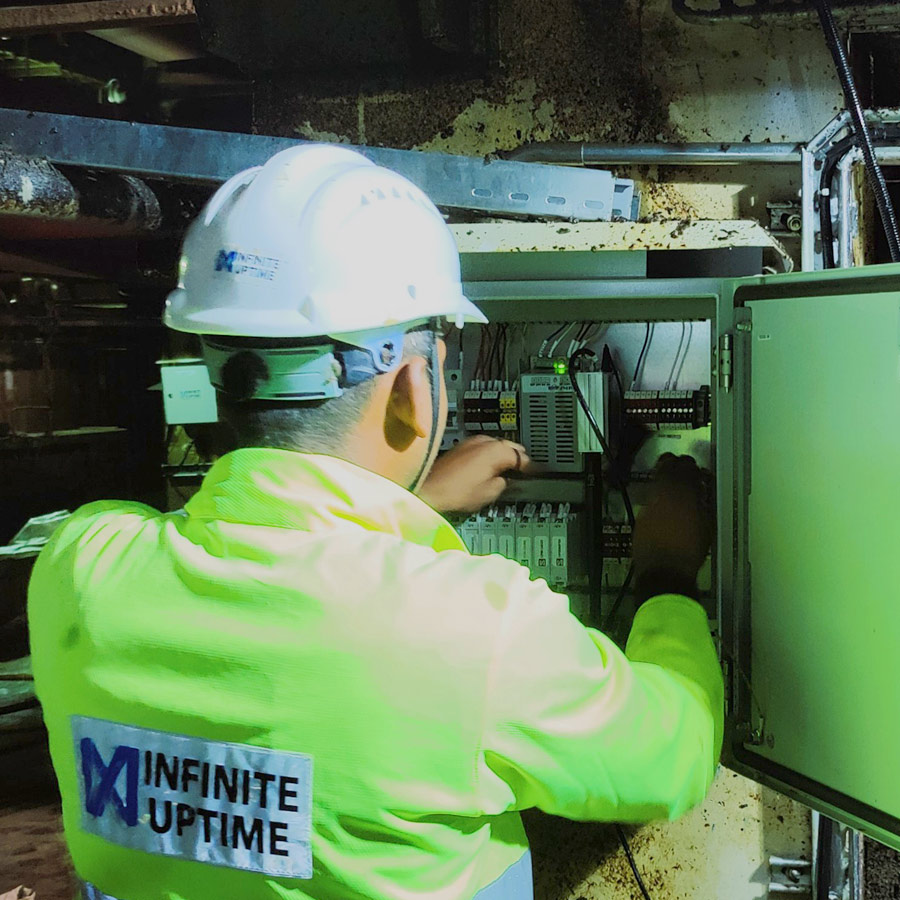
The repair was a cooling fan filter cleaning. In CEAT’s published PlantOS record, the customer’s comment is almost offensively ordinary: “Motor cooling fan filter cleaned”. The report records sixteen hours of downtime savings. Beside the language of industrial artificial intelligence, a dirty filter looks like an uninvited guest. Yet it explains Infinite Uptime rather better than a photograph of a gleaming factory could. Someone spotted a developing problem, someone knew what to do, and someone actually did it.
- PlantOS turns equipment signals into diagnoses and corrective actions.
- Customers include JSW Steel, CEAT and Indorama Ventures.
- Monthly, consumption-based billing helps customers start small.
- Operators execute repairs and sign off on the results.
Infinite Uptime works in the interval between a machine’s complaint and a factory’s response. Sensors and software can identify trouble. Trouble does not disappear because a dashboard has noticed it. A maintenance team must understand the fault, decide its urgency, arrange the intervention and establish whether the work helped. That sequence is the company’s product, and the source of its commercial argument.
The alarm still needs a mechanic
PlantOS, its prescriptive AI platform, combines mechanical signals such as vibration and temperature with process and maintenance context. It aims to identify the component at fault, recommend a corrective action and supply a deadline. Reliability specialists provide another layer of judgment. Remote assistance runs around the clock; on-site expertise supports the physical work. The arrangement is a mixture of industrial hardware, software and service.
The customers are manufacturers for whom a stopped machine can interrupt a much larger operation: steelmakers, cement producers, chemical plants, mines, paper mills and tire factories. A fan or gearbox matters because of what depends on it. Infinite Uptime’s expertise lies in interpreting those dependencies, translating failure patterns into useful instructions and helping maintenance teams follow through.
The first thing to fix was the buying decision
Founder and managing director Raunak Bhinge has described an early engagement with JSW Steel’s Vijayanagar plant in Karnataka. The obstacle in his account was persuading customers to begin using a forward-looking service while asking them to put substantial money down in advance. Infinite Uptime reduced that hurdle by shifting the commercial conversation from upfront capital expenditure to consumption.
In a July 2025 interview, he called this “show-and-grow”: monthly payments begin once clients see value, and usage expands as benefits become apparent. Today the company describes its offer as Production Outcomes as a Service. Pricing is negotiated case by case. Buyers therefore need a project-specific proposal, with covered assets, service obligations and the method for valuing avoided downtime spelled out.
The sensible cost question is how the subscription compares with the disruption a repair could prevent. A cheap sensor on an inconsequential asset may produce little economic value. An intervention on a bottleneck can justify a much richer service. Infinite Uptime’s model invites customers to test that arithmetic before extending the installation.
JSW made trust a maintenance metric
The JSW relationship began in India in 2021, according to Infinite Uptime’s case study. Early deployments concentrated on validating predictive insights and earning maintenance and production teams’ confidence. Recommendations that led to demonstrable results encouraged broader adoption, including American mills. The work expanded into crane applications, steam fans, hot-strip-mill roll monitoring and gearboxes.
The company’s later JSW account reports 6,047 executed prescriptions at an 89.61 percent implementation rate, alongside 36,108 cumulative hours of avoided unplanned downtime. These are company-published, operator-validated results. The distinction matters: a growing saved-hours total is a cumulative measure, and cannot by itself show that actual downtime was halved. Still, the executed-prescription count asks a useful question. Did anybody do the work?
Its “Trust Loop” returns operator confirmation to the system after a recommendation is executed. That makes maintenance teams participants in the feedback process. The useful lesson is portable: choose a consequential asset, state the intervention clearly, record what happened and expand after evidence accumulates. A pilot should leave behind a repaired machine and a defensible result, as well as a presentation.
- 01SenseEquipment + process
- 02PrescribeFault + fix + deadline
- 03ActMaintenance executes
- 04ValidateOperator confirms
A cable has its reasons
TDK Ventures, a strategic investor since 2023, highlights physics-based failure models and the volume of data available from wired, powered sensors. Continuous collection can capture information that intermittent sampling misses. Infinite Uptime’s current Flex Reliability offering also includes wireless periodic monitoring. The choice follows the consequence of missing a fault and how closely the asset needs watching.
AI Shields adds equipment-specific models for complex assets such as kilns, mills, furnaces and cranes. Process conditions can accelerate mechanical damage; a model needs to interpret the machine in its operating context. Plant Fusion addresses risk-based maintenance, stocking and replacement decisions. Together these offerings place Infinite Uptime between condition-monitoring tools, asset-performance software and specialist reliability services. Its proposed distinction is the specificity and execution of the prescription.
“Prediction ≠ Outcomes.”Infinite Uptime’s compact commercial thesis
A larger network, the same small test
The company raised a $35 million Series C in March 2025, led by Avataar Ventures. It globally launched PlantOS that June and acquired Australia’s MOVUS in August. In September 2026, Tech Mahindra announced a partnership to integrate the approach into existing industrial environments, initially emphasizing North America and Europe. On October 1, Infinite Uptime announced expanded collaboration with Microsoft, connecting PlantOS intelligence to its industrial AI ecosystem.
Expansion leaves the underlying requirement intact. Appropriate signals, equipment context and people able to perform repairs must be available. A recommendation cannot manufacture a shutdown window, a spare part or permission to access dangerous equipment. Buyers should establish those conditions and a credible measurement baseline. The company’s appeal is practical: make the maintenance decision easier to carry out, then check the result. Industrial AI earns its place when production carries on.