Seven years is an extravagant amount of time to spend learning a customer’s problems. It is long enough for the fashionable answer to change several times. For Vegam Solutions, it was the interval between building manufacturing software for one customer and rewriting that software to serve others. The apprenticeship came before the expansion.
- The job: connect factory execution, materials, quality and machine data.
- The buyers: industrial manufacturers, with published work at Henkel, BASF Coatings and MBCC.
- The lesson: learn the local exceptions before imposing a global standard.
A friend had brought Subramanyam Kasibhat and his wife, Savita, a contract to develop software for a German manufacturer. In his 2023 Practical Founders interview, Subramanyam recalled entering the assignment without a manufacturing background. Their education happened inside the problem. After seven years with that first customer, they rebuilt the product for a wider market.
There is something pleasingly unfashionable about this sequence. The customer arrived before the category description. Manufacturing expertise was acquired through work rather than announced on a slide. The eventual rewrite suggests the central difficulty: knowing one customer intimately and serving many customers reliably require different kinds of software.
“Never do what has been told as the only way of doing things.”Subramanyam Kasibhat · Practical Founders, 2023
The factory’s missing conversation
Vegam now sells manufacturing operations management technology. The term sounds grand; the work is often wonderfully particular. Its Smart Factory Suite connects the receipt of materials, production staging, manufacturing instructions, quality checks and dispatch. It integrates with enterprise systems such as SAP and with the industrial controls that already run equipment.
Consider an ordinary question: where did this batch go wrong? The answer might involve a material record, an operator action, a machine reading and a laboratory result. If those records live apart, a supervisor has to reconstruct the story. Vegam’s proposition is to connect the records while work happens, making the sequence visible rather than leaving it for a later investigation.
Illustrative workflow based on the Smart Factory Suite’s documented functions.
The company’s expertise sits in these crossings: enterprise IT meeting industrial equipment, standard procedures meeting operator decisions, global reporting meeting local practice. Its integration documentation names SAP ECC and S/4HANA, Oracle, laboratory systems, PLCs, industrial historians and robotics. Buyers are purchasing the ability to make existing systems cooperate, along with the applications that use their data.
One global standard, many local habits
Henkel makes a useful test of that idea. Vegam’s customer study dates the collaboration to 2007 and describes an adhesive manufacturing estate of 134 sites. Those sites had varied assets, different operating environments and difficulties applying consistent data standards. A common digital platform had to accommodate that variety.
The PDF offers a more revealing milestone than a sweeping rollout headline: successful initial deployments across approximately 10% of Henkel’s global footprint, followed by wider scaling. It describes operators participating throughout deployment, workflows tailored to sites, and interfaces adapted for regions such as China and South Korea.
The distinction matters. A corporation can decide that every plant will use a standard. An operator still has to find it useful during a shift. A system that standardizes reporting but complicates daily work invites workarounds. Vegam’s emphasis on local configuration is a response to that tension. The inference for buyers is practical: uniform data does not require identical screens everywhere.
Thirty-two lines, and a common vocabulary for loss
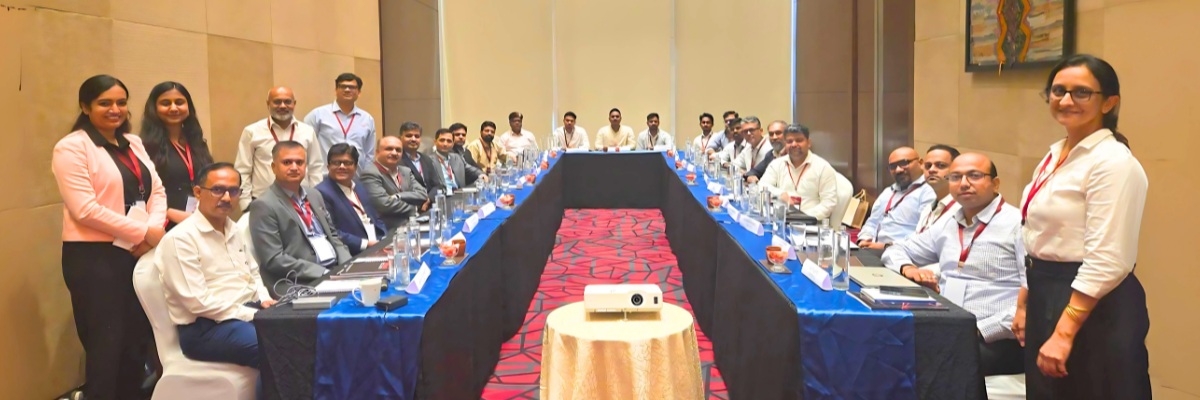
A separate MBCC case study describes a project that began in early 2022: 32 production lines across 15 plants, with different levels of automation and IT infrastructure. Some data came from existing manufacturing systems, some from IoT equipment, and some through manual entry. Vegam used its vMaxOEE software to bring those sources into shared reporting.
OEE, or overall equipment effectiveness, combines availability, performance and quality. Its usefulness depends on the definitions underneath it. Two plants can produce handsome dashboards while classifying downtime differently. Comparing the pictures then tells management less than it appears to.
MBCC project scope and rollout duration, as reported in Vegam’s case study.
Vegam describes remote deployment, mobile tools for less automated plants, multilingual support and common OEE and downtime reporting. The study reports a 5% increase in OEE and investment payback in four months. Those are customer-project claims published by the vendor; they deserve that attribution, rather than promotion into a forecast for every factory.
The transferable move is to accept mixed levels of automation while improving the reporting discipline. Waiting for every plant to become equally sophisticated can turn a useful project into an endless preparation exercise. A shared vocabulary for loss may be attainable before a shared generation of machinery.
The subscription is only one part of the bill
Vegam combines enterprise software and SaaS with implementation, integration and industrial technology. Historical vOEE documentation described a subscription linked to the number of production lines, basic support within the subscription and onsite assistance charged separately. That gives buyers a useful starting point for understanding the commercial model.
The economic question is broader than a licence. Integration consumes engineering time. Operators need training. A production line may need instrumentation. Someone must maintain the mapping between what a sensor records and what the factory calls an event. These are implementation considerations, not a quoted Vegam project budget.
BASF Coatings provides another reported outcome. Its case study describes thousands of materials and finished goods managed manually, with limited visibility into production and material movement. Vegam introduced its SFS platform at sites in India and China. The study reports a paperless operating model, payback in under a year and runner-up recognition in BASF’s internal digital award in 2024.
For a buyer, the sensible calculation starts with a specific loss and a specific intervention. If a dashboard reveals idle time, what can the team change? If better traceability prevents rework, how much rework currently occurs? A payback model needs a credible answer to both questions. Visibility becomes valuable when someone can act on it.
A bearing does not care about the dashboard
The product family extends beyond manufacturing execution. vCMS monitors equipment condition through portable or continuous wireless sensing. Its options include vSensPro Snap for mobile diagnostics, an always-on edge monitor and machine-learning analysis. vWMS handles warehouse work, including truck and gate management, receiving, inventory and staging.

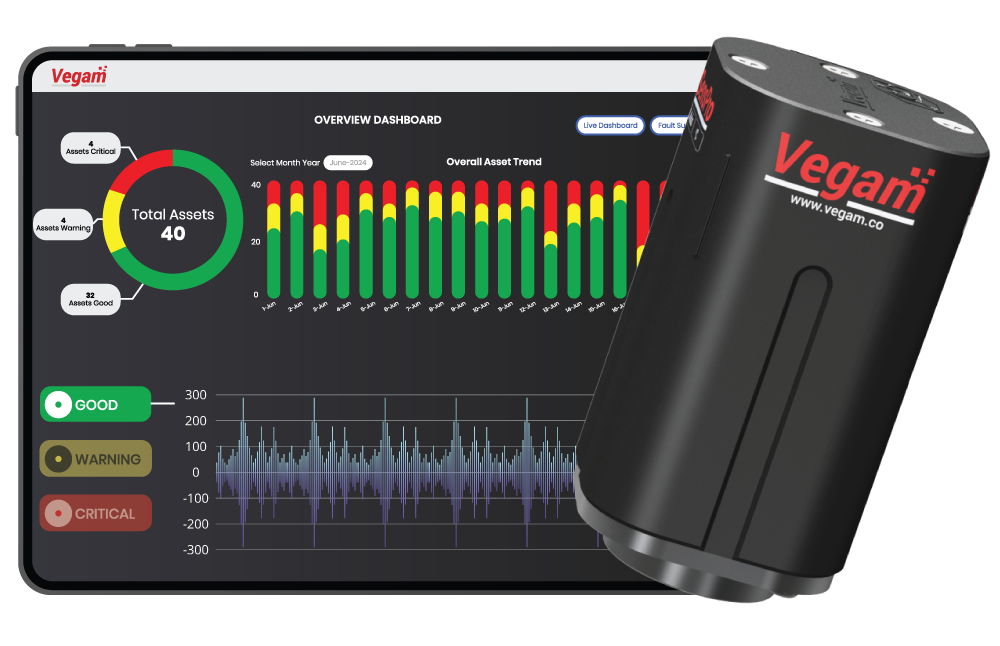
These products address different decisions. OEE asks where productive time disappeared. Condition monitoring asks whether an asset is developing trouble. Warehouse management asks where materials are and what should happen to them next. Bundling them is useful only when their information reaches the people responsible for those decisions.
Vegam Robotics carries the same coordination problem into physical movement. The team describes roots in KLE Technological University in Hubballi, university incubation and faculty mentorship. It also volunteers as industry mentors for La Fondation Dassault Systèmes’ ConnectNext programme. Its ambition includes increasingly autonomous factories; achieving that requires the surrounding process to be dependable enough for a machine to follow.
The exception is where the work begins
Vegam competes in a market of enterprise manufacturing platforms, specialist performance tools and applications built within factories. Its distinction is the combination of operational breadth, integration work and configurable plant workflows. That is a positioning argument, not an independent verdict that every rival lacks those capabilities.
The approach makes sense where manufacturing complexity rewards connected records: batch processes, many materials, multiple plants and heterogeneous equipment. A small operation with a straightforward process may have little reason to buy that breadth. A plant that cannot maintain reliable data or assign responsibility for acting on alerts will struggle to realize the value, however attractive the software looks.
The company has changed its own arrangements as well. In 2024, Subramanyam explained that growth in Europe and the US prompted a move from a Singapore/Dubai base to the US. His account of the Indian subsidiary’s funding transfer describes banking roadblocks and eventual assistance from ICICI’s Silicon Valley team. Expansion brought administrative friction alongside product opportunity.
More recently, the founders have worked on AI Intime, an adjacent enterprise knowledge platform. Subramanyam also describes experienced Vegam engineers using AI while validating its outputs. That makes the older story newly relevant: useful intelligence depends on understanding the circumstances of work. Seven years with one customer was an expensive education in time. The part another company can copy is the attention.