The first thing to fail in a modern factory is often not the machine. It is the plan. A schedule can be perfectly sensible at 7:00 a.m. and fiction by lunch: a delivery slips, a cutter stops, an urgent order jumps the queue, or a roll of aerospace composite spends too long outside its freezer. The spreadsheet survives. Reality moves on.
Plataine makes software for that widening gap. Its Total Production Optimization platform pulls orders and inventory from enterprise systems, listens to events on the shop floor, then recommends what to make, when to make it, which machine and tool to use, and which piece of material should be consumed. The company calls the latest interface “AI Agents.” The useful part is older and less fashionable: nearly two decades spent encoding the unpleasant exceptions that make advanced manufacturing difficult.
That specificity is the story. A general chatbot knows what carbon fiber is. Plataine’s system is supposed to know that this particular prepreg roll was thawed twice, has a limited exposure window, contains a defect here, left a remnant there and must be traceable to the aircraft part that eventually ships. In a business where raw material is costly and certification is unforgiving, memory becomes margin.
Which job, which roll, which tool, right now?
Founder Moshe BenBassat came to Plataine through optimization rather than robotics. A professor whose research touched NASA, DARPA and other institutions, he had already founded ClickSoftware, a company built around scheduling field-service resources. Plataine, founded in Israel in 2008, moved the same class of decision problem inside factories. Avner Ben-Bassat now runs the business as president and chief executive.
The initial wedge was composites. Aerospace structures and wind blades are assembled from expensive materials that behave more like groceries than steel beams: storage temperature, shelf life and time out of the freezer matter. Cutting is a nesting puzzle. Tool availability constrains the sequence. Autoclaves batch parts under strict recipes. The bill for a poor decision appears as scrap, rework, overtime or a late delivery.
One decision loop, four moving inputs
Its product suite follows the factory’s nouns. Production Scheduler tests possible sequences and revises the plan when conditions change. Time Sensitive Material Manager records receipt, storage, thawing, exposure and consumption. Material & Asset Tracker and Tool Manager answer where things are and whether they can be used. FabricOptimizer, FoamOptimizer, HoneycombOptimizer and WoodOptimizer try to fit more parts into less sheet or roll. Supplier Connectivity Manager pushes the view beyond one plant.
Together they create a digital thread: a record connecting incoming material to process events and finished parts. That matters to a quality auditor, but it also matters before the audit. If a suspect material batch is discovered, a manufacturer can identify where it went. If a roll approaches expiry, the planner can use it before opening another. Traceability stops being a scrapbook assembled after production and becomes an input to the next choice.
The proof is hiding in the scrap bin
Factory software is easy to demonstrate and hard to judge. Plataine’s strongest case comes from disclosed customer outcomes. MT Aerospace said its use of FabricOptimizer and Material & Asset Tracker produced 11 percent material savings while reducing paperwork. MRAS, the ST Engineering business that makes composite nacelle structures, reported a 96 percent first-time-right yield. Aciturri reported 4.6 percent less material waste; Kineco Kaman reported a 4.5 percent reduction in prepreg waste.
MT Aerospace
MRAS
Multi-Ply
The numbers are not a universal benchmark; they come from different plants solving different problems. But they expose the business model better than a list of algorithms. Plataine sells enterprise software and deployment services to manufacturers, using a pay-as-you-use structure in which customers select applications. It does not publish list prices. The relevant cost equation is therefore local: subscription and integration on one side; material, planning labor, expediting, rework and missed throughput on the other.
The implementation is part software project, part operations audit. Plataine says an initial go-live commonly takes six to 12 weeks, depending on complexity. That window is plausible only when a customer can expose usable order, inventory and production data and assign people who understand the exceptions. The algorithm cannot infer a hidden shop rule that exists only in a supervisor’s notebook. Much of the early value comes from turning those rules into explicit constraints before anyone asks the system to optimize them.
“Implementing Plataine’s solutions ... led to 11% material savings.”Jürgen Moeller, MT Aerospace
One wind-blade case makes the before picture vivid. Each blade required 700 to 1,000 fiberglass pieces, and engineers manually created cut plans for rolls roughly 200 meters long. A new blade design took two or three days to plan. Overlaps, missing pieces and overcuts appeared first; waste and delay followed. The manufacturer’s “rate up, cost down” pressure changed the calculation. Automation reportedly produced 3 to 4 percent material savings while shortening planning work.
At Kanfit, the jolt was different. The pandemic disrupted production, and scheduling software helped the aerospace manufacturer close its planning gap. At Cyclone, a large Bombardier order threatened to overwhelm a sequential process built on static nesting libraries. The pattern is consistent: management changes its mind about manual planning when volume, volatility or material cost turns expert improvisation into a bottleneck.
A layer, not another factory kingdom
Plataine’s shrewdest positioning choice may be what it does not ask customers to remove. ERP systems know orders and purchasing. MES software records execution. PLM holds product definitions. None necessarily decides the best next move across all of them. Plataine presents itself as the optimization layer between enterprise records and shop-floor reality, integrating with those systems rather than staging a rip-and-replace campaign.
That makes its competitive set slippery. Sometimes the alternative is Excel and a veteran planner. Sometimes it is an advanced planning product such as Siemens Opcenter APS or DELMIA Ortems. Industrial data platforms including Sight Machine and Tulip approach adjacent problems from analytics or frontline operations. Plataine’s difference is its concentration on resource decisions, especially the peculiar physics and genealogy of composite production.
Partnerships reinforce the layer strategy. The company works with SAP and Microsoft, has collaborated with CTC GmbH, an Airbus company, and the Advanced Manufacturing Research Centre with Boeing, and belongs to Britain’s National Composites Centre. In 2024, inno-focus became a route into Germany, Austria and Switzerland. Argosy Japan supports local deployments, including the 2026 selection by multi-plant precision manufacturer Takase Kanagata.
With roughly 60 employees in the supplied company record, Plataine is small beside the industrial software suites around it. That can be an advantage when the buyer needs composite specialists rather than another generic data lake. It can also limit how many plants and integrations the company can absorb at once. The partnership network is therefore more than a row of logos: it supplies local reach, systems knowledge and credibility inside conservative manufacturing accounts.
The copyable move
Start with one expensive constraint, not a “smart factory” program. Measure wasted material, planner hours, late orders or rework before changing the workflow. Connect the minimum systems needed to recommend one decision. Keep a human approval step. Expand only after the first number moves.
There are limits. Optimization needs trustworthy timestamps, inventory records and shop-floor events. A stable, low-mix plant with cheap material may not recover integration costs quickly. A team that ignores recommendations will merely acquire a more decorative dashboard. And when the real constraint is chronic equipment shortage or unreliable suppliers, a clever schedule can expose the problem but cannot manufacture capacity.
Now the software talks back
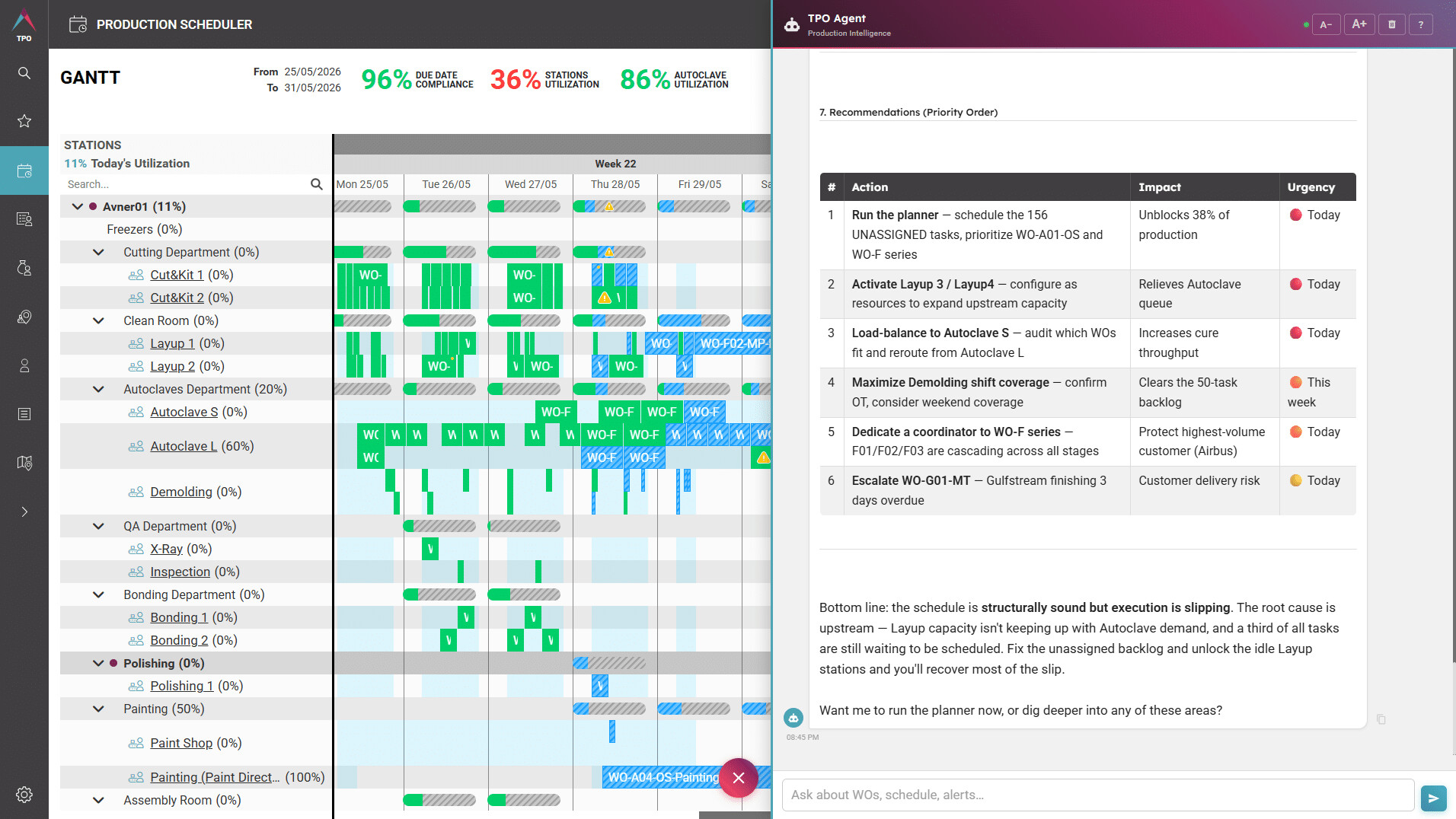
In 2025, Plataine introduced connected AI agents at the JEC composites show. In June 2026, it released a new generation embedded in TPO. A planner can ask why an order is late, explore an alternative or receive a warning before a bottleneck hardens. Sales teams can request a capable-to-promise date. The agents communicate across scheduling, materials and production rather than waiting for someone to reconcile separate screens.
A second 2026 update folded preventive maintenance into the production schedule. Instead of treating maintenance as a calendar that competes with output, the software watches actual equipment and tool usage, triggers the work and recalculates production around it. This is where the agent language earns its keep: not because the system chats, but because one operational event changes several downstream decisions.
The risk is that every software vendor now owns an agent. Plataine’s defense is the unglamorous accumulation underneath: freezer clocks, cut geometry, cure recipes, tool cycles, worker skills, due dates and years of integrations. The interface can be copied. A credible model of what a disrupted composites plant should do next is harder.
Plataine’s customers include large names - Airbus operations, IAI, Triumph, Ethan Allen and Renault’s Formula One team among them - as well as specialized suppliers where a handful of planners carry an entire factory in their heads. That second group may be the more revealing market. The software does not need to build the product. It needs to preserve the best planner’s judgment, update it faster than circumstances change and leave enough evidence for everyone else to trust the call.
The factory of the future, in this telling, is not a dark room full of autonomous robots. It is a familiar, noisy place where the plan finally notices what just happened.