A factory manager can know a machine like a farmer knows the weather and still be wrong about what happened Tuesday afternoon. The press sounded healthy. The operator remembers only one stoppage. The spreadsheet says output missed plan. Somewhere between those facts are seventeen tiny pauses, a lazy changeover and a motor beginning to complain. Guidewheel exists to catch that missing middle.
The San Francisco company sells an annual subscription wrapped around simple hardware: current transformers that clip around a machine's power supply and read its electrical draw. The resulting signal travels to the cloud, where Guidewheel translates it into states such as running, idle or off. Operators add reasons. Managers see live scoreboards. Maintenance receives alerts. Over time, the system builds a record of cycles, downtime, energy use and unusual behavior across machines that may differ wildly in age and manufacturer.
That description sounds modest next to the industrial world's favorite phrase, “digital transformation.” Modesty is part of the design. Guidewheel does not need to wire into every programmable logic controller or replace the plant's existing systems. The core sensor does not touch the operational-technology network. Installation can take hours or days, not the months associated with a custom MES project. Public pricing begins at $15,000 a year for ten machines, with onboarding and support included.
01 / The productThe power cable is the universal adapter
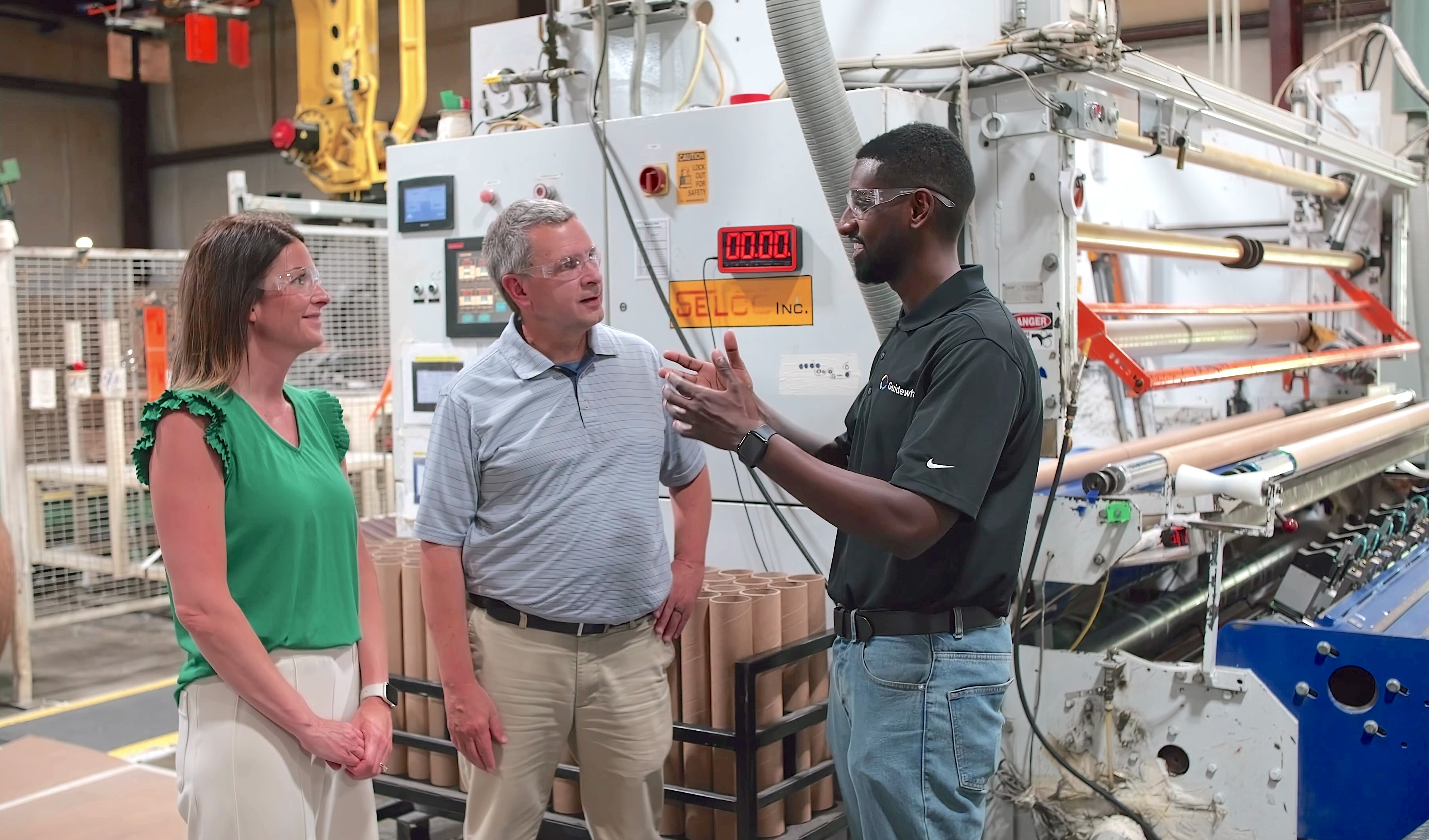
Guidewheel's key observation is almost comically plain: powered machines have power cables. A modern extruder and an elderly stamping press may have nothing else in common. Both leave an electrical signature when they start, stop, accelerate or labor. Reading that signal gives Guidewheel a way around the factory's usual integration mess - mixed vendors, legacy controls, isolated networks and equipment nobody wants to interrupt.
FactoryOps is the umbrella product. It tracks production, utilization, cycles, changeovers, Overall Equipment Effectiveness and energy. It displays scoreboards to the floor, sends SMS or WhatsApp alerts, and helps teams rank losses through Pareto analysis. It can connect with ERP, maintenance and business-intelligence systems through native integrations, Workato or an open API. Scout, the predictive-maintenance product, analyzes the same sensor stream for anomalies without asking the customer to install another device or learn another interface.
The result is not a digital twin in the cinematic sense. It is more like a truthful diary with a very good alarm clock. That is enough to answer expensive questions: Which shift loses the most time? Is a long cycle normal for this product? Should the company buy another line, or is capacity hiding inside the lines it owns? Did last week's fix stick?
02 / The pivotCustomers changed the noun
Guidewheel began in 2018 as Safi Analytics, an energy-management tool. CEO Lauren Dunford had worked in food production and knew the unpleasant ritual of calling customers about delays. She teamed with longtime friend and engineer Weston McBride. Their first thesis joined operational waste to climate impact: measure machine-level energy, find waste, lower costs and emissions.
The first idea was sensible. The customer behavior was more interesting. Manufacturers used the same data to track downtime, manage machines and run shifts. Energy mattered, but a silent production line carried a more immediate price and a clearer budget. The founders listened. Safi became Guidewheel in 2021, named for the small guide wheels that keep factory processes aligned, and the company described its broader category as FactoryOps.
“Start with the simple, fast 80/20 - then layer on lots of things.”Lauren Dunford, on how customers adopt Guidewheel
What failed first? Not the sensor and not the underlying data. The narrow framing did. Energy management treated the signal as an accounting input. Customers treated it as an operating system for the day. The switch changed the buyer, the frequency of use and the proof of value. Sustainability did not disappear. It became the bonus produced by a productivity tool people had reason to open every shift.
These are customer case-study outcomes, not guarantees. Still, they show the economic grammar of the sale. Penn Color began with bottleneck assets, put sensors on key machines, let operators assign reason codes and used the reports to prioritize improvements. It reported a 50 percent uptime increase in the pilot group and 30 to 35 percent higher utilization across its U.S. plants. That opened capacity for new business and helped it retire underused equipment. The useful unit was not “more data.” It was production hours recovered and capital spending avoided.
03 / The marketBetween the clipboard and the control room
Guidewheel serves manufacturers in plastics, packaging, food and beverage, metals, automotive, building materials, consumer goods and industrial equipment. Named customers include Coca-Cola FEMSA, Igloo, Kimberly-Clark, Berry Global, Myers Industries, Penn Color and Pretium Packaging. The end users stretch from operators and maintenance technicians to continuous-improvement leaders and executives running several plants.
Its alternatives arrive from every direction. MachineMetrics, Evocon and Factbird sell production visibility. Vorne offers familiar OEE hardware. Redzone focuses on connected frontline work. Augury leans into machine health. MES, SCADA and historian vendors promise deeper integration. The cheapest competitor remains the clipboard, the whiteboard and the supervisor who “just knows.”
Guidewheel's difference is the combination: hardware-light sensing that works across mixed fleets, cloud software that joins production and maintenance, and an energy dataset included by the physics of the sensor. The company says its oldest connected machine was built in 1935. A platform that can observe that relic and a new line in the same language has a credible claim to cross-plant consistency.
The business is classic enterprise land-and-expand with a box of sensors at the front door. Start on a few critical machines. Establish a baseline. Recover enough production or avoid enough downtime to justify the annual fee. Expand to more assets, then other plants. Multi-site reporting, benchmarking, predictive maintenance and integrations make the account stickier as the history grows.
Investors have funded that expansion. Greycroft led an $8 million Series A in 2021. Breakthrough Energy Ventures led a $9 million A-1 in 2022. In August 2024, BlackRock and Temasek's Decarbonization Partners fund led a $31 million Series B with Rethink Impact, GSBackers and Ecolab joining existing backers. Guidewheel is a public benefit corporation, and its mission is to help the world's 10 million factories reach “sustainable peak performance.”
04 / The playbookWhat another operator - or founder - can steal
First, choose the bottleneck, not the whole factory. A one-week baseline on the painful machine makes success legible. Second, separate automatic truth from human explanation. The sensor should capture when the state changed; the operator should add why. Third, set an alert path before the alarm arrives. Data without an owner becomes wallpaper. Fourth, review the same losses every day and record the corrective action. Fifth, expand only after the plant can point to recovered hours, lower scrap, faster response or deferred equipment purchases.
Founders can steal the product lesson too. Build around the universal behavior of a messy market. Avoid integration where the value does not require it. Watch how customers misuse the first product. The misuse may be the roadmap. Finally, sell the urgent benefit and let the worthy benefit ride along. Guidewheel's energy data became more persuasive when production paid for the sensor.
Conditions that help
- A visible bottleneck with valuable lost hours
- Mixed-age machines that are hard to integrate
- Operators willing to tag reasons consistently
- A manager empowered to act on the daily data
Where it can break
- Electrical draw does not distinguish useful machine states
- The plant already has trusted, complete live telemetry
- Alerts create noise without a response workflow
- Data becomes a tool for blame instead of improvement
The limits matter. Electrical signatures are an elegant proxy, not omniscience. They may need careful configuration, and they cannot explain material quality or operator intent by themselves. Predictive alerts can surface deviations, but maintenance teams still need judgment. A plant that codes downtime inconsistently will manufacture confident-looking nonsense. A company that uses the scoreboard to punish operators may get cleaner charts and worse truth.
Guidewheel is therefore not really selling a sensor. It is selling a daily operating habit with a sensor attached. The hardware lowers the cost of observation. The software organizes attention. The customer supplies context and action. When all three work, a factory stops discovering its losses at the end of the shift and begins fixing them while there is still a shift left to save.