Factory Operations. Solved. Seed round closed: $3.15M - June 2024 95-99% defect detection accuracy Deployed in ~2 weeks 30+ facilities optimized in year one Human action recognition on the line Boston, Massachusetts Born from MIT & Harvard research Factory Operations. Solved. Seed round closed: $3.15M - June 2024 95-99% defect detection accuracy Deployed in ~2 weeks 30+ facilities optimized in year one Human action recognition on the line Boston, Massachusetts Born from MIT & Harvard research
Company Dossier / Industrial AI

Tristar AI

The never-blinking eye on the factory floor - computer vision that catches the missed step before the bad part ships.

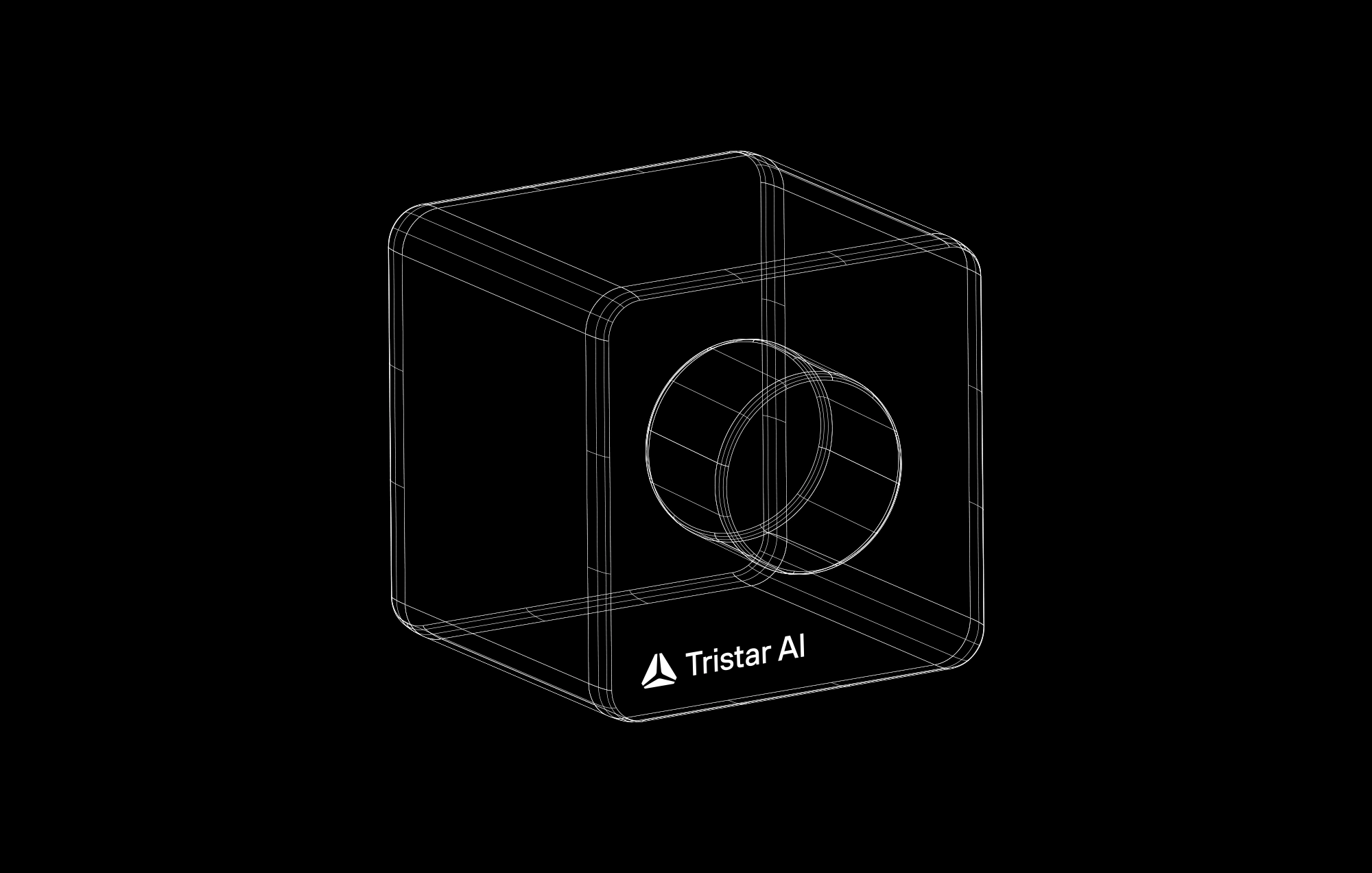
Tristar AI smart camera monitoring a manufacturing production line

CAPTION: A smart camera and a small server-grade GPU, pointed at the line. It doesn't get tired at 3 a.m. It doesn't glance away when the valve turns. It just watches, remembers, and speaks up.

The Scene

3:14 a.m., somewhere on a plastics line

A worker on the overnight shift reaches for a part, seats it, moves on. Except this time the seating step didn't quite happen - a half-second of motion that used to vanish into the noise of a running factory. Nobody saw it. Nobody could have. Then a camera in the rafters, running Tristar AI, notices the shape of the motion was wrong, and a manager's phone lights up before the part is three feet down the conveyor.

That is the entire proposition, stripped of jargon. Tristar AI is a Boston company that puts eyes on the production line - eyes that understand not just what the machine is doing, but what the person is doing. It reads human motion as a sequence of small actions that add up to a task, and when the task goes sideways, it says so immediately. The company's own phrasing is refreshingly blunt: Know immediately. Intervene now to prevent losses later.

Manufacturing has spent a century measuring its output after the fact - counting scrap at the end of the shift, tracing a defect back through a batch, guessing when a machine will fail. Tristar's bet is that "after the fact" is the most expensive phrase in the industry, and that a camera which understands what it sees can move quality control from autopsy to prevention.
95-99%Defect Detection
~2 wksTo Deploy
30+Facilities Year One
$4.45MTotal Raised
The Product

A brain on-site, not in the cloud

The setup is almost anticlimactic: high-definition smart cameras above the line, wired to a single small server-grade GPU sitting in the plant. No warehouse of servers, no shipping footage to a data center. The intelligence lives where the work happens. That matters for latency - alerts have to be instant to be useful - and it matters for nerves, which is why Tristar leans on the phrase "military-grade privacy." The system is built to watch the process, not to build dossiers on the people.

01

Smart Cameras

Scalable, high-definition cameras paired with an on-premise GPU. The eyes of the operation.

02

Human Action Recognition

Breaks motion into small actions - raise an arm, turn a valve - and combines them to recognize complex tasks and spot skipped steps.

03

Defect & Anomaly Detection

Real-time flags for assembly errors and surface anomalies, at a claimed 95-99% accuracy.

04

Enterprise Insights

A dashboard turning footage into live production, quality, and maintenance analytics - actionable, not just archival.

"Know immediately. Intervene now to prevent losses later."
- Tristar AI's operating philosophy
The Origin

It started in a Houston plastics shop

Founder Salem Karani did not arrive at manufacturing through a slide deck. He grew up inside his family's plastics business in Houston, watching his father wrestle with the daily fog of running a plant - the defects you find too late, the downtime you can't explain, the sense that the floor is always slightly ahead of the people responsible for it. He took that frustration into research at MIT and Harvard, and pointed AI at the exact problem he'd watched consume his father's days.

He didn't build it alone. Tristar's founding trio pairs Karani's vision with a product lead and a business lead, a team drawn from MIT, Harvard, and the University of Texas at Austin, with automotive and tech-industry veterans mixed in. Small, technical, and unusually close to the shop floor they're trying to fix.

SK

Salem Karani

Co-Founder / CEO
JL

Jack Liu

Co-Founder / CPO
BR

Ben Rocci

Co-Founder / CBO
The Mission

Work smarter, not harder - literally

The stated mission is to "empower people to work smarter, not harder," using computer vision to build safer, more efficient workplaces and stop costly mistakes before they compound. It's a mission with a chip on its shoulder about a specific villain: the mistake nobody caught in time.

Notice what Tristar is not selling. It isn't promising to replace the worker with a robot. The whole design philosophy - reading human action - assumes people stay on the line and that the smartest thing you can do is give them a partner that never looks away. In an era loud with talk of automation erasing jobs, that's a quieter, more interesting position.

The Beat

The hard industries, on purpose

Tristar aimed at the sectors where a defect is expensive and the tolerances are unforgiving: plastics, automotive, chemicals, and defense. These aren't glamour verticals. They're the places where a skipped step or a surface flaw can mean a recall, a scrapped batch, or a safety incident - which is exactly why real-time visibility is worth the install.

Plastics Automotive Chemicals Defense Precision Manufacturing
The Money

$4.45M, and a bet on the unglamorous

Tristar raised roughly $1.3M in a 2023 pre-seed, then closed a $3.15M seed in June 2024, co-led by Las Olas Venture Capital and TenOneTen Ventures. The syndicate - Ford Street, NextView, SNR 5, Trust Ventures, Seraph Partners - is the kind that shows up when a team is chasing a real, boring, enormous problem rather than a demo-day trend.

$1.3M
Pre-Seed · Apr 2023
$3.15M
Seed · Jun 2024

Co-led by Las Olas Venture Capital & TenOneTen Ventures. Additional read: press coverage of the raise via EIN Presswire.

The Record

How it got here

2022

Tristar AI founded in Boston by Salem Karani, Jack Liu, and Ben Rocci - technology rooted in MIT and Harvard research.

April 2023

Raises ~$1.3M pre-seed to build out the smart-camera and human-action-recognition platform.

Year One

Reports optimizing production lines at 30+ facilities nationwide, with measurable drops in defects and unplanned downtime.

Jan 2024

Presents "Manufacturing Operations. Solved." at the AI in Manufacturing conference.

June 2024

Closes $3.15M seed round co-led by Las Olas VC and TenOneTen Ventures.

The Return

Back to 3:14 a.m.

Rewind that overnight shift five years and the missed step is simply gone - swallowed by the hum of the line, discovered maybe next week when a customer complains, maybe never. The manager would have spent the morning guessing which of a thousand motions went wrong, and the worker would have carried the blame for a mistake no one could even locate.

Now the same half-second triggers a phone. The part gets pulled, the step gets redone, the batch stays clean, and nobody spends a morning playing detective. Tristar AI didn't add a robot to the floor or take a job off it. It did something smaller and stranger: it gave the factory a memory, and gave the people running it the one thing manufacturing never had enough of - the chance to fix a mistake while it's still just a mistake, and not yet a loss.