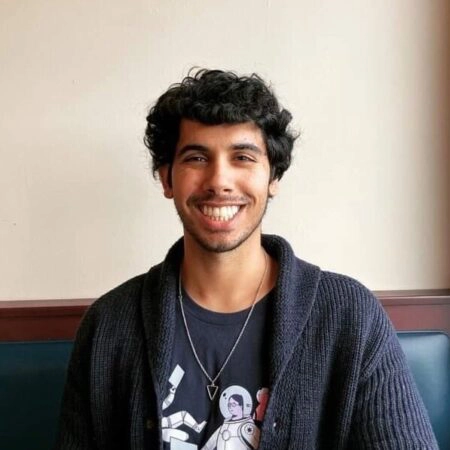
Salem Karani runs Tristar AI, a Boston company that points computer vision at the factory floor and tells managers, in real time, when a part is going bad or a step got skipped. The hardware is almost boring on purpose: cameras and a small server-grade GPU. What is not boring is what the software watches. Most computer vision systems learn to recognize objects. Tristar's learn to read people - the motion of hands, the rhythm of a task, the moment a routine breaks.
That choice sounds academic until you see what it buys. Because the models understand human motion at a kinematic level rather than memorizing one specific assembly line, they generalize. Tristar can drop them into a factory it has never seen and have them working in roughly two weeks, no months-long retraining ritual. "Everyone else was labeling objects," Karani says. "We focused on human motion. It took years, but now we can drop our models into new factories without retraining."
It is the kind of bet that only makes sense if you already know what a factory feels like at 3 a.m. Karani does.
Raised by a production line
He grew up inside a family-operated plastic film manufacturing business, watching his father wrestle the volatile economics of American manufacturing - overseas competition, swinging commodity prices, the constant threat of a bad batch. The detail he keeps returning to is not a spreadsheet. It is his father's devotion to the machines.
"My dad was obsessed with his machines. He'd sleep at the factory to make sure nothing went wrong on the graveyard shift." That image - a man unwilling to trust the night shift to luck - is more or less the product spec for Tristar AI. Karani built the thing that can stay awake so the next generation of plant owners doesn't have to sleep on a cot by the extruder.
What he absorbed went beyond one family business. "What stayed with me was just how much of America works in factories and farms, not in finance or software." It is a worldview, and it shows up in how he sells.
The pitch is not the technology
Karani is almost allergic to the standard AI sales motion. "A mistake a lot of people make selling into manufacturing is thinking they can lead with AI," he says. "I don't pitch machine learning models - I pitch reducing scrap, cutting waste, improving uptime. That's the language they speak."
This is not modesty. It is credibility, and he knows exactly why it matters. "These are people who've worked in production for 20 years. They know when someone's faking it. We're not." When you were raised by one of those people, you cannot fake it even if you wanted to. The whole company is built on the assumption that the buyer is smarter about manufacturing than the seller - so the seller had better show up with numbers, not jargon.
The number Karani cares about most is a ratio. "Our north star is 4 to 5x return for every dollar spent with us. If we keep delivering that, we'll keep growing." Not a moonshot. A multiplier a plant manager can defend to a CFO.
Early to a party nobody else saw coming
The co-founders started building AI vision models in 2020, well before generative AI made "AI" a board-level obsession. That looked like patience at the time and prescience in hindsight. "We didn't plan it this way, but the timing worked out," Karani says. "As the broader market grew more comfortable with AI, we were already ahead on R&D." The market caught up to a head start.
Tristar AI was founded in 2022 with Jack Liu, who leads product, and Ben Rocci, who leads business. Karani holds both the CEO and CTO seats - chief executive and chief technologist in one chair, which fits a founder who treats the model architecture and the sales pitch as the same problem viewed from two ends. The founding team's resumes run through MIT, Harvard, and the University of Texas at Austin, with experience across automotive and technology.
From drones to defects
Before Tristar, Karani earned an electrical and computer engineering degree at UT Austin and a master's in biomedical informatics at Harvard, with study at MIT along the way. He has said he helped scale two early-stage computer vision startups. One of those was GreenSight, where he served as Head of ML & Computer Vision and a senior software engineer, working on autonomous drone hardware and software. His very first manufacturing job has a name that reads like foreshadowing: a systems engineering internship at Tristar Packaging.
Drones taught him to make vision systems work in the messy, unlabeled real world - wind, glare, motion, edge cases. Factories are the same problem with worse lighting and higher stakes. The throughline is consistent: computer vision that has to survive contact with reality, not a benchmark.
The bigger ambition
Karani does not describe Tristar as a defect-detection tool. He describes it as an operating system for the factory. The wedge is quality monitoring, but the roadmap reaches into predictive maintenance, sourcing, and procurement - turning the data a factory already generates into decisions it can act on. "We're building models that understand materials like plastic film or steel at a physics level," he says, which is the kind of sentence that only a plastics-family kid with a Harvard informatics degree would say casually.
The strategy has a flywheel built in. "The more people who touch the system, the stickier we become. That's where the real value is - getting everyone aligned on how to improve margins." Quality, operations, engineering, finance, procurement: the more departments lean on the same shared view of the floor, the harder Tristar is to rip out. Investors describe what he is building in grand terms - a real-time operating system for modern manufacturing, the software layer of American reindustrialization. Karani keeps it concrete. Cut the scrap. Hit the multiplier. Repeat.
Advice with dirt under its nails
Ask him how to build for manufacturing and he won't hand you a framework. He'll hand you a year of your life. "Go work in a factory. Spend a year on the floor. That's the only way you'll understand the culture, the pain points, and the real buying dynamics." It is advice that doubles as autobiography - he got his year early, and for free, watching his father refuse to sleep.