Who they are now
A camera looks at a part. A machine decides.
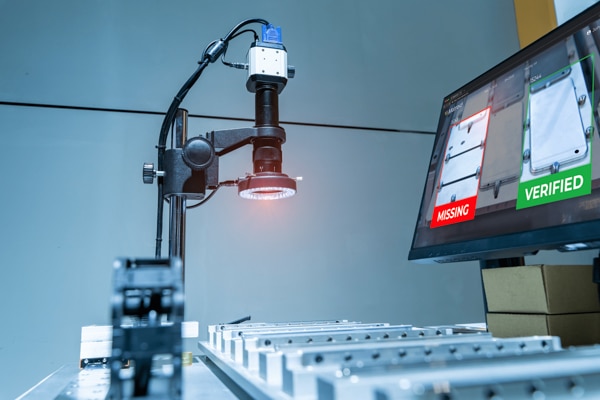
Somewhere on a manufacturing line right now, a small camera is staring at a tray of metal parts. It does not blink, it does not get bored on the night shift, and it does not need a coffee. Mounted above the conveyor, it runs a Matroid detector that was trained one afternoon by a person who has never written a line of Python. When a part is missing, the screen turns red. When everything is where it should be, it turns green. Missing. Verified. Thousands of times a day.
That is Matroid in 2026: a Palo Alto software company that turns ordinary camera feeds into searchable, alert-firing systems. Its platform detects objects, people, events, defects, and safety violations - in real time, and in footage that already happened. The company is small by headcount and large by ambition, sitting at the unglamorous intersection where deep learning research meets the loading dock.
Every factory already has cameras. Matroid is the part that finally understands what they are watching.
The premise, stated plainly
The problem they saw
Computer vision worked. Almost nobody could use it.
For years, computer vision was a magic trick performed exclusively by people with doctorates. The models existed. The accuracy was real. But to point one at your own problem, you needed a data science team, a labeling pipeline, GPUs, and the patience of a saint. The result: the people who actually understood the defect - the quality engineer, the line supervisor, the safety officer - were the ones least able to build the model that would catch it.
It was a strange bottleneck. The expertise sat in one room and the machine learning sat in another, and they were not on speaking terms. The factory had the cameras and the knowledge. It did not have the translator.
The person who knows what a defect looks like should not need a PhD to teach a computer to find it.
The bottleneck Matroid set out to remove
The founders' bet
A mathematician left big AI to build small tools.
Matroid was founded in 2016 by Reza Zadeh, a Stanford adjunct professor who had been on the founding team at Databricks and worked on machine translation at Google. He co-authored a book on TensorFlow and hosts an annual machine learning conference. In other words, he had every credential needed to keep building exotic models for other experts. He chose, somewhat against type, to build a product for people without his credentials.
The name is a small inside joke. A "matroid" is a mathematical structure that generalizes the idea of independence - the sort of thing only a mathematician names a company after. The bet underneath it was less abstract: that if you made training a detector as simple as dragging and dropping, the demand would not come from Silicon Valley. It would come from factories, airports, and aerospace floors that had been sitting on camera footage nobody could mine.
FounderReza Zadeh
CEO and founder. Stanford adjunct professor, Databricks founding-team alum, co-author of "TensorFlow for Deep Learning."
The boardroomHeavy hitters
Advisors and board have included Databricks' Ion Stoica and Matei Zaharia, NEA's Pete Sonsini - and astronaut Chris Hadfield.
The product
They call them detectors.
The unit of work at Matroid is the detector: a custom vision model you build, no code required, to find one specific thing. Objects. People. Actions. Emotions. Defects. A missing screw. A worker without a hard hat. Once trained, a detector watches a live feed and fires an alert the instant it sees its target - and it can also rewind, searching months of recorded footage for the same thing. It is, in effect, a search bar for the physical world.
Where it runs is the quietly clever part. Matroid deploys to the cloud, to on-premise servers behind a corporate firewall, and to embedded edge devices sitting right next to the camera. For an aerospace contractor or a government site that cannot send video anywhere, that last option is not a feature - it is the whole reason the deal closes.
BuildDrag-and-drop training
Domain experts train camera-agnostic detectors without a data scientist in the loop.
WatchReal-time alerts
Live monitoring fires the moment a detector sees its target across one feed or many.
SearchRewind the footage
Query months of recorded video for an object, person, or event - after the fact.
DeployCloud, on-prem, edge
Run it where the data lives, including air-gapped sites that can't ship video out.
Train it this afternoon. It catches the defect tonight.
The Matroid loop, compressed
The proof
Money, partners, and a 96% F1 score.
Matroid has raised $33.5 million across two rounds, from a backer list that says a lot about who finds this useful: Intel Capital and NEA on the venture side, Energize Ventures on the industrial side, and In-Q-Tel, the strategic investment arm tied to the U.S. intelligence community, on the government side. When Intel, an industrial-energy fund, and a national-security investor all show up to the same cap table, the "who is this for" question mostly answers itself.
The technical proof is less abstract. Matroid built a glaucoma-detection model that hit a 96% F1 score using 3D convolutional networks, and a 3D architecture called FusionNet that topped Princeton's ModelNet competition. The point is not the medical scan or the leaderboard - it is that the same engine pointed at an eye can be pointed at a jet part, a loading dock, or an airport gate.
The capital, round by round
USD raised · Seed-to-B · cumulative reaches $33.5M
Seed figure approximate, inferred from a $33.5M total against a $10M Series A and $20M Series B.
When Intel, an energy fund, and an intelligence-linked investor share a cap table, the customer list writes itself.
On who actually buys computer vision
Where it shows up
The platform runs across manufacturing, automotive, electronics, metals and raw materials, aerospace, airport management, and video security - inspecting for defects, verifying assembly, monitoring safety compliance, and searching surveillance footage. The partnerships fill in the rest of the picture: HP for the hardware, Oracle for the analytics, Eagle Eye Networks for the cameras.
The mission
"Accelerate AI, responsibly, through vision."
Matroid states its mission in six words, and the load-bearing one is "responsibly." A company whose investors include an intelligence-linked fund, whose product can recognize faces and track people, has to mean it. The stated vision is narrower and more honest than most: make AI usable by the people building a safer, more productive world - the quality engineer, not the research lab.
There is a mild irony here worth naming. The founder spent years making machine learning more powerful and more exotic. The company he built spends its days making that same power ordinary - boring, even. A good detector is one nobody thinks about. It just turns the screen green.
Five things that amuse and inform
- "Matroid" is a real mathematical structure - the kind of name only a mathematician gives a startup.
- The same detector tech that inspects aerospace parts has been pointed at medical scans to flag glaucoma.
- Astronaut and former ISS commander Chris Hadfield has been listed among the company's advisors.
- In-Q-Tel, tied to the U.S. intelligence community, sits on the investor list.
- The founder co-wrote a book on TensorFlow while building a product designed so you never have to read it.
Why it matters tomorrow
The cameras were always watching. Now they understand.
Go back to that conveyor. Before Matroid, the camera above it was a recording device - footage you reviewed only after something went wrong, a black box you opened during an incident. Now that same camera holds an opinion. It knows what a finished part looks like and what a missing one looks like, and it says so in real time, in two words a human can read from across the room.
That shift - from recording to understanding - is the whole game, and it is happening across every industry that runs on cameras and cannot afford to miss. As edge hardware gets cheaper and detectors get easier to train, the bottleneck Matroid attacked keeps shrinking. The expertise and the machine learning are finally in the same room. Missing. Verified. The screen turns green, and the night shift carries on without anyone watching.
A detector you never think about is a detector doing its job. It just turns the screen green.
Matroid, in one line