A factory can lose an hour without making much of a scene. A bearing warms by degrees. A fan begins to vibrate outside its ordinary rhythm. A line slows, maintenance is summoned, and somewhere between diagnosis and repair a neat rectangle vanishes from the production calendar. The machine has made its complaint. The organization has simply heard it too late.
Karthikeyan Natarajan has built a career around hearing technology in business terms. The mechanical engineer from India spent 21 years at Tech Mahindra, then five years at Cyient, where he rose from president and chief operating officer to chief executive. In 2025 he began a new chapter at Infinite Uptime, first as co-CEO and now as CEO. The Dallas-based executive has moved across automotive, telecom, aerospace, semiconductors, energy and heavy manufacturing, but his favorite unit of argument remains pleasingly unfashionable: the outcome.
In his present job, that outcome might be a fault caught before a production-critical motor stops, a repair performed at the useful moment, or a plant squeezing more output from equipment it already owns. It is hard to put on a conference banner. It is easy to put on a profit-and-loss statement.
The useful bargain
There is an early clue in a remark Natarajan made at the IoT World Congress in 2016. The Internet of Things was then acquiring the usual halo that surrounds a new corporate acronym. Natarajan, leading Tech Mahindra's integrated engineering business, cut through it with a bargain. If a customer was spending $10 million on maintenance, he said, give his team $8 million and expect better equipment availability.
The arithmetic was the point. Sensors, connectivity and analytics were not trophies. They were tools in a commercial promise. Even the story behind Tech Mahindra's early machine-to-machine work was delightfully earthy: backup generators fitted with sensors so operators could know whether they were running and how much fuel remained. Before “industrial AI,” there was a generator that had to start.
By then, Natarajan had already spent more than a decade moving up through Tech Mahindra. He helped articulate the 2013 merger of Mahindra Engineering Services with the larger technology business, arguing that global reach, domain skill and product-development capability belonged together. In 2017, he stood behind a new industrial IoT center created with PTC in Bengaluru. In 2019, he was talking about 5G as an accelerant for connected products and about automobiles becoming software-defined.
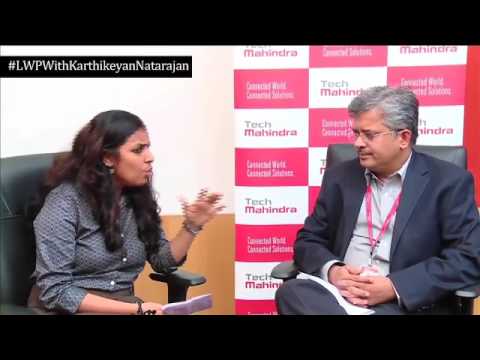
The connective tissue in those episodes is less the technology than the translation. A radio protocol becomes a faster product cycle. An IoT platform becomes equipment availability. A merger becomes a wider promise to a customer. It is the executive's craft to keep both languages in his head without allowing either to become nonsense.
His education sits neatly beneath that double fluency. Natarajan trained in mechanical engineering and later studied business management at Symbiosis Institute of Business Management. He also completed executive programs at Yale School of Management and the University of Michigan's Ross School of Business. The combination is visible in the way he presents an industrial problem. He can begin with a physical asset, cross through software architecture, and finish with return on investment without pretending those are separate conversations.
That range also explains the patience of his career. Twenty-one years inside Tech Mahindra is long enough to see several technologies arrive wearing revolutionary clothes, then settle into the less glamorous work of budgets, integration and adoption. Natarajan's public comments rarely dwell on novelty for its own sake. He returns to scale, market expansion, domain knowledge and the decisions a customer can make. The temperament is closer to an operator than an evangelist. Even when the subject is an intelligent factory, he keeps an eye on the maintenance bill.
A transformation specialist changes scale
Cyient recruited Natarajan in March 2020 for a sentence that would become familiar: transform a services company into a solutions company. As president and COO, he took responsibility for sales, delivery and business development across aerospace and defense, communications, transportation, semiconductors, energy, utilities, geospatial and industrial markets. The appointment landed just as a global pandemic made every ordinary operating assumption rather adventurous.
His remit expanded. He joined the board in 2021 and became CEO in April 2023. Corporate biographies from the period credit him with sharpening Cyient's focus on talent, service capability, innovation and customer-centered execution. His industry work extended beyond the company, through NASSCOM's Executive Council and its Engineering R&D Council.
The five-year passage matters because it shows Natarajan at a different altitude. Tech Mahindra supplied the long apprenticeship and scale. Cyient gave him the whole enterprise. When he resigned in January 2025, the next move took him into a company far smaller than either, but much closer to the machine.
Infinite Uptime had raised a $35 million Series C in March 2025, with plans to expand in the United States and invest in its product, research and data science. Its terrain is heavy industry: steel, cement, mining, chemicals, paper, tires, energy and food production. These are places where equipment is expensive, heat and corrosion are not metaphors, and a false alarm is a quick way to teach an operator to ignore the next one.
Prediction meets the shift supervisor
The fashionable question in AI asks what a model can generate. The industrial question asks whether anyone will stop a line on its advice. Natarajan's answer is a chain: collect mechanical and process signals, interpret them with equipment-specific context, prescribe a corrective action, let the operator validate it, then return that result to the system.
Infinite Uptime calls its software PlantOS and packages the work as production outcomes rather than a shelf of hardware and licenses. The distinction between predictive and prescriptive is central. Prediction says a machine may fail. Prescription identifies the asset, describes the developing fault, recommends an intervention and attaches a business consequence. One creates awareness. The other has a chance of creating a work order.
This is where Natarajan's public language becomes unusually cautious for a technology executive. He writes about clean data, redesigned processes, trained people and change management as the bridge beneath a powerful model. He has also argued that employee resistance to AI can reflect a rational fear about wages, purpose and replacement. Tools enter organizations through a social contract, even when nobody bothers to write it down.
On the plant floor, trust accumulates in smaller increments. A recommendation proves correct. A technician signs off. The line stays up. The next alert carries a little more authority. Infinite Uptime describes this as a trust loop, with human validation embedded rather than treated as an inconvenient detour on the road to autonomy.
The ambition inside the ordinary
Natarajan's current biography says he has helped lead two engineering and digital businesses beyond the billion-dollar scale. Yet his latest company makes its case one motor, pump and fan at a time. That contrast is the charm of industrial technology. Large outcomes hide inside mundane interventions. A bearing changed on Tuesday can protect Thursday's production.
In 2026, Infinite Uptime said it had crossed 1,000 digitized plants. Natarajan marked the milestone by pointing past dashboards toward a sequence: machine data, intelligence, action, measurable result. The company has paired that commercial message with research on why industrial AI stalls, arguing that fragmented data and missing operational context prevent predictions from becoming decisions.
He has also widened his public lens. His writing jumps from factory integration to electric vehicles, organizational resilience and the arrival of agentic software. A recurring concern sits underneath: established organizations often recognize a shift yet insist on fitting it into the old model. Kodak and Nokia make appearances, as they do in the cautionary tales of many executives, but Natarajan's prescription is more demanding than fashionable panic. Rebuild the operating model. Create the bridge. Make the capability deployable.
There is no romance in uptime until the machine stops. Then every minute develops a price, every silo becomes visible, and every ignored signal seems eloquent in retrospect. Natarajan's wager is that industrial AI can intervene before hindsight becomes expensive. Its success will not be measured by how convincingly a machine can speak. It will be measured by whether people know what to do when it does.
The missing hour, if all goes well, never goes missing. It passes quietly, productively, almost beneath notice. For an executive who has spent three decades turning technological possibility into operating arithmetic, anonymity may be the most honest sign that the system worked.