A power-plant boiler is not sentimental about its own decline. It does not complain. It waits. Steel thins by fractions, corrosion spreads under an ordinary-looking surface, and a small defect negotiates patiently with heat and pressure. By the time a human being sees the trouble, the trouble may have acquired a budget, a shutdown schedule, and a conference room.
Troy Demmer has built his career around arriving earlier in that sentence. He is the president and cofounder of Gecko Robotics, the Pittsburgh company whose machines climb, crawl, fly, and swim across critical infrastructure. The robots carry cameras and sensors into places that are dirty, awkward, confined, elevated, or simply too large to inspect well by hand. Their real cargo, however, is evidence: wall-thickness readings, images, locations, and repeatable measurements that can tell an operator what has changed.
This is a curious destination for a finance and economics graduate. Demmer did not leave Grove City College in 2011 with a robot tucked under his arm. He worked as a financial analyst at UPMC. He became interested in tools that could improve diagnosis in health care. Later, at Carnegie Mellon, he created BetterSpeech, a crowdsourced platform meant to help people improve their public speaking, and won a campus startup competition with it. His early record looks less like an engineer's straight line than a series of attempts to make hidden conditions legible.
The patient changed. The question did not.
At Grove City, Demmer had shared a room with Jake Loosararian, an electrical-engineering student who encountered a power plant with persistent downtime. The plant's boiler was enormous, expensive to stop, and difficult to inspect. Traditional work involved scaffolding, ropes, handheld gauges, and sparse measurements. Loosararian began building a magnetic robot that could climb the boiler wall with ultrasonic sensors. He spent long stretches on site adjusting it to a real environment, which has a way of humiliating tidy prototypes.
The old roommates reconnected. Gecko's own account says Demmer was then building tools to diagnose the human body. In 2013 they joined forces. The patient had become a boiler, but the logic was familiar: a reliable diagnosis depends on good observations, and good observations depend on reaching the right place.
Demmer describes access to that first plant as an unfair advantage. The phrase is revealing. In startup folklore, an advantage is often a patent, a famous investor, or a distribution trick. Gecko's was permission to spend time with an obstinate machine and the people responsible for it. “I don't think you could build a technology like this in a lab,” Demmer said on the Crossing the Valley podcast. The boiler supplied the curriculum.
It also supplied the company's first discipline: solve the actual inspection before promising a universal revolution. Gecko entered Y Combinator's Winter 2016 batch. That year it placed third at the Rice Business Plan Competition, collecting $150,000 in cash and prizes. In 2017, the Pittsburgh Business Times included Demmer in its 30 Under 30 class. Forbes followed with its 2019 30 Under 30 list in energy. Awards are pleasant; a robot that stays attached to hot, curved steel is more persuasive.
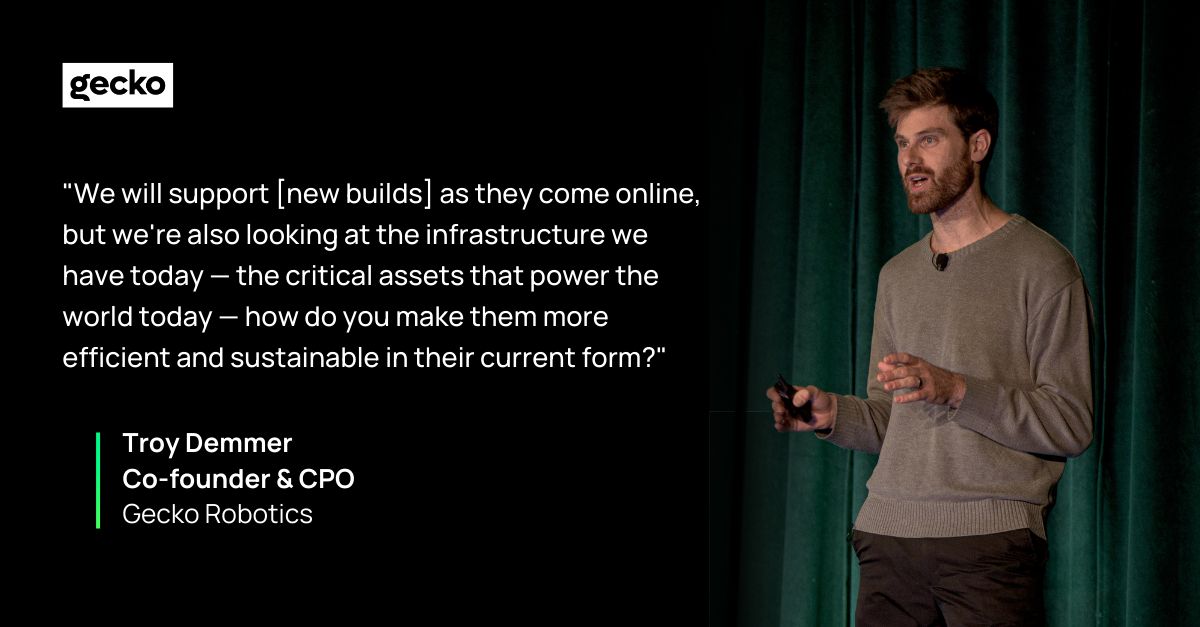
Data with dirt under its fingernails
The easy description of Gecko is “wall-climbing robots.” It is accurate in the way that calling a doctor “a person with a stethoscope” is accurate. The instrument matters, but the larger business is interpretation. As Gecko added robotic forms and sensor payloads, it built Cantilever, a software platform that assembles inspection data into digital models. The aim is not merely to find a patch of thin steel. It is to give operators a record of an asset's condition, compare changes over time, and decide where maintenance money should go.
Demmer's public argument begins with a rebuke to airy AI conversation. Industrial data is not sitting online, polished and waiting. Much of it has never been collected. Some lives in paper reports, isolated systems, or the memory of an experienced worker. Some was gathered point by point with inconsistent location or accuracy. An algorithm trained on poor measurements can recommend the wrong action with impressive confidence.
“AI is only as good as the data it's trained on.”Troy Demmer, on first-order industrial data
When Demmer testified before the House Committee on Homeland Security in May 2024, he put numbers on the alternative. Gecko's wall-climbing robots, he said, could gather 1,000 times more data at 10 times the speed of traditional methods. The point was not statistical decoration. Denser, repeatable readings allow software to distinguish a pattern from a hunch.
There is a pleasing modesty in this version of artificial intelligence. Before prediction comes measurement. Before the digital twin comes a machine clinging to a wall. Before a dashboard can be clever, somebody has to decide what an ultrasonic echo means and whether the robot recorded its location correctly. The future arrives, but it wipes its boots first.
A second act in uniform
Gecko began in commercial power and expanded through refineries, manufacturing sites, and other industrial facilities. Demmer personally helped lead its move into defense. The route was deliberately practical. Small Business Innovation Research awards helped the company learn registrations, certifications, and procurement. Rather than wait for a new weapons program, Gecko targeted operations and maintenance work where budgets already existed and a useful capability could be tried in the current year.
Its first naval deployment took place at a forward repair facility in Japan, not at a major domestic yard. Demmer reasoned that a forward base had fewer resources and more urgency, conditions that could reward a useful workaround. The company moved from a single destroyer toward broader classes of ships. It also applied its inspection approach to Air Force missile silos and to the manufacture of nuclear naval components.
The expansion carried a lesson he repeats to other builders: industrial adoption is part of the product. “It's not just pushing code,” he said. A system has to fit the shipyard, the certification regime, the existing process, and the worker who will face it on Tuesday morning. If it does not make life easier for people on the ground, Demmer warns, “you're gonna get organ rejection.” It is a medical metaphor, once again, and a good one. Even capable technology can be treated as a foreign body.
By June 2025, Gecko had raised a $125 million Series D at a $1.25 billion valuation. In work with BPMI and its suppliers, early trials reduced inspection spans for forged naval components by as much as 90 percent. In March 2026, Gecko announced a five-year Navy and General Services Administration contract with a $71 million ceiling, beginning with 18 ships in the Pacific Fleet. Those are company milestones, not Demmer's solitary trophies. His work is inseparable from Loosararian, their colleagues, inspectors, customers, and crews.
Pittsburgh as product strategy
Gecko's decision to remain in Pittsburgh has acquired the polish of company lore, but the operational reasoning is plain. The region places software and robotics talent near plants, steel, energy companies, defense work, and a labor force familiar with physical systems. Demmer and Loosararian spent time in Silicon Valley and took lessons from its builder culture. They chose not to confuse learning there with needing to become from there.
That choice has become more visible as the company has grown. Gecko's headquarters sits on Pittsburgh's North Side. In July 2026, it announced a 10,000-square-foot manufacturing and integration facility in nearby Sewickley. The address is more than civic sentiment. For a company that believes proximity to the problem is an advantage, geography belongs in the architecture.
Demmer's own trajectory has moved from analyst to operator, from COO to chief product officer, and now president. The titles track a widening job. In recent interviews he talks less about an inspection robot than about “indexing the physical world,” making factories capable of improving over time, and finding immediate returns for customers. Yet his most convincing ideas remain narrow and tactile. Measure the wall. Respect the workflow. Give a person better evidence.
“We're solving the narrow, deep problems.”Troy Demmer, NYSE Wired conversation
Narrow and deep is an unfashionable pair of adjectives in a business culture fond of platforms. It also explains why Gecko eventually became one. The company did not begin by declaring every machine knowable. It began by learning one boiler, then another asset, then another industry. Breadth was earned through contact.
The rust keeps no calendar. The ship does not volunteer that a plate is thinning. The factory cannot search the internet for its own missing maintenance history. Someone has to go and look, repeatedly and well. Demmer's career is a wager that the act of looking can be mechanized without becoming abstract, and that better intelligence begins not with a grand answer, but with an honest reading.