The first plan depended on a machine being able to see. This sounds reasonable until the machine meets shiny stainless steel. Alex Lonsberry and the small team that would become Path Robotics had promised an early customer two autonomous welding cells. They expected to scan the parts with an off-the-shelf three-dimensional sensor, find the seams and let a robot do the rest. Then the parts behaved like mirrors. Light bounced where it pleased. The sensor became confused. Physics, as usual, had declined the calendar invitation.
The team had about three months to solve the problem. Its answer was a new sensing method that projected an asymmetric pattern and separated the original signal from its reflections. The episode is more revealing than a tidy list of funding rounds. Industrial robotics does not live in a tidy world. It lives amid glare, heat, irregular gaps, large objects and parts made by people who did not consult the algorithm first.
Lonsberry has built his career around that disagreement between the model and the material. As co-founder and chief technology officer of Path Robotics in Columbus, Ohio, he has helped develop sensing, software and machine-learning systems meant to let welding robots respond to what is actually in front of them. The ambition is not merely to repeat a programmed motion accurately. It is to notice when repetition will fail.
Before the neural network, there was the garage
Alex and his younger brother Andy grew up in Ohio with a mechanical engineer for a father. Ken Lonsberry ran a family factory making off-road vehicles for several years, and the boys spent weekends around machines. They welded with him in the garage, machined parts, and built go-karts and dune buggies. It was an education in the useful impatience of physical work: either the thing fits, turns and survives the ride, or it does not.
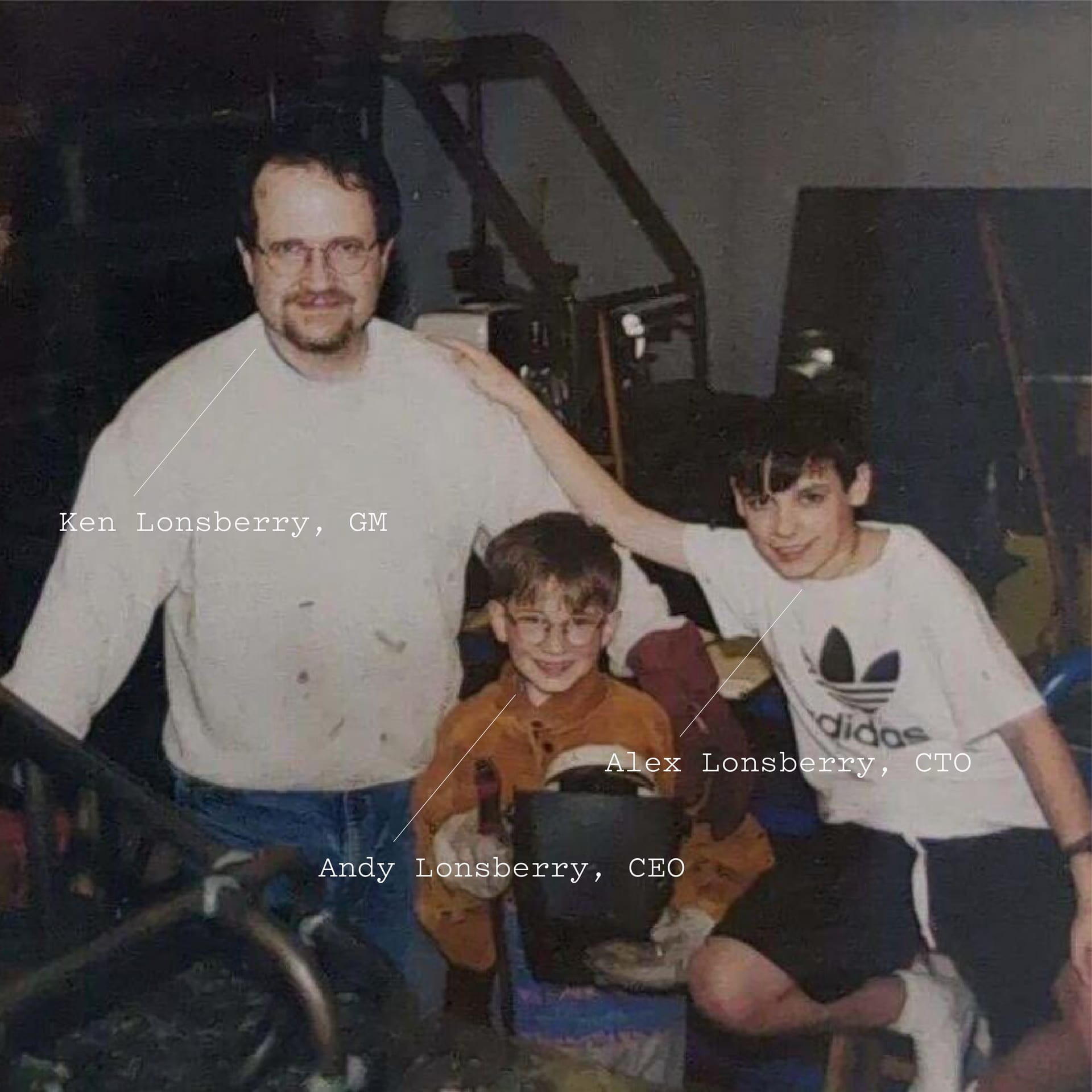
That workshop history prevents the Path origin story from becoming another fable in which software arrives to rescue an industry it has never met. The brothers knew the satisfactions of making things and the frustrations that gather around production. Their family's vehicle business struggled to hire enough skilled people, especially welders. Demand was not the whole problem. Capacity was.
At Case Western Reserve University, Alex studied mechanical engineering, earning his bachelor's degree in 2009 and a master's in 2012. His master's research used imaging to guide mechanical systems. His later doctoral work ranged across recurrent neural networks, nonlinear dynamical systems, event prediction and biologically inspired robotics. The vocabulary grew more abstract, but the essential question remained pleasantly concrete: how can a system perceive what is happening and control a complicated body in response?
“Alex was always discovering a new paper, proposing a new idea.”Roger Quinn, director of Case Western Reserve's Biologically Inspired Robotics program
The university's Sears think[box] gave the brothers room and equipment to turn those questions into prototypes. They worked marathon sessions there as graduate students, joined by fellow mechanical engineering doctoral student Matt Klein. Alex later said Path would not exist without the facility, calling it both incubator and launchpad. Universities enjoy the phrase “technology transfer.” In this case the transfer involved long nights, welding equipment and considerably more grime than the phrase suggests.
A hundred conversations, one recurring headache
Before settling on a product, Alex and Andy talked with roughly 100 American manufacturers. The complaints converged on welding. Skilled welders were difficult to recruit. Conventional welding robots were useful when every part arrived in exactly the same position and the same motion could be repeated at industrial scale. Much of heavy manufacturing offers no such courtesy. Parts vary. Fit-up varies. Production mixes change. The work demands judgment.
A local manufacturer supplied the first serious wager. Joe Onderko agreed to spend $300,000 on two autonomous welding cells. Two robot sets consumed about $200,000 before the founders had solved the sensing problem. The arithmetic acquired teeth. Onderko later joined Path and became its chief evangelist, but at the start he was customer number one, the person willing to pay for a promise whose difficult details had yet to introduce themselves.
They introduced themselves promptly, beginning with the reflective steel. That obstacle helped establish the habit that still defines the company's pitch: scan the real part, understand the seam, plan the motion and adjust while working. Traditional automation often asks the environment to become predictable. Path asks the machine to become more observant.
Lonsberry describes the controlling “policy” as a large network that tells the hardware where to go and how to weld. The intelligence is designed to be extensible across different embodiments: small arms, large arms, several arms. This separation matters. A robot arm may be the most photogenic part of the system, but the less visible assets are perception, control and the record of what happened across many real welds.
The Ohio decision
Path moved to Columbus in 2019. The choice kept the company near manufacturers, within reach of Case Western Reserve and Ohio State engineering talent. When people asked why the founders had not gone to Silicon Valley, Lonsberry's answer was operational rather than ceremonial: they wanted to build for manufacturers, with manufacturers. A customer should be a drive away, not a five-hour flight.
There is also biography in the geography. Lonsberry grew up watching manufacturing decline in Ohio. He has said he wants that capacity back and sees no reason the United States must depend on distant production. The position could sound grand in isolation. In context, it comes attached to a childhood factory, a family business that could not find enough hands, and years spent trying to make one troublesome industrial process more adaptable.
“Many manufacturers needed a machine that could adapt like a human. We set out to build a system that could do just that.”Alex Lonsberry
The company has grown around that premise. It raised a $56 million round in 2021 and another $100 million in 2024. In 2025 it introduced Obsidian, a purpose-built foundational model for welding trained on tens of millions of welded inches. The label “physical AI” can invite fog, but the practical meaning is easy enough to test. Can the system perceive a changing physical situation, choose an action and improve the quality or speed of useful work?
Path reported more than $100 million in bookings for 2025. By 2026 its technology was moving into shipbuilding, where scale and variability make fixed assumptions especially expensive. Collaborations with Saronic and HII placed its systems in the orbit of American shipyards. A later production agreement included a commitment of up to $600 million for Path systems, tied to performance and deployment milestones.
When the workpiece will not come to you
A fixed welding cell works by bringing the part to the robot. A ship hull has other plans. In April 2026, Path introduced Rove, pairing Obsidian with a legged mobile platform. The arrangement looks like a robotic arm riding a very purposeful mechanical animal. It can approach a large structure, locate the seam, scan it and weld where a conventional cell cannot go.
Rove is new hardware, but conceptually it returns to the first lesson of the reflective steel. The work will not rearrange itself for the convenience of the machine. The machine must handle the work as it exists. Mobility adds another layer of uncertainty, and therefore another demand for sensing and control.
Lonsberry's public manner is that of the engineer who keeps widening the boundary of the same problem. His former professor remembered the papers and proposals. His own descriptions move readily from sensors to neural policies to hardware. Yet he repeatedly returns to the shop floor, to the manufacturer's outcome and to the welder's tacit knowledge. Intelligence earns its adjective by becoming useful in metal.
That focus also gives the company's labor argument some texture. Path says its machines are intended to absorb repetitive work and relieve a shortage, not to erase the trade that taught the system what competent welding looks like. New employees can attend the company's weld school and try the craft themselves. The gesture is practical as well as cultural. A team building a machine for welders ought to know the difference between watching an arc on a screen and standing near one. Software can collect millions of welded inches; respect for the work begins at human scale, with the helmet down and the torch in hand.
He has been clear that welding is a beginning rather than an endpoint. Assembly, grinding, painting and other fabrication work all contain versions of the same challenge: perception joined to action in environments that vary. Path's opportunity depends on whether the capabilities developed around the weld can travel without losing the practical discipline that created them.
The family photograph offers a good final diagram. Ken stands beside his two sons in a cluttered workshop. Young Alex leans in from the right. There is no clean room and no glowing interface, only people, tools and the residue of work. Years later, the software is more sophisticated and the robots can walk. The world around them remains gloriously uncooperative. That is precisely the point.