The experiment had been failing for roughly six months. Hyun Kim was an undergraduate at Duke, working in a genetics lab, repeating manual steps that seemed to multiply the opportunities for error. There is a special kind of education in watching careful work collapse for the same boring reasons. Kim did not emerge with a stirring slogan. He emerged annoyed by repetition.
That annoyance became a compass. He drifted toward automation, added electrical and computer engineering to biomedical engineering, and began applying machine learning to complex images. By graduate school, he was in Duke's Intelligent Robot Lab, studying robotics, computer vision, and deep learning. The specimens had changed, but the question had not: could a machine absorb the repetitive work without losing the judgment?
Kim's career can be read as a long refusal to separate intelligence from its chores. Models attract attention. Data cleaning, labeling, deployment, and maintenance attract calendars full of meetings. Superb AI, the company he co-founded in 2018, began in those chores. Its current ambition is larger: give machines reliable sight in factories, logistics centers, security environments, and eventually robotics. Yet the original irritation is still visible beneath the glossy term “physical AI.” The world is untidy. The software has to cope.
A childhood arranged across maps
Kim was born in Seoul in 1990. At about 12, he moved to Singapore with his family for his father's work. He has described a back-and-forth adolescence - two years in Singapore, one in Korea, then five more in Singapore - and the mix of nationalities at Singapore American School as an early lesson in operating globally. The United States became the obvious destination for university. Duke became the place where his interests repeatedly changed shape.
He arrived interested in bioengineering and genetics, took a two-year leave for military service in South Korea, and returned as programming was remaking other engineering disciplines. The shift was not a rejection of his first subject so much as a migration toward better tools. By junior year he was working where engineering and computation met. A year later, he moved again, toward robots.
The Amazon Robotics Challenge provided a rehearsal for everything that came next. Kim led motion planning for Team Duke. The robot's assignment sounded almost insultingly ordinary: recognize objects, pick them from a cluttered setting, and put them somewhere else. Accomplishing it required perception, planning algorithms, control, and custom hardware to cooperate. A failure anywhere could make the entire robot look foolish. Full-stack problems have a way of punishing departmental pride.
The route from repetition to physical AI
The useful exit from research
In 2016, midway through his doctorate, Kim took leave to join SK Telecom's new AI research group, T-Brain. The timing was charged. AlphaGo had defeated Lee Sedol, turning artificial intelligence into national conversation in Korea. Kim worked on self-driving systems, StarCraft AI, and generative adversarial networks. He also co-authored DiscoGAN, a 2017 paper about learning relationships between visual domains without matched pairs of examples.
Research offered elegant questions. Daily practice supplied an inelegant fact: too much of a researcher's time disappeared into preparing data. Kim had seen it in robotics simulations at Duke. At SK Telecom, he saw colleagues collecting and labeling datasets for autonomous driving and game AI. Publishing another paper might improve the method. Building a product could improve the work.
He left the PhD rather than return to it. With Moonsu Cha, Jonghyuk Lee, Jungkwon Lee, and Hyundong Lee, he founded Superb AI in April 2018. The company entered Y Combinator's Winter 2019 batch. Kim later said its two durable lessons were to focus on users and iterate quickly. Both sound obvious. Both are difficult for researchers trained to admire novelty for its own sake.
The first product helped teams create and manage training data, using automation to reduce the slow work of image and video annotation. The pitch found customers from consumer electronics to autonomous vehicles. Forbes named Kim its featured Enterprise Technology honoree for the 2020 30 Under 30 Asia list. MIT Technology Review's Korean edition included him among its Innovators Under 35 in 2021. He also joined South Korea's Presidential Committee on the Fourth Industrial Revolution and received a presidential citation for ICT development in 2022.
Awards made a tidy biography. Customers made a messy roadmap. Labeling was only one broken handoff. Teams also needed to curate data, train models, diagnose failures, deploy systems, and feed new evidence back into the process. Superb AI expanded until its platform covered the loop.
Where the demo meets dust
Industrial computer vision is an argument with conditions. A factory light moves. A camera angle changes. A product line introduces a new part. A rare defect never appears in the training set until it matters. The model must run in a cloud, on local servers, or at the edge, sometimes inside a closed network. The neatness of a benchmark gives way to the temperament of a worksite.
This is where Kim's language changed from data operations to an “intelligence layer.” Cameras and servers already cover much of the physical world. The opportunity, in his view, is software that converts their visual stream into decisions, then keeps learning from what happens next. Superb AI added on-premise deployment, synthetic-data tools, a vision foundation model called ZERO, and video analytics. In 2024 it raised $10.2 million in Series C funding from investors including Doosan Investment, Hyundai Motor Group, Kakao Investment, and Samsung Next.
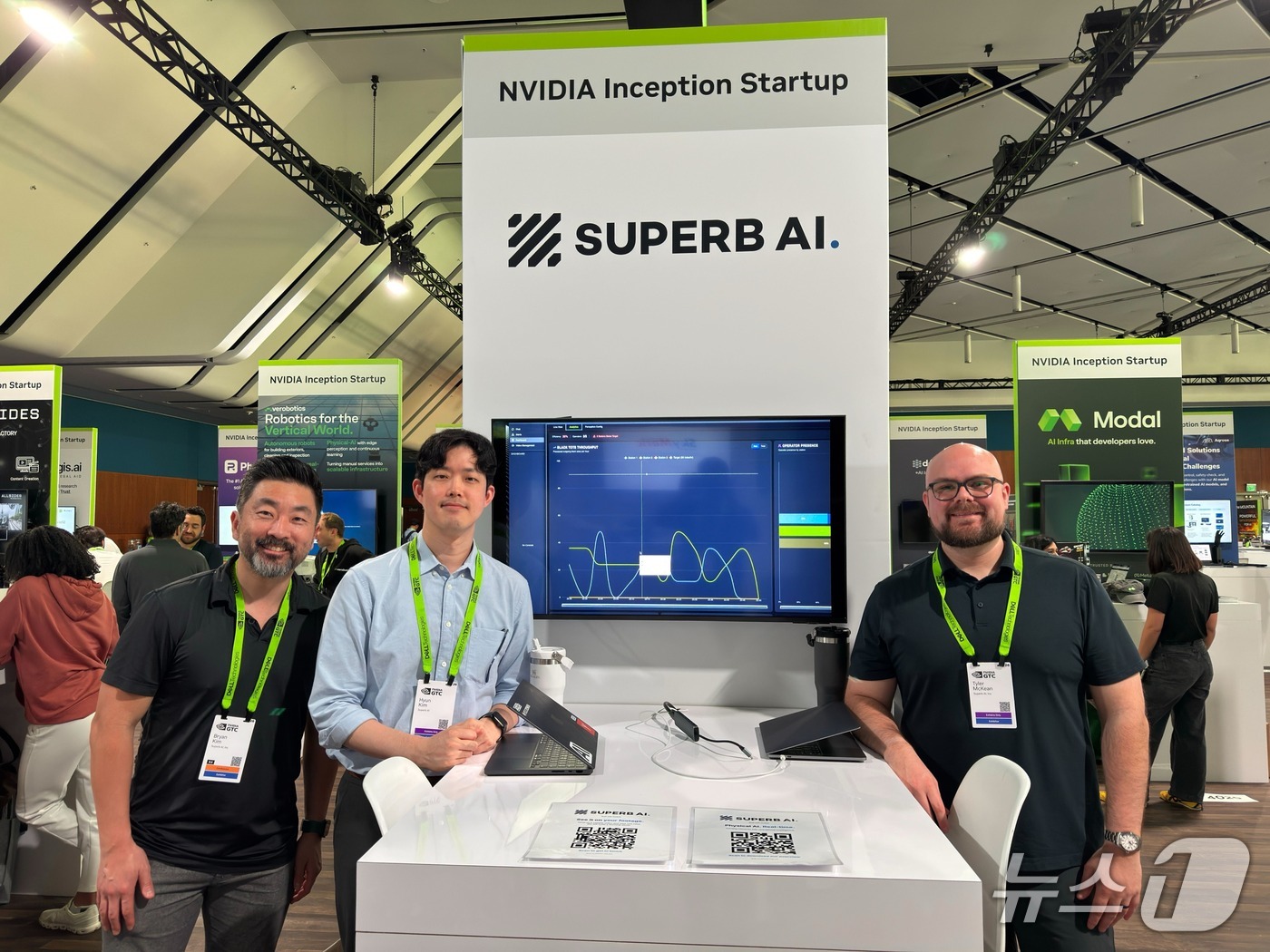
The company followed with roughly $10 million in pre-IPO funding in late 2025 and said it was targeting a Korean stock-market listing in 2026. It joined an LG AI Research-led national foundation model consortium and entered NVIDIA's physical AI ecosystem. At GTC 2026, the company had both a booth and an invited session. By its eighth anniversary, it said its industrial archive exceeded 130 million images across more than 100 domains.
Numbers of that size invite swagger. Kim's more interesting claim concerns composition. Real industrial data carries the peculiarities that generic internet imagery avoids: strange surfaces, bad angles, uncommon objects, poor weather, and costly exceptions. The archive matters because of where it came from, not merely because it is large.
The skeptic changes his mind
Rare events create a nasty paradox. A system may need to recognize smoke, an accident, or an unusual defect, but responsible operators cannot wait for enough real examples to occur. Synthetic data offers staged evidence: generate the missing scenario, train the model, then test whether its lesson survives contact with reality.
Kim has admitted that he once doubted this approach because simulations and worksites differed too much. As that gap narrowed, he became an advocate. The conversion says something useful about his operating style. He appears less attached to a technology than to the bottleneck in front of it.
His enthusiasm arrives with conditions. At a 2025 forum on physical AI, Kim argued that governance should become stronger when software can cause direct physical harm. Traceability, accountability, human oversight, and social acceptance belong in the deployment plan. A camera that advises a person is one thing. A system that guides a robot adds force to the equation.
In early 2026, Superb AI reported collecting 1.08 million RGB-D frames across 50 Korean residential environments for a government foundation-model project. RGB-D data captures color and depth, the difference between recognizing a cup in a picture and estimating where it sits in space. The work points toward machines that can interpret rooms, factories, and warehouses before acting inside them.
The founder's durable question
Kim's path contains several fashionable chapters: GANs, MLOps, foundation models, synthetic data, physical AI. The continuity is more revealing than the vocabulary. A genetics student saw repetitive labor undermine an experiment. A robotics researcher saw complex systems fail at their handoffs. A corporate engineer saw talented colleagues spend their days preparing data. A founder followed the work outward until the product included the whole operating loop.
There is a lesson here for anyone searching for an idea amid louder technologies. Follow the task experts accept as a tax. Look for the spreadsheet, the manual check, the awkward transfer between tools. Then stay long enough to discover that removing one bottleneck usually reveals the next.
Superb AI's next act remains unfinished. A planned listing brings scrutiny. Industrial customers bring long sales cycles and unforgiving requirements. Physical AI brings questions that are technical, social, and legal at once. Kim's stated north star is pleasingly plain: build AI that works in the customer's real environment.
The real environment, of course, is where lab experiments fail, warehouse bins become cluttered, and factory lights refuse to stay put. It is also where useful companies are made. Hyun Kim has been following that disorder for most of his adult life. The machines are beginning to follow him into it.