The least glamorous object in artificial intelligence may be a half-empty plastic bin of IV tubing. It has no glowing eyes, no humanoid hands and no keynote soundtrack. But if the hospital's software says the bin is full while the shelf says otherwise, somebody has to notice, count, type and reorder - or discover the mistake when a clinician needs the item. Chooch AI has decided this small mismatch is a company-sized problem.
The San Mateo firm uses fixed cameras and computer vision to monitor hospital supply rooms, closets and PAR locations. Its models identify packaging, estimate quantities and track movement. The software compares the picture with each item's minimum and target stock levels, forecasts when something will run out and can draft a replenishment order into the hospital's existing enterprise system. The interface is a camera. The promise is that nurses and materials staff do nothing new.
That is a much cleaner story than the one Chooch told after its founding in 2015. Back then, brothers Emrah and Hakan Gultekin were pursuing a horizontal ambition: copy human visual intelligence in machines. Over the years the platform was applied to factory defects, face authentication, retail analytics, PPE checks, wildfire smoke and video search. A $20 million Series A in 2020 backed that broad platform, with Vickers Venture Partners leading. Chooch said it had 18 enterprise customers at the time.
“Basically we set out to copy human visual intelligence in machines.”Emrah Gultekin, co-founder, in 2020
The shelf is the system
The company still sells vision technology for safety, security and manufacturing. Yet its public identity has tightened dramatically around healthcare supply chains. LinkedIn now describes Chooch in one operational sentence: AI that monitors hospital supply rooms and triggers replenishment. That shift is revealing. “Computer vision platform” invites a buyer to imagine a project. “Stop manually counting medical supplies” gives the project an owner, a budget line and a before-and-after measurement.
A typical installation includes Power over Ethernet cameras, a managed network switch and an on-premises edge server or customer virtual machine. Chooch describes the current hospital product as hybrid: images are captured locally, identifying details are blurred on-device, and isolated Microsoft Azure services handle portions of inference, storage and analytics. Each shelf is divided into monitored zones. Each SKU develops a consumption model based on what leaves, when it leaves and where.
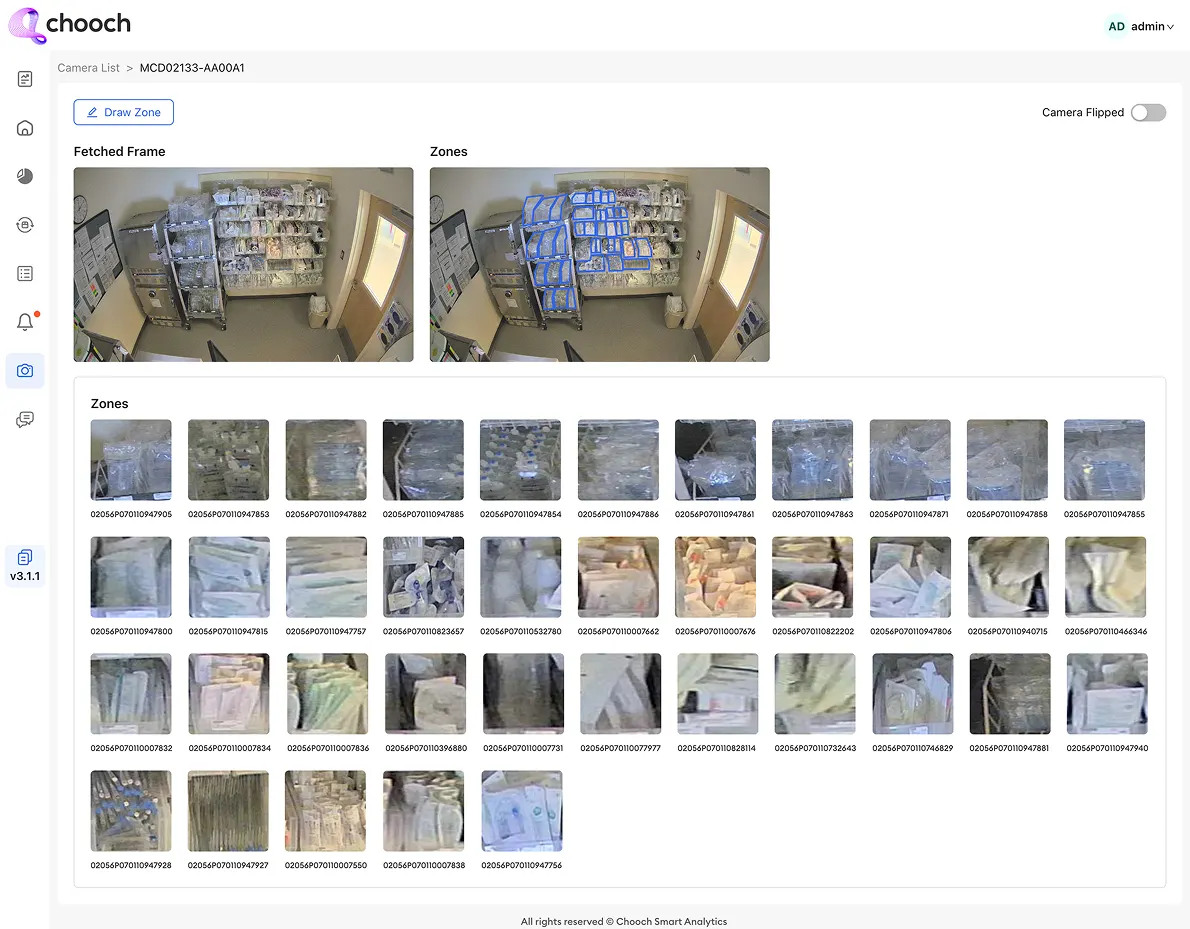
The point is not merely that the model sees a package. The product has to preserve identity through the rest of the workflow. Is this the 20-count unit or the 50-count unit? Is it below the reorder point? Will the next delivery arrive before depletion? Is the lot under recall? Chooch says it can surface expirations and recalls, maintain an audit trail and synchronize orders, receipts and adjustments with an ERP. Seeing is the opening move; a trustworthy operational action is the finish.
What failed first
In the supply room, the first failure is usually not software crashing. It is a human-dependent step quietly failing to happen. Someone forgets a barcode scan. A periodic count is already stale by lunchtime. A static PAR level ignores a sudden shift in procedures. RFID can improve tracking, but tagging every cheap disposable adds cost and handling. Smart cabinets are useful for controlled, high-value items, yet replacing ordinary shelving across a hospital is a heavy proposition.
| Method | Human action | Good at | Weak spot |
|---|---|---|---|
| Manual count | Count and enter | Starting cheaply | Stale between rounds |
| Barcode | Scan every move | Item identification | Missed scans |
| RFID | Tag items | Tracking tagged stock | Per-item economics |
| Vision | Keep shelf visible | Passive, continuous capture | Occlusion and calibration |
Chooch's alternative is passive observation. That design choice matters because it asks the already-busy clinician for no new behavior. The company says cameras fit existing shelves and workflows, while a standard secure API connects to materials-management systems. It recommends starting with a few rooms, measuring the first phase and expanding. The best version feels less like a digital-transformation program than installing a smoke detector: once it is configured, people respond to exceptions instead of patrolling for them.
The asterisks are important. Chooch reports results across three hospitals including 95 percent fewer stockouts, up to 47 percent less waste, lower rush-freight spending and projected returns as high as four times the investment. It also gives an example of a $3.9 million investment returning more than $15 million over five years. Those are company-reported cases, not a universal rate card. The actual price is custom, based on rooms, cameras, integrations, installation and support. A small community hospital and a sprawling health system are not buying the same object.
The cost is the deployment
Historical pricing shows how much the business has changed. In 2020, Chooch's general platform was reported to start at $25,000 a year in the cloud, with usage charges, plus edge-device and per-camera fees. Today's hospital offer is priced as a tailored deployment. That makes sense. The model may be reusable, but a working system also needs camera placement, networking, packaging recognition, ERP mapping, security review, staff trust and ongoing tuning.
Where the clever demo meets the supply closet
- Packages move, overlap, rotate and change artwork.
- A dense shelf can hide the item behind the item.
- The ERP's product master must match what the camera calls a SKU.
- Privacy and cybersecurity teams need a satisfactory data path.
- An automated order is useful only when thresholds and lead times are right.
This is also the answer to what changed Chooch's mind. There is no public declaration that the horizontal platform failed. The stronger evidence is the company's behavior: after years of demonstrating many possible applications, it now leads with one costly workflow and an increasingly complete product around it. Language models helped, too. Emrah Gultekin has said that vision alone was the missing half and that language became the connecting tissue around 2023. In practical terms, vision-language models can distinguish packages, understand custom prompts and make visual systems easier to query. But specialization gave the technology somewhere valuable to live.
The partnerships reveal the required stack. NVIDIA programs support accelerated vision; Dell and Lenovo provide edge infrastructure; Cisco helps with connected sensors; Microsoft Azure appears in the hybrid architecture; Intel supports edge applications. Deloitte and EY help with enterprise adoption, while Henry Schein and Vizient bring distribution and healthcare reach. Chooch is not replacing the hospital's entire supply chain. It is trying to become the perception layer between physical shelves and systems of record.
The model is not the product. The closed loop - shelf, signal, decision, order - is the product.
What a builder can steal
Chooch's most copyable idea is not computer vision. It is the sequence by which an unruly AI capability becomes an enterprise product. Start with a repetitive job that people already resent. Observe it without asking them to adopt a ritual. Attach the output to a system that already owns the budget and data. Prove the result in one bounded location. Expand only after the exception rate, savings and workflow are understood.
The stealable playbook
Sell the vanished chore
- Name the manual action: counting, scanning, checking, reviewing.
- Capture the signal passively so users do not become unpaid data-entry staff.
- Connect the insight to an action inside the customer's existing system.
- Choose one room or line where errors and savings can be measured quickly.
- Price and expand around deployment value, not model novelty.
The approach will not work everywhere. Cameras need stable sightlines and enough image quality to distinguish near-identical products. Inventory hidden in drawers, stacked behind other items or moved unpredictably can defeat passive vision. Hospitals with weak product-master data or old systems may face integration work that swamps the savings. If the counted items are extremely valuable, RFID or locked cabinets may provide stronger chain-of-custody. If the room changes constantly, calibration costs rise. And if a false count can directly endanger a patient, humans still need sensible checks and escalation.
Chooch also competes with more than other vision platforms. The alternatives include clipboards, barcodes, RFID, smart cabinets and the comfortable belief that the current process is good enough. Specialized hospital-inventory vendors arrive with deep distribution relationships and established workflows. General computer-vision vendors arrive with model ecosystems and cloud scale. Chooch's answer is to bundle the perception, edge deployment, privacy layer, forecasting and ERP action into one loop.
A useful kind of boring
The company name is a joke with two lives. The founders say it blends “choose” and “search,” while echoing an Italian insult for a dummy. An untrained AI, the thinking goes, can produce idiotic results. Ten years later, the joke has become a product requirement. A system allowed to draft replenishment orders cannot merely be dazzling. It has to notice the right box, in the right zone, at the right time, without hallucinating a shipment of gauze into existence.
That is where Chooch fits in the market: below the grand promise of physical AI and above the humble shelf. It is enterprise software with hardware consequences, sold to hospital supply-chain leaders, IT departments and finance teams that can calculate the cost of waste, shortages and manual work. The company still possesses the broad vision stack it spent a decade building. Its more interesting asset may be the discipline to describe that stack as a job somebody wants gone.
The future of AI will include dramatic robots. It may also include a camera staring patiently at saline bags, doing nothing until one row becomes too thin. In a hospital, that quiet competence has a customer.
Go see it work
Chooch publishes a detailed product tour, deployment notes and older platform demonstrations. The links below open the company and product channels directly.