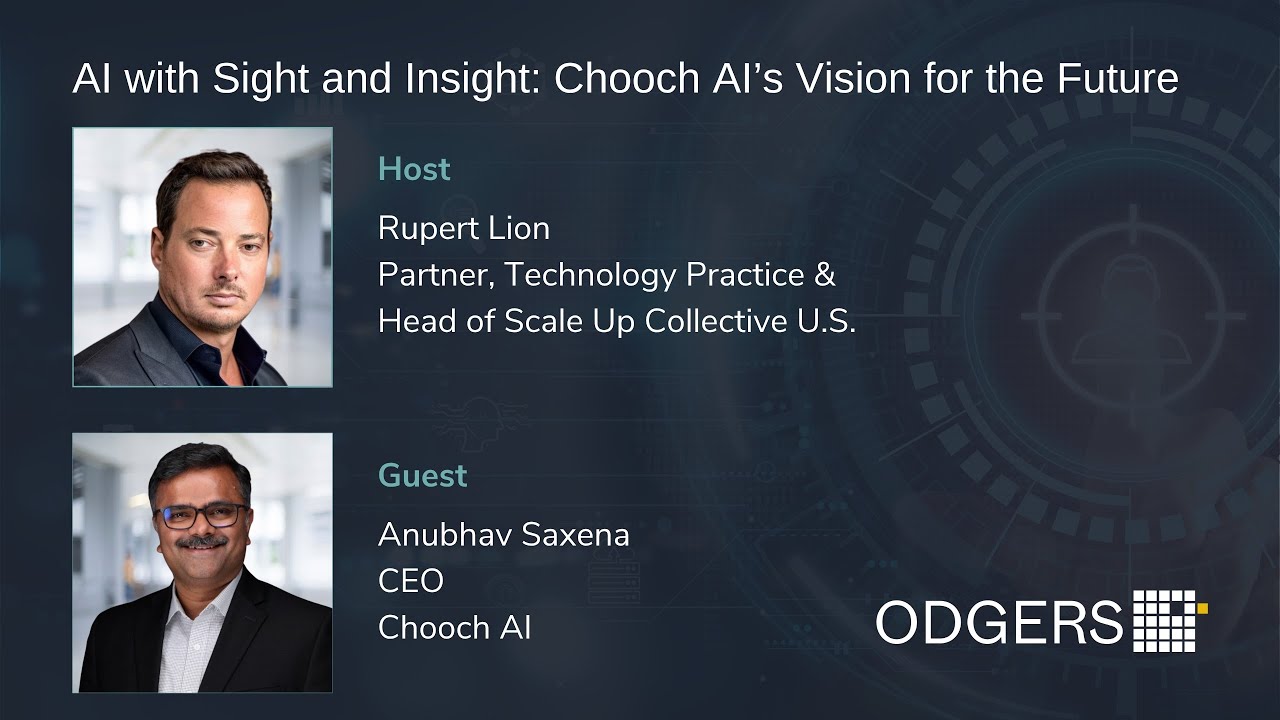
A factory camera has a dreary job. It watches the same line, the same doorway, the same arrangement of objects, hour after hour. It does not complain. It also does not understand. For most of its working life, the camera has been a witness with no vocabulary - excellent at remembering what happened, useless at preventing the next small disaster. Anubhav Saxena has built a career around that awkward distance between a signal and a decision. At Chooch AI, where he is chief executive and a board member, the signal happens to be visual.
This puts Saxena in a less theatrical corner of the artificial-intelligence boom. The popular interface is a blinking cursor, waiting for a clever prompt. His preferred interface is the camera already bolted above a loading bay or production line. The question is not whether a model can describe the scene. It is whether the software can notice the consequential detail, interpret it quickly and start the right workflow.
A missing object. A production defect. Smoke where there should be none. A rule ignored for three seconds. Each event is visually ordinary until it becomes operationally expensive. Saxena's pitch is that AI should meet the physical world at that precise hinge: after perception, before consequence.
Before the camera, there was the transducer
Saxena's origin story begins with instrumentation rather than software. While studying at the University of Pune, he interned as a scientist with India's Defence Research and Development Organisation. His public professional account describes work on purpose-built transducers for the Agni missile program, combining instrumentation, electronics, mechanical engineering and software.
A transducer translates one kind of physical energy into another kind of signal. The detail feels almost suspiciously neat in retrospect. Decades later, Saxena is still preoccupied with translation: light into pixels, pixels into classifications, classifications into actions. Careers rarely proceed in straight lines, but they sometimes keep returning to the same verb.
The intervening years were spent learning the scale and machinery of enterprise technology. Public biographies trace leadership roles through Wipro, HCLTech and Information Services Group. At Automation Anywhere, he served as executive vice president and chief of global alliances during the rise of robotic process automation. At HeadSpin, as chief growth officer, his brief joined cloud appliances, remote-control automation, artificial intelligence, machine learning and analytics.
The sequence matters. Services companies teach an executive to live with the untidy particulars of implementation: regional markets, partner incentives, legacy architecture and customers whose operations cannot be paused for a clean-room experiment. Automation companies add another discipline. They sell labor saved, errors reduced and processes completed, not an abstract admiration for the model. By the time Saxena reached computer vision, he had already spent years near the difficult seam between a capability and a commercial system.
In 2020, he joined the board of ABBYY, whose products turn documents and business processes into machine-readable information. The following year he was named CEO of McLaren Strategic Ventures and joined the team around Season Two Ventures. These are different vantage points on the same commercial puzzle: how a promising technical capability survives contact with a large organization.
The body plan for a smart factory
Saxena has a useful habit of assigning every fashionable technology a job. In a 2025 conversation at Deloitte's Smart Manufacturing and Operations Forum, he offered a compact anatomy lesson: “Computer vision is the eyes, AI is the brain, IoT sensors are the nerves, and robotics are the hands.”
“Computer vision is the eyes, AI is the brain, IoT sensors are the nerves, and robotics are the hands.”Anubhav Saxena
The metaphor is memorable because it refuses to let any component declare independence. Eyes without nerves cannot report. A brain without hands cannot intervene. Hands without judgment are merely expensive movements. In enterprise systems, the practical advantage belongs to coordination.
The visual decision loop
That loop explains why visual AI is both alluring and difficult. The first box can be bought from a catalog. The last box belongs to an organization with old software, established procedures and people who have sensible doubts about new alerts. Accuracy matters, but so do latency, privacy, deployment location, integration and the cost of being wrong. A dazzling demo can recognize a hard hat. A working system must know whether recognition matters, whom to tell and what silence means.
Edge deployment changes the tempo. Sending every frame away for analysis can add delay, bandwidth cost and exposure. Processing near the camera can shorten the path from observation to response, while cloud systems can handle broader management and analysis. Neither location is a philosophy. Each is an engineering choice shaped by the environment, which is why Chooch describes both edge and cloud options instead of insisting that one box belongs everywhere.
Chooch positions its platform across edge and cloud deployments, using pretrained or custom models to examine images and video. The company describes applications in manufacturing quality control, infrastructure monitoring, environmental detection, supply chains and public safety. The nouns vary. The product logic stays fixed: teach the camera which moments deserve a decision.
The two tests: can it work, and will it pay?
Saxena's public language contains fewer prophecies than constraints. He regularly couples “technically feasible” with “economically viable.” The pairing comes from an operator who has watched categories arrive with excellent demos and awkward invoices. Compute may make an application possible. Only a favorable ratio between cost, risk and operational benefit makes it repeatable.
This is where his automation background becomes important. Robotic process automation flourished by finding predictable, repetitive digital tasks and attaching them to a measurable business result. Visual AI extends that pattern into physical space. It replaces the screen scrape with a camera frame, then tries to preserve the rest of the bargain: observe, classify, route, record.
The opportunity is large precisely because the problems can look small. Counting items is dull until an error stops a line. Reviewing footage is administrative until the critical minute is buried inside a week of video. An alert is useful until there are so many alerts that nobody believes the next one. Operational AI must master boredom. Boredom, unlike novelty, repeats and therefore has a budget.
This also changes how progress should be measured. A language model can be judged in a conversation. A visual system earns confidence over a long succession of ordinary frames. The absence of false alarms matters alongside the presence of correct ones. Performance can shift with lighting, camera angle, weather, crowded scenes and unfamiliar equipment. Continuous improvement is less a triumphant software release than a patient negotiation with reality.
The glamorous demo recognizes an object. The valuable product knows what should happen next.
There is also a trust problem hiding inside every camera. Saxena has said Chooch remains committed to building AI with security and trust at its core, adding, “when security leads AI innovation lasts.” This is more than tidy corporate phrasing. Visual data is intimate even when the use case sounds industrial. A system that watches continuously needs clear limits, controlled access and an answer for where its data travels.
World AI, with its feet on the floor
In a 2025 interview for the Where Leadership Matters podcast, Saxena used the phrase “world AI” to distinguish intelligence aimed at physical vision and tasks from the text models that dominate public attention. He linked its rise to stronger compute, better economics and frontier models. He also predicted a longer industrial cycle: offshoring led to automation, which could lead to intelligent onshoring as machines make some local production more practical.
It is a sober way to discuss robots. Saxena acknowledged the possibility of more humanoid machines while returning to economic viability and human-centered design. Shape is secondary to usefulness. The robot does not need a winning smile if a fixed camera and a modest actuator can solve the problem.
His path to Chooch makes this stance legible. The defense intern learned that a signal must survive a demanding physical environment. The services executive learned that scale is mostly coordination. The automation leader learned to connect a machine action to a business process. The investor learned to inspect economics. The board director learned to ask what can go wrong after success. Chooch gathers those lessons around a lens.
Saxena does not need cameras to become imaginative. He needs them to become discriminating. Watch everything, notice little, escalate less, and be right when it counts. It is an austere ambition for an exuberant industry.
The chatbox gave artificial intelligence a friendly face and a place in the daily routine. Visual AI asks for a different kind of acceptance. It works in the background, where proof arrives as a missing interruption: the defect caught, the delay avoided, the hour of footage nobody had to review. Success may be difficult to photograph. For a company devoted to sight, that is a rather good joke.