A camera at a road junction has an awkward relationship with artificial intelligence. It produces pictures continuously. The useful answer - a vehicle count, a blocked lane, a dangerous situation - has to arrive while the picture still matters. An exquisite answer delivered too late is merely an expensive souvenir. Somewhere between the camera and that answer sits Blaize.
The company designs processors and software for inference: the work of applying an already-trained AI model to new information. Its particular obsession is making that work fit into the world’s less accommodating corners. A roadside cabinet, a factory installation or a distributed retail network comes with a power supply, a budget and an owner who would prefer fewer surprises.
- The proposition: programmable AI inference with attention to power, latency and data movement.
- The package: GSP processors, edge platforms, visual development software and hybrid infrastructure.
- The buyers: equipment makers, enterprises, cloud providers and the partners delivering their systems.
- The tension: a growing commercial business is still learning which opportunities become profitable orders.
The electricity bill enters the conversation
Blaize’s Graph Streaming Processor, or GSP, approaches an application as a graph of connected operations. That matters because AI work involves more than running a neural network. Information must be prepared, moved between stages, interpreted and turned into something another system can use. Blaize’s architecture aims to make that journey less wasteful.
Its first-generation platforms advertise 16 trillion operations per second at a processor power envelope of seven watts. That is an interesting specification, with a necessary qualifier: a processor rating does not describe the electricity consumption of an entire installation. Cameras, memory, networking and the host system have their own appetites. The practical attraction is a design intended for constrained inference, rather than a promise that every model will run better.
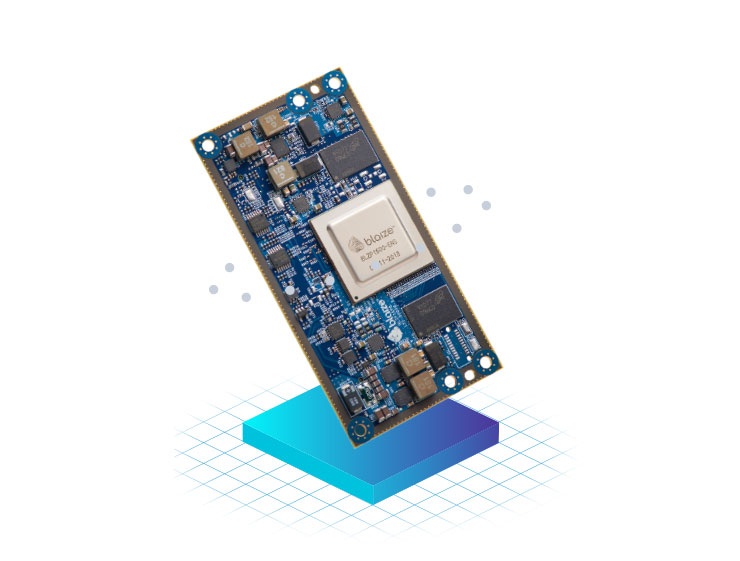
This places Blaize among suppliers of edge AI acceleration, competing with GPU and CPU deployments as well as other specialist processors. Its newer hybrid approach also leaves room for GPUs. The customer can divide work between local inference and centralized infrastructure. A company does not have to abolish its existing computing estate to consider another kind of processor.
Three graphics veterans take the scenic route
Blaize began in 2010 and was previously known as ThinCI. Co-founders Dinakar Munagala, Satyaki Koneru and Ke Yin came with experience in graphics processor design. Munagala and Yin had spent years at Intel; Koneru’s background included Intel and Nvidia. They knew the awkward mechanics underneath a polished demonstration: architecture, scheduling, simulation and the expense of moving information around.

Their expertise helps explain the company’s focus. Graphics chips already require engineers to manage large, parallel workloads under practical constraints. Blaize applied that experience to a programmable architecture for AI. The company describes its beginnings as a bootstrapped development effort. The eventual products would require rather more than enthusiasm and a modest electricity bill.
In 2020, Samsung and VeriSilicon helped bring the GSP-based Pathfinder and Xplorer platforms to market using Samsung’s 14nm FinFET process. Blaize is a fabless designer: it depends on manufacturing partners to turn architecture into silicon. The launch arrived despite the pandemic emerging immediately before tape-out, the stage when a design is committed for fabrication.
Capital followed the long development cycle. A $71 million Series D in 2021 was led by Franklin Templeton and Temasek. A further $106 million financing was announced in April 2024, with investors including DENSO and Mercedes-Benz. Blaize then completed its combination with BurTech and began Nasdaq trading in January 2025. These are milestones in funding and access to capital; customers still have to buy the resulting work.
The chip needs an entourage
Pathfinder supplies embedded platforms; Xplorer supplies accelerators for host systems. Picasso, the software development toolkit, helps developers convert and optimize applications for the GSP. The names suggest an expedition with an artist in attendance. The underlying problem is prosaic: a trained model needs a working route into a deployed application.
AI Studio extends that route into a visual development environment. Users can prepare and label data, import or develop models, optimize them, deploy applications and monitor what happens afterward. Its marketplace holds reusable datasets, models and other components. For a team that understands the business problem better than the programming machinery, that can reduce the amount of specialist work needed to assemble a first version.
- 01Prepare
the data - 02Build
the model - 03Optimize
for the edge - 04Deploy
the application - 05Monitor
and retrain
AI Studio’s published workflow, simplified. The final step feeds the next iteration.
The monitoring matters. Models can encounter data that differs from what they learned: a changed scene, a new operating pattern, a shift in input quality. AI Studio includes data-drift monitoring and retraining workflows. A friendly interface can simplify this work. It cannot relieve an organization of deciding what counts as an acceptable result.
Blaize’s AI Services Platform moves further toward complete applications. It packages inference, business logic, orchestration and lifecycle management into APIs for areas including vision, documents and speech. The company also describes placing engineers within customer and partner environments to handle integration. The commercial direction is clear: sell more of the working outcome, and carry more responsibility for the last mile.
A quarter-million cameras, with a footnote
Consider Yotta Data Services. In September 2025, Blaize identified the Indian infrastructure provider as the end customer in a $56 million public-safety initiative. The announced footprint was more than 250,000 cameras, with deployments planned through 2026. Traffic management, license-plate recognition and video surveillance analytics were among the intended uses. That is the announced program’s scale, rather than an audited count of cameras already operating.
Blaize’s buyers and partners occupy several layers of the market. A 2023 company interview identified DENSO and Mercedes-Benz as both customers and investors. Cloud providers and system integrators bring another route to enterprises and public agencies. The ultimate user may never buy a chip directly; the processor becomes one component of a service or installed system.
The January 2026 Nokia memorandum of understanding set out joint exploration of inference architectures and deployments in Asia Pacific. An April collaboration added Indonesia’s Datacomm Diangraha. Here the division of labor is instructive: Blaize contributes inference computing, Nokia contributes networking expertise and Datacomm contributes regional infrastructure delivery. All three jobs have to work before an enterprise gets its useful answer.
Revenue grows up. Margins ask questions.
Blaize reported $38.6 million in 2025 revenue, compared with $1.6 million in 2024. But its business includes third-party servers, and its annual filing says those products generated a substantial portion of sales. An inference specialist can grow by delivering infrastructure while still facing the economics of hardware resale. The revenue line alone cannot tell you how much proprietary silicon customers adopted.
Rounded figures. Includes the company’s full revenue mix, not just GSP sales.
The distinction between a deal and an order became equally consequential. Starshine’s announced $120 million cooperation agreement depended on purchase orders. At March 24, 2026, Blaize reported one $10.4 million order and no additional orders. An impressive commercial framework had not produced its advertised volume.
“What changed is the pace at which opportunity converts into orders, alongside materially higher memory pricing.”
Dinakar Munagala · August 2026
In August, Blaize cut its annual revenue outlook to $40 million-$43 million. Second-quarter revenue was $12 million, but gross margin was 8%, reflecting a mix tilted toward lower-margin third-party servers. On September 30, it announced a reduction affecting about 26% of its workforce, with expected costs of $1.1 million-$1.3 million and annual savings of $7.5 million-$8.4 million. Management directed its focus toward hybrid AI, AI Services, autonomous systems and sovereign AI programs.
Measure the trip, then count the orders
For someone evaluating Blaize, the useful starting point is an application with a specific constraint. Test the actual models on representative inputs. Measure accuracy and end-to-end latency, total system power, bandwidth and the effort required to integrate and maintain the installation. A component benchmark is useful evidence within that larger experiment.
The approach is most persuasive when local inference has a clear job and power, latency or distributed operating costs constrain the design. Its appeal weakens if the application depends on unsupported models or operations, or if integration costs consume the expected savings. Workloads well served by existing GPU infrastructure may have little reason to move. Blaize’s own hybrid strategy accommodates that possibility.
There is a second lesson for builders: keep the sales forecast as concrete as the technical test. A pilot, a partnership and a purchase order have different meanings. Blaize’s history makes the distinction unusually visible. The clever chip earns attention. The repeatable installation, delivered on terms that support a business, earns the next order.