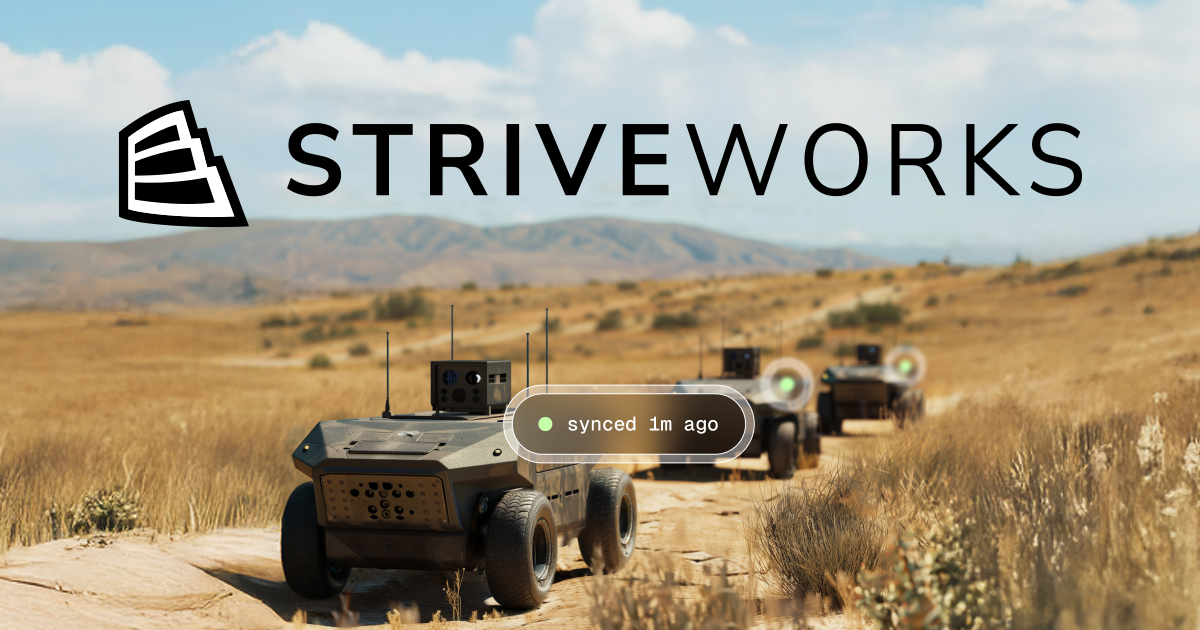
Somewhere off a coastline, on a ship with a flaky satellite link, an AI model just got smarter. No data center. No engineer hovering over a laptop. The sensors changed, the model noticed, and Chariot pushed a fresh version before the old one had time to be wrong. That is Striveworks on a Tuesday.
Most AI companies want to show you the demo. Striveworks would rather show you the day after the demo - when the lighting is bad, the network is gone, and the model someone trained six months ago is quietly losing the plot. That unglamorous day is the entire business.
The Problem They SawModels don't fail in the lab. They fail in the field.
There is a comfortable myth in machine learning: that the hard part is building the model. Train it, benchmark it, frame the accuracy number, ship it. The myth is comforting because it ends right before the trouble starts. In the real world, conditions drift. A camera gets dust on it. An adversary changes tactics. The data the model sees on Thursday no longer looks like the data it learned on. The model keeps answering confidently, and slowly, expensively, it becomes wrong.
For a consumer app, that is an annoyance. For a hospital, a bank, or a soldier reading a sensor feed, it is something else entirely. The people who most need AI to keep working are precisely the people who can least afford it to drift in silence - and they are the ones least served by a tidy demo.
"National security demands speed - the ability to detect, decide, and act before your adversary does."
A quant and a mathematician walk into a defense problem.
Striveworks started in Austin in 2018 with an unlikely founding crew. Jim Rebesco came from Virtu Financial, the high-frequency trading firm where being fast is table stakes and being able to prove why a system did what it did is the whole job. Eric Korman arrived with a PhD in mathematics from the University of Pennsylvania and a postdoc's habit of refusing to wave his hands. Anthony Manganiello brought three decades across financial services and the U.S. Army.
Their bet was not that they could build better models than everyone else. Plenty of people build good models. Their bet was that the model is the easy 20%, and that whoever owned the other 80% - deployment, monitoring, retraining, and an auditable record of every decision - would own the customers who actually have stakes. It is a deeply unsexy bet. It is also, as it turns out, a correct one.
Chariot
Turn production data into models, and models into production systems - with lineage tracking both where a model came from and what its inferences went on to do.
Chariot Core
The operational command center wiring data, models, and mission outcomes together so nothing lives in a notebook on someone's laptop.
Multi-Domain ATR
Adaptive computer vision and automatic target recognition built to keep performing when the scene refuses to cooperate.
Cloud-to-Edge
Deploy and update models from the cloud all the way down to disconnected edge hardware - including, memorably, a ship at sea.
Lineage is the feature nobody requests and everybody needs.
Chariot's signature trick is provenance. As you train, test, deploy, and use a model, the platform records the upstream lineage - which data, which version, which assumptions - and the downstream lineage of what every inference was used for. Ask a Chariot model "why did you say that, and what happened next," and it can actually answer. In a regulated industry, that is not a nice-to-have. It is the difference between a tool you can put in front of an auditor and a tool you cannot.
The other half is speed. Striveworks claims customers move models from idea to production in hours rather than months. Taken alone, fast is cheap - anyone can ship something quickly if they are willing to lose track of it. The interesting part is doing both at once: speed and a paper trail, with no asterisk. Wilde would have appreciated the irony - the company selling the fastest AI is the one most obsessed with remembering exactly what it did.
"Striveworks has operationalized AI in some of the world's most demanding national security environments."
Milestones, in the order the world noticed.
The customers are the kind who read the fine print.
Chariot is deployed with the U.S. Army's Next Generation Command and Control program - the multi-billion-dollar effort to modernize how battlefield information is gathered and acted on, where Striveworks shares the field with names like Anduril, Palantir, and Microsoft. It runs with the Navy and with Combatant Commands spanning Europe, the Indo-Pacific, and Central Command. A $70M enterprise agreement opened the door to hundreds of thousands of defense personnel, and a Deloitte Fast 500 nod confirmed the growth was not a rounding error.
There is a tell in who buys this. Consumer AI gets graded on vibes; defense and regulated enterprise get graded on whether the thing works when someone's safety depends on it. Striveworks chose the audience that reads the fine print first. Hard customers are a slower sale and a far better moat.
The MissionHelp organizations actually use the AI they bought.
The official line is about maximizing AI investment - shipping and maintaining models that stay effective as conditions change. Strip the polish and it is almost humble: a lot of organizations have spent real money on AI and gotten a pile of pilots that never made it to production, or made it once and quietly rotted. Striveworks exists for the boring, decisive middle - the operations layer where a model becomes a dependable system instead of a science project.
Things that amuse and inform
- The CEO came from high-frequency trading, where provenance and milliseconds both matter - and both show up in Chariot.
- A co-founder did postdoctoral math research at UT Austin before the company existed.
- The flagship proof point isn't a benchmark - it's updating a model on a ship with bad connectivity.
- The whole pitch is the day after launch, which is the day most AI demos conveniently skip.
The drift never stops. That's the opportunity.
Every model deployed anywhere begins to age the moment it ships. The world keeps changing; the model does not, unless something makes it. As AI moves out of the demo and into the parts of life where being wrong has a cost, the question stops being "can you build a model" and becomes "can you keep one honest." Striveworks built its company around the second question while most of the industry was still celebrating the first.
So picture that ship again. The link is still flaky. The sensors still changed. But the model already updated, and somewhere there is a record of exactly why. The old version never got the chance to be wrong. That is the product. That is the bet. And it is, increasingly, the whole point of AI that ships.