An invoice can be wrong in a particularly elegant way. The explanation is persuasive. The arithmetic appears in the right place. Then the field that actually feeds the payment system contains another number. A reader admires the reasoning; a workflow sends the money. Farshid Sabet has been paying attention to that small, expensive distance.
In September 2026, the Corvic AI co-founder described a company test of five tools on three synthetic invoices. Corrections were tucked into footnotes, handwritten notes, and contract terms. Some systems reasoned their way to the correct amount and still delivered a different final value. Sabet reported that Corvic got all three right, while explicitly acknowledging the limited size of the test.
The example suits a career spent moving technology toward practical use. Sabet’s work has taken him through SanDisk, Aptina, Movidius, Intel, and Katana Graph. Now, as CEO of Corvic, he is concerned with the handoff between a system’s apparent intelligence and a business’s actual next step. An answer has consequences well beyond the chat window.
Before the answer, there was the card
Go back to August 2006. Sabet was SanDisk’s senior director of mobile content and security solutions, presenting on how content would drive mass storage. His slides considered music, video, games, personal pictures, and the security needed to move them between devices. The mobile phone was becoming a container for more of everyday life, and the container needed to behave properly.
The barriers he listed included fragmented hardware and software, incompatible rights-management standards, poor portability, and inadequate security on removable cards. There is a family resemblance to the problems he describes today: useful information stranded by the systems meant to carry it. The resemblance belongs to the problems; the technologies themselves have changed.
That same year, SanDisk and Philips announced work on secure phone ticketing. Sabet anticipated phones being used for tickets, coffee, and other purchases through NFC applications. It is a pleasantly ordinary ambition. The future arrives looking like a cup of coffee, provided the payment works. A chip becomes interesting when somebody can get through a turnstile without hunting for change.
Making a camera keep up
At Aptina, Sabet led the mobile business. In 2012, he was speaking about a smartphone image sensor designed for high performance and rapid capture. The announcement concerned low-light sensitivity, video, and the elimination of shutter lag. The technical details served a recognizable wish: press the button and capture the thing you meant to photograph.
Movidius brought another change in perspective. Sabet became its chief business officer in 2013, working in a company developing vision-processing technology. The question was moving beyond recording pixels toward making useful computations from them. A camera could supply information for software to interpret, with inference taking place close to the device.
He later worked at Intel on edge AI, then moved into the graph-software world at Katana Graph. In describing that progression, he has emphasized the people working on distributed graphs and graph neural networks. His path crosses both commercial leadership and the infrastructure beneath applications. It offers a useful perspective on AI: the visible interface is only one portion of the work.
- SanDiskMobile storage & security
- AptinaImage sensors
- Movidius / IntelVision & edge AI
- Katana GraphDistributed graphs
- Corvic AIEnterprise intelligence
Three founders, one stubborn gap
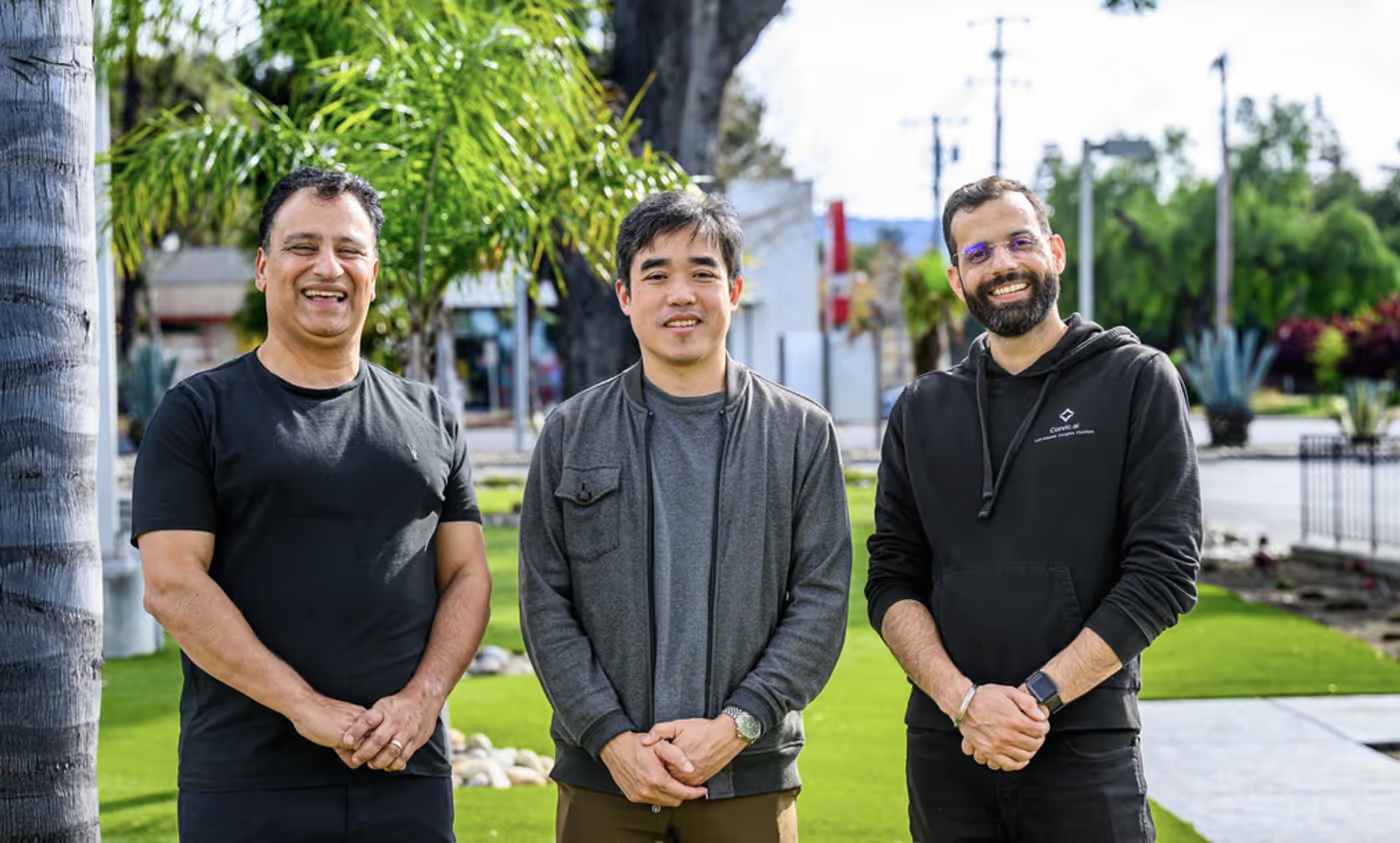
Corvic dates to 2023. Sabet co-founded it with Donald Nguyen, its chief technology officer, and Gurbinder Gill, its chief product officer. The team combined experience in AI, graph analytics, distributed machine learning, and enterprise infrastructure. Their chosen problem was the difficulty of getting enterprise information into a form that AI systems could use reliably.
In April 2025, Corvic announced a $12 million seed round led by M Ventures and Bosch Ventures. Foothill Ventures, Lam Capital, LDV Partners, K2 Access Fund, and Brian Long of Atlantic Bridge also participated. The financing gave a public milestone to work that had developed in stealth.
Sabet’s explanation of the business centered on fragmentation: reports, databases, and changing inputs were difficult to connect. Corvic’s approach was to improve the data supplied to models. The ambition was especially relevant to organizations with substantial proprietary information, where a fluent general answer may leave the important business question untouched.
The spreadsheet has company
Corvic’s beginnings included research into multimodal reasoning. Its platform works across text, tables, graphs, and images. Those formats coexist inside an enterprise, but coexistence is a generous word for information that cannot easily be used together. A table gives quantities; a diagram gives relationships; a document adds the condition that changes the interpretation.
The company’s stated aim is to combine generative AI’s flexibility with the rigor of custom pipelines. Its language includes explainability and provenance, meaning the ability to trace an outcome to the evidence behind it. For Sabet, the commercial promise depends on that connection holding as the material changes.
The work also extends through partners. NTT DATA and Corvic announced an alliance in 2025 focused on data mapping, migration, and enterprise generative AI. Sabet described a mismatch between maturing models and the infrastructure surrounding them. The partnership addressed businesses dealing with legacy systems, disconnected formats, and consolidation across organizations. Such work rarely supplies a glamorous demo. It can decide whether the demo survives its first real assignment.
The unromantic route to adoption
April 2026 brought Corvic V3, a Google Cloud Marketplace listing, and individual plans in public beta. The company was widening access beyond enterprise design partners. Practitioners could begin with their own data, while enterprises had a route through an established cloud marketplace. Distribution was becoming part of the product’s practical story.
In May, Corvic announced that its platform was transactable through AWS Marketplace. Sabet’s explanation was straightforward: existing procurement and deployment systems could help teams move faster. Enterprise software has to pass through purchasing, integration, permissions, and budgets before anyone gets to enjoy the clever part. Even a useful answer has an administrative journey.
Later that month, Corvic expanded its advisory board with Christopher J. Rossbach of the University of Texas at Austin and Ramin Safai, Wells Fargo’s executive vice president of information security. Their specialties brought systems research and security leadership into the company’s advisory network. The additions fit the demands Sabet keeps returning to: reliability must be designed into a working environment.
A customer can be the wrong victory
Sabet has described turning down recognizable enterprise customers who wanted on-premises deployments, because those requests conflicted with protecting a scalable cloud product. Advisors were disappointed. It is an unusually revealing business anecdote, precisely because it lacks a triumphant closing number. Sometimes the consequential decision is the sale that does not happen.
His discussion of hiring favors people whose work a founder already knows. His discussion of decisions distinguishes reversible mistakes from commitments that are harder to unwind. Together, these are practical statements about judgment under pressure, rather than a promise that experienced people stop making mistakes.
For a founder, a prestigious customer can become an argument that is difficult to question. Sabet’s example asks a more awkward question: what will this win require the company to become? That is the uncomfortable arithmetic of a product business. Revenue carries obligations. A name on a customer slide can arrive with a second roadmap attached.
Teaching a useful answer to repeat itself
By July 2026, Corvic was introducing V5, with reusable workflows, expanded connectivity, and additional security controls. An interaction that worked could be saved and run again with current data. The intended applications included research, finance, operations, engineering, procurement, and support.
The shift matters to Sabet’s broader story. A successful interaction can be a delightful event. A business process needs that event to happen again, under changing conditions, with access to the right information. Repeatability moves attention toward credentials, connected systems, and the upkeep of the workflow.
Sabet has also shared a V5 demonstration focused on patent research, prior-art investigation, and intellectual-property analysis, calling the topic something he cares deeply about. It is a specific interest with a familiar shape: the answer depends on careful work across evidence. Search results are a beginning. The useful conclusion demands relationships, distinctions, and a record of how the analysis was reached.
The right tool must earn its place
His September writing separates graphs, context, and memory. A graph represents entities and relationships. Context is the information available for a particular request. Memory involves durable information and rules governing how it is retained, corrected, retrieved, and removed. The distinction sounds academic until a business needs to correct a fact that yesterday’s system still believes.
Sabet also argues for choosing retrieval methods according to the question. A direct lookup and a question spanning several relationships place different demands on a system. His GraphRAG discussion gives graph methods a role in connected questions while acknowledging cases where vector retrieval performs better. That qualification is useful coming from somebody whose company works with graphs.
His short formulation is sharper: “Every tool should earn its place in the architecture.” It leaves room for enthusiasm, but puts enthusiasm on probation. The burden falls on the workload, the operating cost, and the result. A fashionable technique must submit to the same interview as an unfashionable one.
“Every tool should earn its place in the architecture.”Farshid Sabet
Expectations come with an exponent
In August 2026, Sabet recalled a lesson from SanDisk founders Eli Harari and Sanjay Mehrotra about expectations outrunning reality. He attributed an equation to Harari in which disappointment grows with the gap between the two. It is a memorable way to explain why a modest technical miss can become a substantial commercial failure.
Sabet remains optimistic about AI’s longer-term impact, while arguing for verification and ownership of the work people send. His aspiration for Corvic is accessible enterprise intelligence that businesses can trust and use. The invoice example brings that aspiration down to a size almost anyone can inspect.
There is no need for a grand finale in a payment field. The number can simply be correct. Across storage, cameras, edge inference, and enterprise software, Sabet has worked near the machinery that makes an experience possible. At Corvic, the experience he is pursuing is a quiet one: an answer whose evidence survives the trip into action.
(Expectation − Reality)n