The short shift
- Maven builds wheeled, two-armed robots for logistics and manufacturing, beginning with mixed-case palletizing and tote handling.
- It won its first major customer before it had a working robot, then designed the system around that customer's end-to-end workflow.
- The company reports up to eight robots working 16-hour days at 99% or better uptime for a Fortune 250 consumer-goods company.
- A $100 million Series A will fund 250 third-generation robots and the cost-focused fourth generation. Customer pricing remains private.
In the beginning, there was no robot. There was, according to Maven Robotics co-founder Hamza Derbas, “a cartoon of a robot and a team of people.” This is not the usual order of operations in Silicon Valley. Ordinarily, the machine comes first, followed by the demo video, followed by the breathless search for a problem worthy of it. Maven reversed the sequence. In 2024, Derbas heard that a large consumer-goods company had come to town to meet four robotics vendors. He talked his way into the room. Then he made a peculiar pitch: let us watch your people work.
The visit took Maven through factories and warehouses, where demand changes quickly and the humble cardboard box becomes a systems problem. Goods arrive from different factories. A distribution center must build a new pallet for each store. Within 48 hours, the mix can change again. A person walks, selects one case here and another there, and assembles the order. Maven proposed taking on the whole flow, from the warehouse-management system to the truck, rather than automating one photogenic motion in the middle.
It won the contract. Competitors had actual robots. Maven had questions, a drawing, and enough credibility to persuade a cautious buyer that it understood the work. That may be the most useful thing about the Maven story. The company's first serious act of engineering was customer discovery.
The person-shaped trap
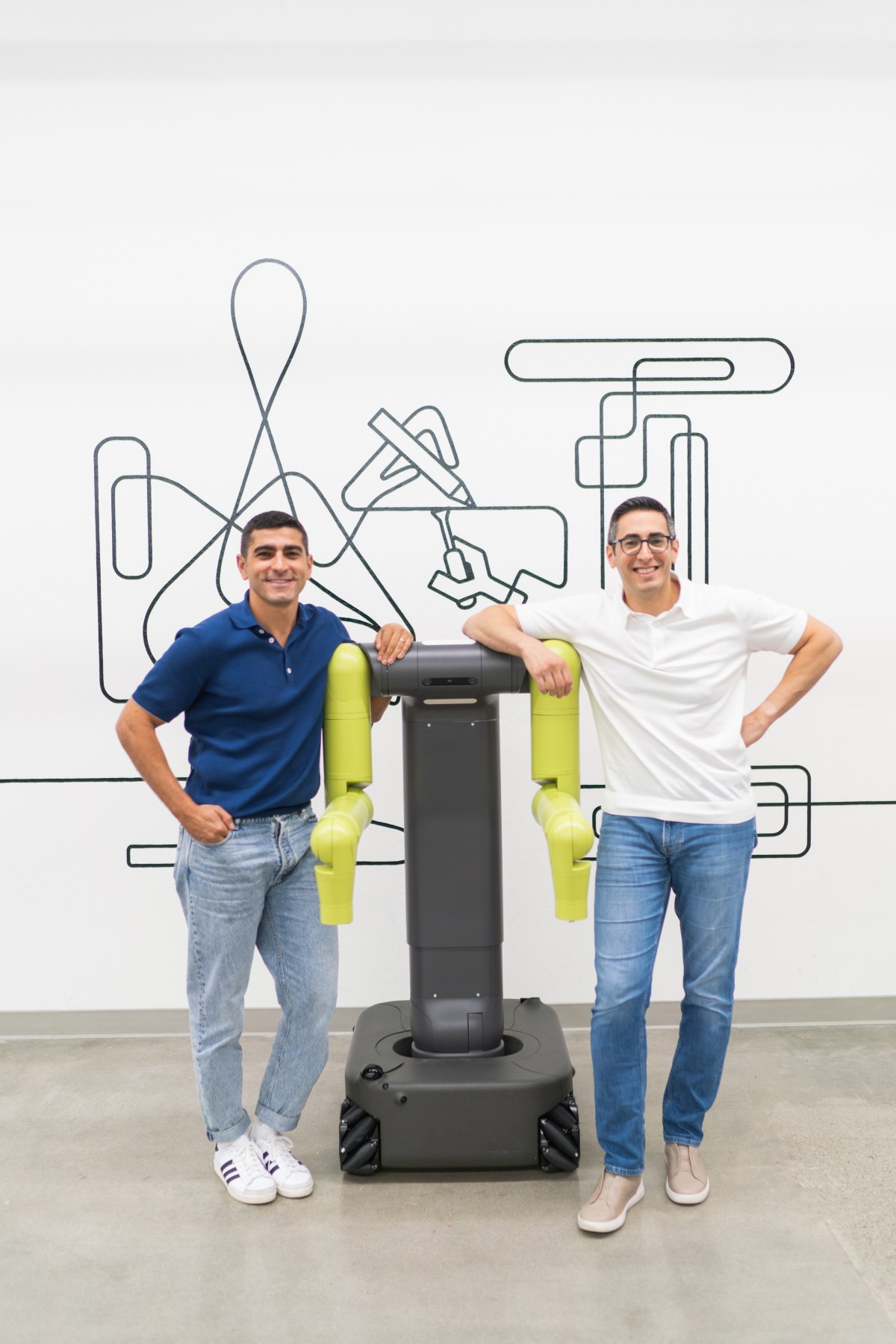
Maven's machine has two arms and an upright torso, but it does not bother with legs. It rolls on an omnidirectional base, raises and lowers itself on a telescoping pillar, and carries modular tools on two seven-degree-of-freedom arms. The company says it can move at up to four meters per second, lift 30 kilograms continuously, reach from the floor to three meters, and run eight hours before a hot-swapped battery takes over.
That form is an argument. Humanoid robots attract attention because the world was made for human bodies. Derbas has a narrower view of the warehouse: legs add mechanical complexity and cost where a good floor already exists. The useful comparison is not whether a robot resembles a worker. It is whether the complete system meets the customer's cycle time, quality, safety, and return requirements.
“We're grounded in solving one customer problem at a time.”Hamza Derbas, co-founder and CEO
The first problems are mixed-case palletizing and tote handling. They are specific enough to measure and large enough to support a company. Maven estimates the combined opportunity at $80 billion, though market-size figures should always be handled with tongs. More persuasive is the physical scene: varied boxes, changing orders, long walks, repetitive lifting, and an enterprise buyer who can repeat one integration across many sites.
Deep first, wide later
Maven calls its development method “deep, then wide.” A research-led robot might perform many tasks with uneven reliability. Maven starts with a platform intended to be general, then works one job until it passes the production bar. Only then does it add another. Its software represents skills as reusable primitives rather than one-off scripts, so grasping, moving, placing, and recovering can be recombined. The theory is that breadth can be added from above the reliability line instead of forever approaching it from below.
The model-training loop is borrowed from autonomous vehicles. Operating robots send information back in minutes or hours. Engineers retrain models, evaluate changes, run ablation studies, select weights, and deploy again. Maven also collects demonstrations with pincer-like gloves that let a human imitate the desired gripper. The flywheel has a price of admission: the robot must do useful work before the company earns access to useful data.
This is also where Maven differs from a model supplier. It owns the robot, real-time control, sensing, fleet orchestration, diagnostics, factory integration, data pipelines, and field deployment. Enterprise customers buy an outcome. If a vision model is clever but the battery, gripper, safety case, or warehouse connection fails, the outcome still fails.
What failed first was ordinary
Maven built quickly by refusing to manufacture every component on day one. Generation one proved the team could make a robot. Generations two and three pursued quality and cycle time, knowingly sacrificing cost. Then the off-the-shelf pneumatic end effectors on generation three became the ceiling. Maven designed its own. The fourth generation has a different constraint: economics. The company is now developing actuators and shifting toward casting and injection molding, processes suited to volume rather than a handful of workshop builds.
The copyable lesson is selective integration. Buy parts while speed is the bottleneck. Build a part when evidence shows it is holding the system back. Redesign for manufacturing when cost becomes the constraint. That sounds obvious after the fact. In hardware, where custom components flatter the engineer and consume the calendar, it is a form of restraint.
A small fleet meets a large cheque
By its public launch in September 2026, Maven said as many as eight robots were working 16 hours a day with 99 percent or better uptime. A live display at its Santa Clara facility showed machines operating at a customer site while employees moved around them. The customer is unnamed, described only as a Fortune 250 consumer packaged goods company. The performance numbers come from Maven, and eight robots are still eight robots. They are evidence of production work, not proof of mass deployment.
Investors have paid for the next test. RoboStrategy led a $100 million Series A with LocalGlobe, Vine Ventures, and XTX Ventures. Earlier backers had reportedly invested about $18 million. Maven plans to use the new round to build 250 third-generation machines and begin the fourth. It targets 100,000 cumulative autonomous hours by the end of 2026 and one million by the end of 2027. Those are ambitions, not completed milestones.
Maven's approach fits large sites with dense, repetitive, valuable work, automation budgets, and workflows that can justify a deep integration. It is less persuasive for homes, small businesses with dozens of low-frequency tasks, rough terrain that truly needs legs, or facilities unable to support safety review, system integration, and field service. A task-by-task strategy also depends on reusable skills; if every new workflow requires bespoke hardware and code, “general purpose” collapses into a collection of expensive special projects.
The brothers and the factory floor
Maven's founders are brothers. Hamza spent more than two decades in automotive and autonomous systems, including nine years in Apple's special projects group. Khalid came from private equity and business operations. When Apple's widely reported vehicle effort ended in 2024, Hamza faced a choice between returning to automotive work and building the company the brothers had imagined since childhood. They chose the company and recruited colleagues from complex programs across Apple, Tesla, Rivian, Cruise, Zoox, Ford, Archer Aviation, and elsewhere.
That history helps explain Maven's culture. Its jobs page does not read like a hunt for one magical model. It asks for mechanical engineers, end-effector designers, embedded programmers, controls specialists, simulation engineers, field operators, safety-minded integrators, fleet-software developers, and MLOps infrastructure. The robot is a coalition, which means the company must be one too.
Maven says its mission is to activate autonomous work and eventually create “infinitely elastic industrial capacity.” The phrase is grand. The method beneath it is almost stubbornly modest: watch the work, choose one flow, meet the numbers, collect the data, fix the limiting part, and repeat. The company's future will not be decided by whether its robot looks intelligent in a short clip. It will be decided at 3 a.m., halfway through the second shift, when a dented box arrives at an odd angle and nobody from the robotics team is standing nearby.