Somewhere in a working factory, a palletizer finishes a stack. That event sounds simple. It is not. A conveyor has to clear, a mobile robot has to be available, the warehouse system has to know the pallet exists, and an operator needs confidence that no forklift will meet the robot in a blind corner. If those machines come from different suppliers - as they usually do - the handoff can become a small software project with every new line.
Botsync has built its company around that awkward moment. Founded in Singapore in 2017 by four roboticists from Nanyang Technological University, it makes autonomous mobile robots, or AMRs, that carry pallets, trolleys and components around factories and warehouses. But the more consequential part of its offer may be SyncOS, a no-code orchestration platform designed to connect robots and automation equipment regardless of who made them.
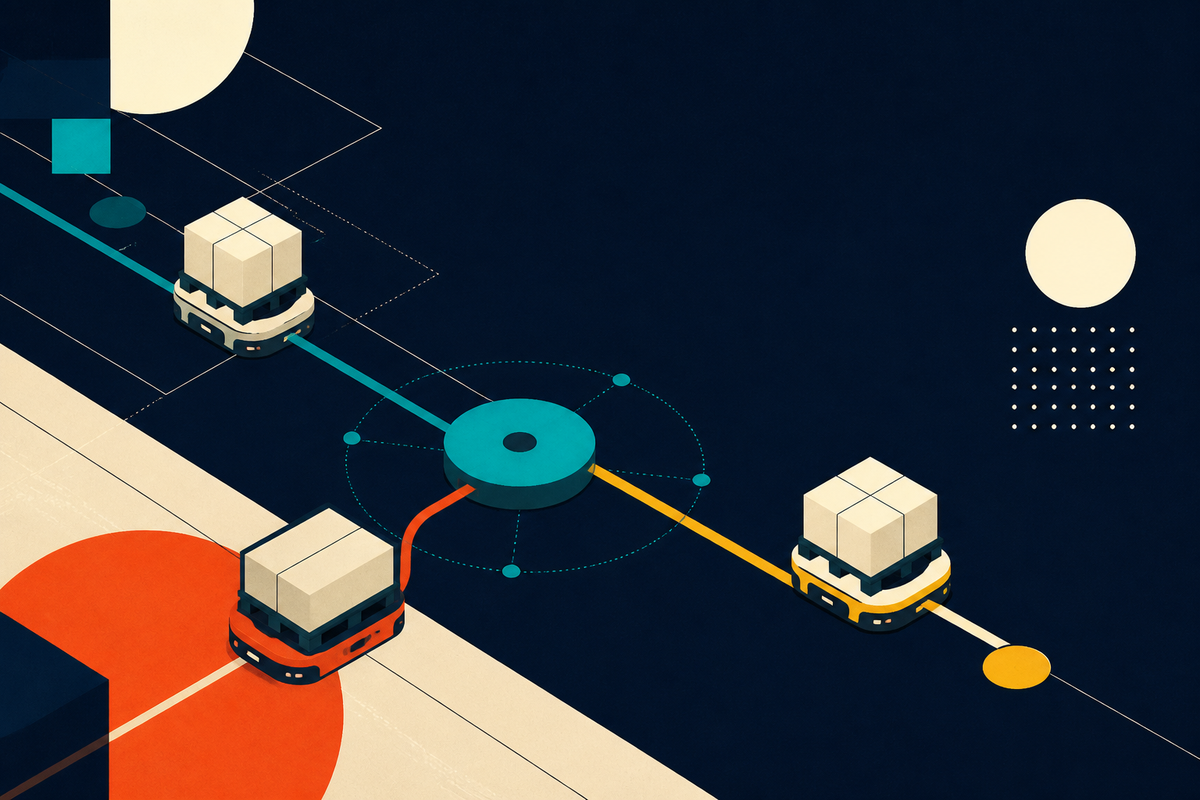
That puts Botsync in two businesses at once. Its MAG machines provide the wheels, sensors, lifts, forks and conveyor tops that move physical loads. SyncOS supplies the logic: when to dispatch a robot, which one should take a task, how it should interact with a palletizer or warehouse management system, and what happens when production priorities change. The company sells the traffic and the traffic controller.
The cost of a pallet arriving late
Intralogistics is the movement that happens inside an operation: raw material to a production line, finished goods to a warehouse, empty pallets back to a cell. It is easy to overlook because none of it becomes the product. Yet a late part can idle expensive machinery, while too many forklifts in a confined space create safety risks and require trained people across every shift.
Botsync targets those repetitive routes. Its MAG1500 Lifter carries loads up to 1,500 kilograms and runs at up to 1.5 meters per second. Conveyor variants transfer pallets directly to other equipment. The MAG1400 Fork can pick, lift and stack pallets in facilities that were designed for conventional forklifts. Smaller MAG configurations have moved cages, boxes and automotive trolleys.
The customer list shows where that proposition lands: Ford, Caterpillar, Coca-Cola, Nestle, Kimberly-Clark, Aquaporin and Bollore Logistics are among the companies Botsync has publicly named. The use cases span automotive lines, food-and-beverage end-of-line operations, consumer-goods plants and distribution centers. These are buyers who tend to care less about a robot's novelty than its uptime, its integration burden and its payback period.
At Bollore Logistics in Singapore, a MAG300 with a cage-lifter module moved boxes and tote bins between storage, replenishment and packaging processes. Botsync reports a rate of 300 boxes per hour, 90 labor-hours saved each month and an estimated two-year return on investment. The interesting detail is not merely that the robot moved. A camera-based detection system could trigger a task when an operator placed a full trolley in the pickup area, while SyncOS tracked trolley status and distributed empty ones.
“The next frontier of robotics won't be in just making smarter robots, but building intelligent systems that can orchestrate different robots together more effectively.”Rahul Nambiar, co-founder and CEO
Hardware meets the messy middle
Robotics marketing likes clean floors and choreographed demos. A brownfield factory offers the opposite: narrow lanes, old programmable controllers, patchy connectivity, human traffic and equipment purchased in different decades. Ripping all of that out is expensive. Waiting for a shutdown window can delay a project for months. Botsync's commercial claim is that its systems can fit around existing infrastructure with minimal modification.
A deployment connecting a Yaskawa palletizing workcell illustrates the model. SyncOS monitored the arm; once a pallet was complete, the system dispatched a MAG1000 to collect it and return with an empty. Botsync says the setup required no custom programming or PLC changes and recorded 193,000 production trips while delivering more than one million parts to the line. Operators could see task status, robot health and line performance from one dashboard.
At a large food-and-beverage facility in India, 12 MAG1000s connected four production lines, 12 robotic arms, empty-pallet dispensers and outbound conveyors. The fleet moved 77 full pallets an hour with reported 99 percent uptime. The software could alter task priorities and destinations as the operation changed - a flexibility that fixed conveyor installations struggle to match.
| Industrial choice | What it does well | The tradeoff Botsync targets |
|---|---|---|
| Manual forklifts | Flexible and familiar | Shift staffing, repetitive work and traffic risk |
| Fixed conveyors | Reliable high-volume routes | Layout changes are costly and routes are rigid |
| Single-vendor robot fleet | One supported ecosystem | Lock-in and harder integration with existing machines |
| Botsync model | Mobile hardware plus mixed-fleet orchestration | Still requires site engineering and enterprise buying cycles |
Why invite a rival robot?
The unusual strategic choice is that SyncOS is built to manage AMRs and AGVs from other manufacturers. A hardware maker might prefer to lock every customer into its own fleet. Botsync instead argues that factories will remain heterogeneous. A site may need a compact robot in one area, a forklift-style unit in another and an existing AGV that has years left on its depreciation schedule. If SyncOS becomes the common control layer, Botsync can remain useful even when it does not win every hardware order.
Fleet Manager assigns work to the most suitable vehicle, coordinates traffic and uses opportunity charging to preserve throughput. Integrator connects the fleet to conveyors, robotic arms, PLCs, scanners and WMS or ERP software. A drag-and-drop interface lets operational teams adjust workflows without waiting for a developer to rewrite integration code. That is the distinction from many AMR rivals: Botsync positions interoperability and business-process logic as products, not just implementation chores.
The alternatives are formidable. MiR, Geek+, Locus Robotics, Seegrid, OTTO Motors, ForwardX and regional players sell mobile robots. Jungheinrich, Dematic and Swisslog bring broader automation portfolios. Systems integrators can stitch together custom solutions, and large manufacturers can build internally. Botsync's opening is the gap between a fleet dashboard and a complete industrial workflow - particularly in Asia, where facilities, labor economics and legacy equipment may differ from the Western sites for which many systems were first designed.
A deployment business learning to scale
Botsync earns from enterprise hardware, software and the engineering around deployment: site analysis, workflow design, integration, commissioning, training and support. That mix can produce a strong customer relationship, but it is not frictionless SaaS. Every real floor contains edge cases. Sales cycles are long, reliability expectations are unforgiving, and geographic expansion requires service capacity near the customer.
The company has used capital to widen that capacity. After pre-seed backing from Artesian, it raised $1.2 million in 2020 and $2.1 million in 2022. A $5.2 million Series A in 2024 was led by Capital 2B and Betatron, with IvyCap Ventures, AppWorks, Iterative, Wong Fong and others participating. SGInnovate added an undisclosed extension in January 2026 to fund product development, deployments and expansion into Australia and the United States.
Botsync reported 240 percent growth in production trips during 2025 and 230 percent growth in revenue, though it did not publish the absolute revenue number. It also said it had more than 200 systems with 30 enterprise clients across six countries and territories. Those figures are company-reported, but production trips are a useful metric: they represent completed work in live environments rather than machines booked or pilots announced.
The team is now 90-plus, distributed across Singapore, India, Thailand, Malaysia, Hong Kong and Australia. Its careers material emphasizes curiosity, direct communication, autonomous work and patience with outcomes but urgency in execution. That language fits the work. A robotics company spanning hardware, autonomy software and enterprise integration needs specialists who can obsess over a sensor and still understand why a pallet missed its appointment.
Where Botsync fits
Botsync sits at the intersection of industrial hardware, logistics software and systems integration. It is not a pure robot manufacturer, because SyncOS can operate above other fleets. It is not a pure software company, because its own machines give it deployment data and control over critical hardware. And it is not a conventional integrator, because it is trying to turn repeated integration work into a reusable platform.
That position could become more valuable as open standards such as VDA 5050 make mixed fleets easier to coordinate. It also invites a demanding test. Platform claims only matter if the software handles the ugly exceptions of production: blocked lanes, damaged pallets, late signals, low batteries and people who need to change a rule mid-shift. The deeper Botsync moves into multi-vendor environments, the more its credibility will rest on mundane reliability.
For customers, the immediate proposition is concrete. Replace repetitive pallet and trolley runs. Reduce forklift traffic. Add traceability to material movement. Connect automation islands without rebuilding the plant. Scale from one route to a coordinated fleet. For Botsync, the larger wager is that the command layer will become the lasting point of leverage. The robot may get the photograph. The system deciding where it goes gets the factory.