SERIES A: $5.4M LED BY IAN ALPHA FUND AR 1250 LIFTS 1,250 KG, PARKS ITSELF NOW DEPLOYED ACROSS 5 COUNTRIES NEW US OFFICE IN PLANO, TEXAS HEADED TO AUTOMATE 2026 ONE ROBOT, ENDLESS POSSIBILITIES SERIES A: $5.4M LED BY IAN ALPHA FUND AR 1250 LIFTS 1,250 KG, PARKS ITSELF NOW DEPLOYED ACROSS 5 COUNTRIES NEW US OFFICE IN PLANO, TEXAS HEADED TO AUTOMATE 2026 ONE ROBOT, ENDLESS POSSIBILITIES
Company Profile · Industrial Automation · Bengaluru

ANSCER Robotics

"Your Mobility, OUR ANSCER."

The Bengaluru company building hybrid autonomous robots that haul pallets, dodge people, and park themselves - on factory floors that were never designed for machines.

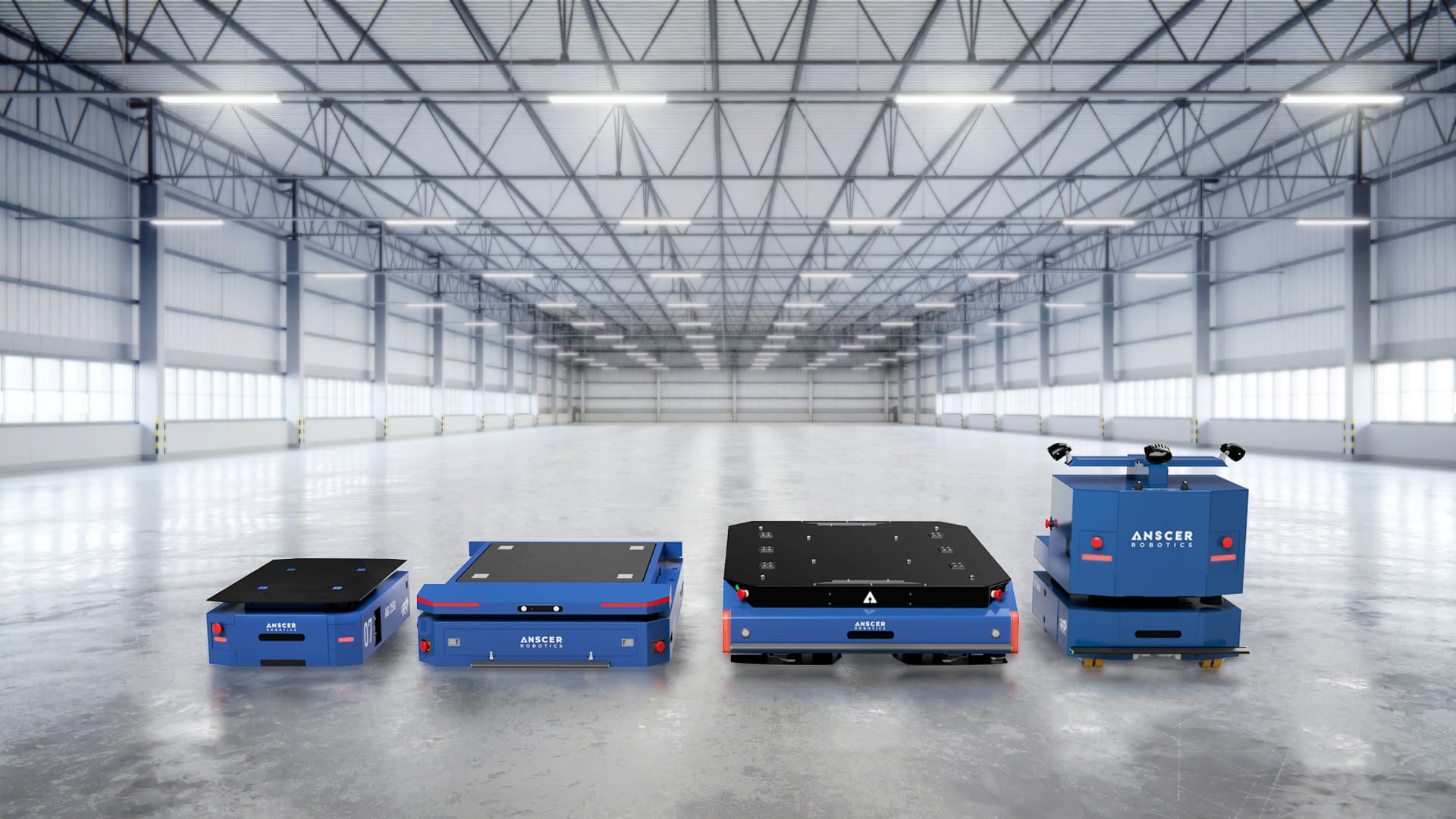
The ANSCER Robotics robot lineup, from compact movers to heavy-duty pallet lifters
THE LINEUP. Every robot ANSCER builds, lined up like a class photo nobody told to smile. The big one on the end can carry a small car's worth of pallets.
Who they are now

It is 2 a.m. on a warehouse floor, and the forklift is driving itself.

There is no driver. No supervisor leaning on a railing. A squat orange-and-grey machine slides a 1,250-kilogram pallet off a rack, rotates without bumping the rack beside it, and rolls toward a dock door it has visited a thousand times. This is an ANSCER robot doing the least glamorous job in the building - and doing it on repeat, all night, without complaint.

ANSCER Robotics is six years old, headquartered in Bengaluru, and freshly funded with a $5.4 million Series A. It makes autonomous mobile robots and the software that herds them. Its machines now work in five countries, and the company has just planted a flag in Texas. None of which it talks about with much drama, because the work itself is undramatic by design. The whole point is that nobody notices.

A robot that does its job perfectly is, unfortunately, invisible. ANSCER is fine with that.- The central irony of warehouse automation
The problem they saw

Factories had a choice. Both options were bad.

For decades, anyone moving heavy things inside a building faced a fork in the road. Option one: the automated guided vehicle - an AGV - which follows a magnetic strip or a buried wire with the precision of a train and the imagination of one too. It is strong and accurate, and it stops cold the moment a stray pallet lands on its track. Option two: the autonomous mobile robot - an AMR - which navigates freely and reroutes around obstacles, but historically went soft when asked to lift real industrial weight.

So plants picked their poison. Precision without flexibility, or flexibility without muscle. The messy middle - heavy loads in chaotic, human-filled rooms - stayed stubbornly manual. People kept driving forklifts through the night, because the robots on offer were either too rigid or too dainty for the dock.

The AGV was a strong robot with no sense of direction. The AMR was a clever robot with no upper-body strength. The warehouse needed both, and got neither.- The gap ANSCER set out to close
The founders' bet

Four founders, one stubborn idea: stop choosing.

In 2020 - a year that discouraged most people from starting anything - Ribin Mathew, Ebin Sunny, Raghu V, and Raj Mohan launched ANSCER Robotics in Bengaluru. Their bet was unfashionably simple: don't pick AGV or AMR. Build a robot that carries like an AGV and thinks like an AMR. Give it the muscle of the old machines and the brain of the new ones.

Ribin MathewCo-founder · CEO
Ebin SunnyCo-founder · COO
Raghu VCo-founder · CBO
Raj MohanCo-founder · CTO

The bet had a second half, and it was about money rather than engineering. Industrial automation has always been a capital expense - a big cheque written upfront, a leap of faith before a single pallet moves. ANSCER offered Robots-as-a-Service: rent the robot, pay monthly, treat automation like a subscription you can scale up, scale down, or switch off. It turned a leap of faith into a tap on the brakes.

The hardware bet was: refuse the trade-off. The business bet was: refuse the upfront cheque. So far, both are holding.- On ANSCER's two-part wager
The product

One platform, four jobs, and a manager that never sleeps.

ANSCER's catalogue reads less like a product line and more like a crew with different specialties. Each series handles a slice of the floor; the Fleet Manager keeps them from arguing over the same aisle.

01

AR Series

Flexible AMRs for transport, lifting and tunneling. The AR 1250 carries up to 1,250 kg.

02

PSR / PLR Series

Autonomous pallet stacking and jack robots that fetch and shelve pallets on their own.

03

TR Series

Tugger robots for trolley trains and higher-throughput hauling, built for safety.

04

AGV Series

AGV precision with AMR flexibility for structured, repeatable routes.

05

Fleet Manager

Central software with live dashboards and analytics to orchestrate the whole fleet.

CAPTION: Five products, zero coffee breaks. The Fleet Manager is the only one of the group that has ever filed a status report.

There is a partnership that hints at where this goes next. ANSCER mounts FANUC cobot arms onto its mobile bases - so a single machine can both travel across a plant and physically pick, place, and manipulate once it arrives. A robot that can both walk and work is a meaningfully different animal from one that only does one of those things.

Most warehouse robots either move or manipulate. Bolt a FANUC arm onto an ANSCER base and you get a robot that does both - which is to say, a robot that gets out of its own way.- On the ANSCER x FANUC integration
The story so far

Six years, one straight line up.

ANSCER Robotics · Milestones

  • 2020
    Founded in Bengaluru by Ribin Mathew, Ebin Sunny, Raghu V and Raj Mohan - in a year that talked everyone else out of starting.
  • 2021–2024
    Builds the hybrid AMR/AGV platform; backed early by IKP EDEN, Geninfy Robotics Labs and the Indian Angel Network.
  • 2025
    Ships smart AMRs into factories and warehouses across India and Southeast Asia - Thailand, Malaysia, Singapore, Indonesia.
  • 2026 · May
    Closes a $5.4M (₹45 crore) Series A led by IAN Alpha Fund, with Info Edge Ventures.
  • 2026 · May
    Opens a US office in Plano, Texas; begins deployments at leading parcel-delivery companies.
  • 2026 · June
    Heads to Automate 2026 to put the hybrid robots in front of North America.

CAPTION: A timeline with no obvious dip - which either means impressive consistency or that nobody invited the bad quarters to the meeting.

The proof

The numbers that did the convincing.

Investors do not write cheques for taglines. ANSCER's pitch came with figures: five countries of live deployment, roughly 74 people building the thing, and a Series A that pushed total funding past $7 million. Here is the money story in one chart.

Funding raised

USD, cumulative // source: company & press reports
Early rounds
~$1.7M
Series A (2026)
$5.4M
Total to date
~$7.1M
Bars scaled to total funding (~$7.1M = 100%). Early-round split is approximate.
2020FOUNDED
5COUNTRIES
~74TEAM
1,250KG PAYLOAD

The customers are the part ANSCER mostly keeps quiet about - leading parcel-delivery companies among them - because deployment contracts rarely come with permission to brag. What it will say is where the robots earn their keep: not in tidy demo rooms, but in the rough ones.

Our robots are designed and built for deployment in complex, rough environments - manufacturing floors and dock areas.- Mark Messina, CEO, ANSCER Robotics Americas
The mission

"One Robot, Endless Possibilities."

Strip away the product names and the funding rounds, and ANSCER's mission is plain: make the repetitive movement of heavy things safer, faster, and less reliant on a tired human at 2 a.m. The company frames it as building world-class robots from Bengaluru for the world - and the geography matters. This is hardware engineered in India and shipped to dock doors in Texas, which is not the direction industrial automation usually flows.

Build in Bengaluru, deploy at a Texas dock. ANSCER is quietly running the export map in reverse.- On where the robots come from, and where they go
Why it matters tomorrow

Back to that warehouse floor.

It is 2 a.m. again. The orange-and-grey machine is still sliding pallets off racks, still threading past a night-shift worker who barely looks up anymore. Nothing about the scene is cinematic. That is exactly the win. The job that once required a person to drive a forklift through the small hours now requires a person to glance at a dashboard - and the difference between those two jobs is the whole argument.

ANSCER bet that factories should not have to choose between a strong robot and a smart one, and that automation should be a subscription rather than a leap of faith. Six years, five countries, and one Series A later, the bet is still standing. The robots keep moving. Nobody claps. And that, for a company whose best work is invisible, is the highest compliment the floor can pay.

The measure of a good warehouse robot is how little you think about it. By that standard, ANSCER is winning the room - one silent pallet at a time.- The closing scorecard
Watch

See the robots move.