A warehouse can be full of motion and short of progress. Someone pushes a cart down an aisle, checks a list, finds a box, then walks it somewhere else. From a distance, everything looks industrious. Count the minutes spent actually selecting goods, however, and a different business appears: a surprisingly elaborate walking tour, with shipping attached.
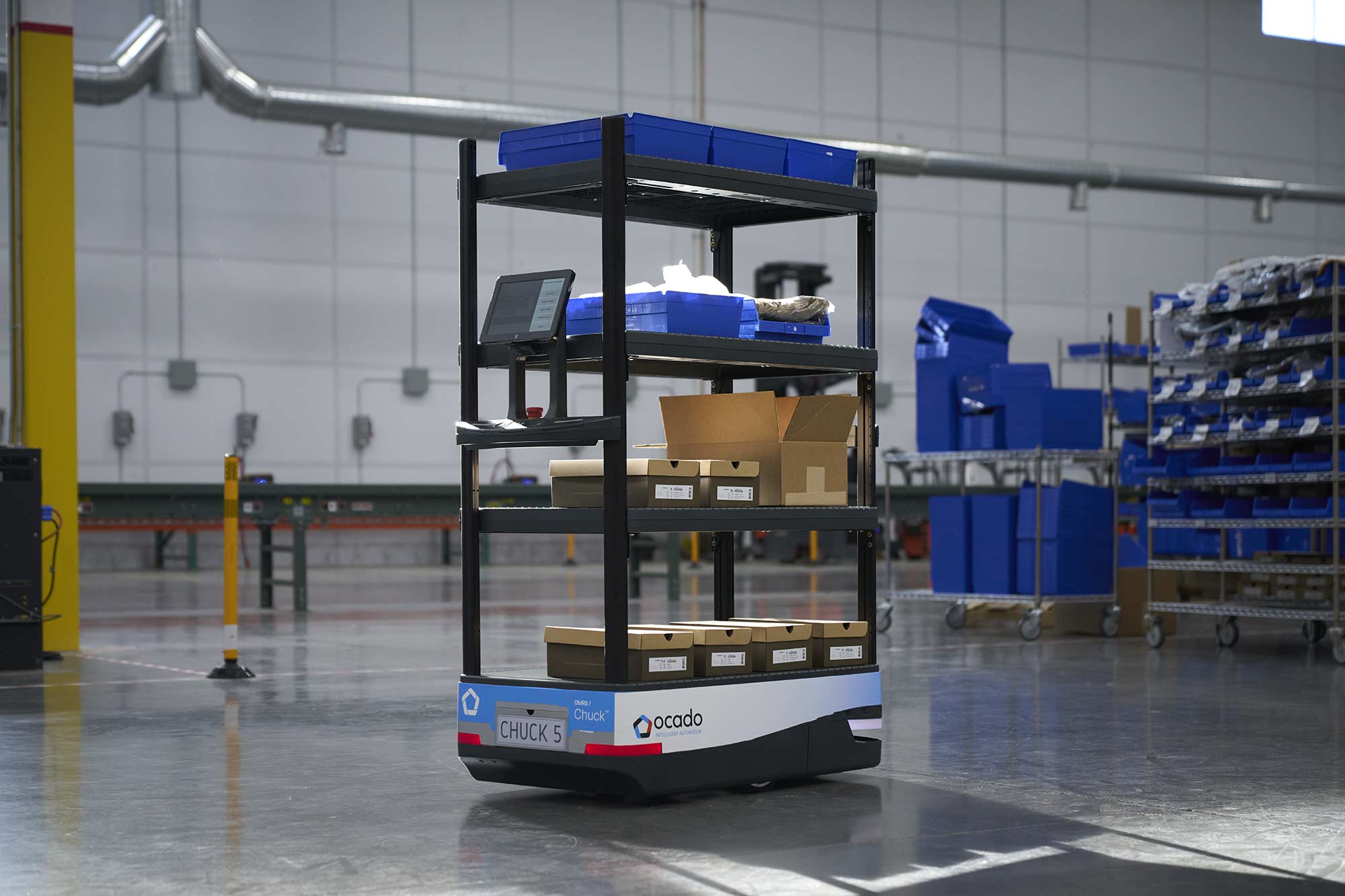
6 River Systems built Chuck for that gap. It is a mobile robot with shelves, a screen and a job that would disappoint a science-fiction casting director. People still take goods from the racks. Chuck carries the orders and guides the work. The interesting question is how much of a working day disappears between one useful action and the next.
- Chuck combines an autonomous cart with software that directs warehouse tasks.
- Retailers, logistics firms and parts operations use it in existing buildings.
- Shopify bought the company in 2019; Ocado acquired it in 2023.
- The technology now lives within Ocado Mobile Robot System, or OMRS.
01 / The men who knew the other robot
Jerome Dubois and Rylan Hamilton had worked at Kiva Systems, the warehouse robotics business that became Amazon Robotics. In 2015, they founded 6 River Systems with Christopher Cacioppo. Their experience mattered because warehouse automation is an awkward marriage of machinery, software and very physical circumstances. A clever algorithm must eventually negotiate an aisle.
Investor Menlo Ventures described an opening left by Kiva’s move inside Amazon: other retailers and logistics operators still needed automation. Chuck took a collaborative approach. An operator could improve an existing warehouse by introducing robots that worked beside people, rather than beginning with a wholesale reconstruction of how inventory was stored.
By 2017, the collaborative fulfillment system was generally available. A $15 million financing led by Norwest followed; Menlo led a $25 million Series B in 2018. The proposition was legible to people who had spent time on warehouse floors: reduce travel, simplify training and use the assets already there. There is considerable commercial charm in a machine that does not demand a new building.
02 / A cart with opinions about your itinerary
Think of an order as a set of appointments with products. Without coordination, the worker organizes those appointments, pushes the transport and delivers the completed load. Chuck and its software rearrange the schedule. The robot meets an associate, guides picking and then travels to its next destination, freeing the person to move onto another assignment.
- 01AllocateSoftware groups the work.
- 02MeetChuck reaches an associate.
- 03PickA person selects the items.
- 04DeliverChuck carries the load onward.
The distinction helps place the company in the market. Locus Robotics is a direct alternative in collaborative picking. Fixed conveyors and goods-to-person systems offer other ways to change material flow, often with different infrastructure requirements. Chuck’s appeal rests on carrying multiple orders through the warehouse while people continue to use the shelves.
The current software, Ocado IQ, coordinates Chuck and the heavier Porter robot. It supports picking methods configured by aisle and sends operating information to The Bridge. The Ocado IQ App extends directed work to manual areas. Hardware gets the photograph; the decision about which task happens next may deserve equal billing.
03 / Two buyers, two very different price tags
In September 2019, Shopify announced an approximately $450 million transaction for 6 River Systems. The deal mixed cash and shares and included about $69 million in conditional founder and employee equity compensation. It closed that October. Chuck was joining Shopify’s ambition to build a fulfillment network, while 6RS continued selling to other warehouse operators.
Different transaction terms. These figures do not establish a simple accounting loss.
By May 2023, Shopify had changed its priorities. CEO Tobi Lütke framed logistics as a worthwhile “side quest” and announced its transfer to partners. Ocado’s purchase of 6RS completed on June 30 for $12.7 million in cash. A platform selling commerce software had reconsidered owning the machinery behind deliveries.
Read the sequence as a change in corporate strategy, rather than evidence that Chuck stopped doing its job. At the acquisition announcement, Ocado reported deployments in more than 100 warehouses and more than 70 customers. Those are historical figures, but they explain why another owner saw value in the technology, commercial relationships and engineering knowledge.
For a buyer, the episode supplies a useful question beyond the demonstration: who will support the fleet through its working life? Service commitments, software continuity and integration ownership belong in the purchasing conversation. A robot is a long-term colleague, even if its corporate stationery changes.
04 / The trouble started before the picking
Liberty Hardware’s problem was a shrinking clock. Its shipment expectations moved from 48 hours to 24 hours to same-day service, while allocation and picking remained manual. Its published customer story describes 16 Chucks, doubled pick rates and new-hire training cut from a week or more to half an hour. These are vendor-published customer results, rather than a forecast for every warehouse.
At NRI’s OluKai operation, shoes brought a different complication: sizes, colors and bulky shoeboxes spread picks across the building. NRI reported doubled pick rates and a 12% reduction in variable cost per unit. Operational data also exposed design problems that people had been quietly solving as they worked.
“The bots pointed the finger right to the heart of the problem.”
Peter McKenna, CEO of NRI · customer case study
That observation is the more interesting one. Human adaptability can hide a bad process. The colleague who knows which detour to take makes the order arrive and the flaw disappear from view. Measure the work consistently and that helpful improvisation becomes something management can examine and fix.
Performance Health paired Chuck with Packsize X5 machines, picking directly into shipping cartons cut for each order. OIA’s case study reports a 104% increase in orders picked per hour and payback in under a year. It is a result for a combined picking-and-packaging project; assigning the whole improvement to the robot would be generous accounting.
Index: before = 100. The 104% increase covers the integrated project, not an isolated robot test.
05 / Rent for the rush, measure the rest
National Logistics Services offers a useful lesson in fleet sizing. Its case study describes 27 Chucks available year-round and another 15 rented for holiday demand. Prepared sites let the company move robots around its network. Buying enough machinery for the busiest week would make the quiet weeks rather expensive.
Historically, 6RS offered outright purchase and rental. The business combines equipment, enterprise software, integration and support. To assess the cost, a warehouse operator needs a project quote covering those pieces, then a payback calculation based on actual labor, throughput and error costs. Corporate acquisition prices tell you nothing about the cost of automating your aisle.
The copyable method starts with observation. Record time spent picking, traveling, waiting and correcting errors. Choose a representative workflow. Measure the whole order, including downstream packing, so a faster pick does not simply create a larger queue elsewhere. Train the people who will use it and compare ordinary weeks with peak periods.
06 / The aisle gets a vote
Fit matters. Chuck’s published operating range is 2°C to 35°C, which puts freezer work outside that specification. Its documentation excludes potentially explosive environments and specifies floor and lighting requirements. Item dimensions, load weight, aisle traffic, wireless coverage and the host warehouse system all deserve attention before the commercial calculation.
There are also straightforward economic limits. If travel consumes little of a shift, there is less travel cost to recover. If packing already throttles throughput, faster picking alone leaves that constraint in place. These are operational deductions, not claims that a particular customer’s deployment failed. A handsome cart cannot repeal a bottleneck.
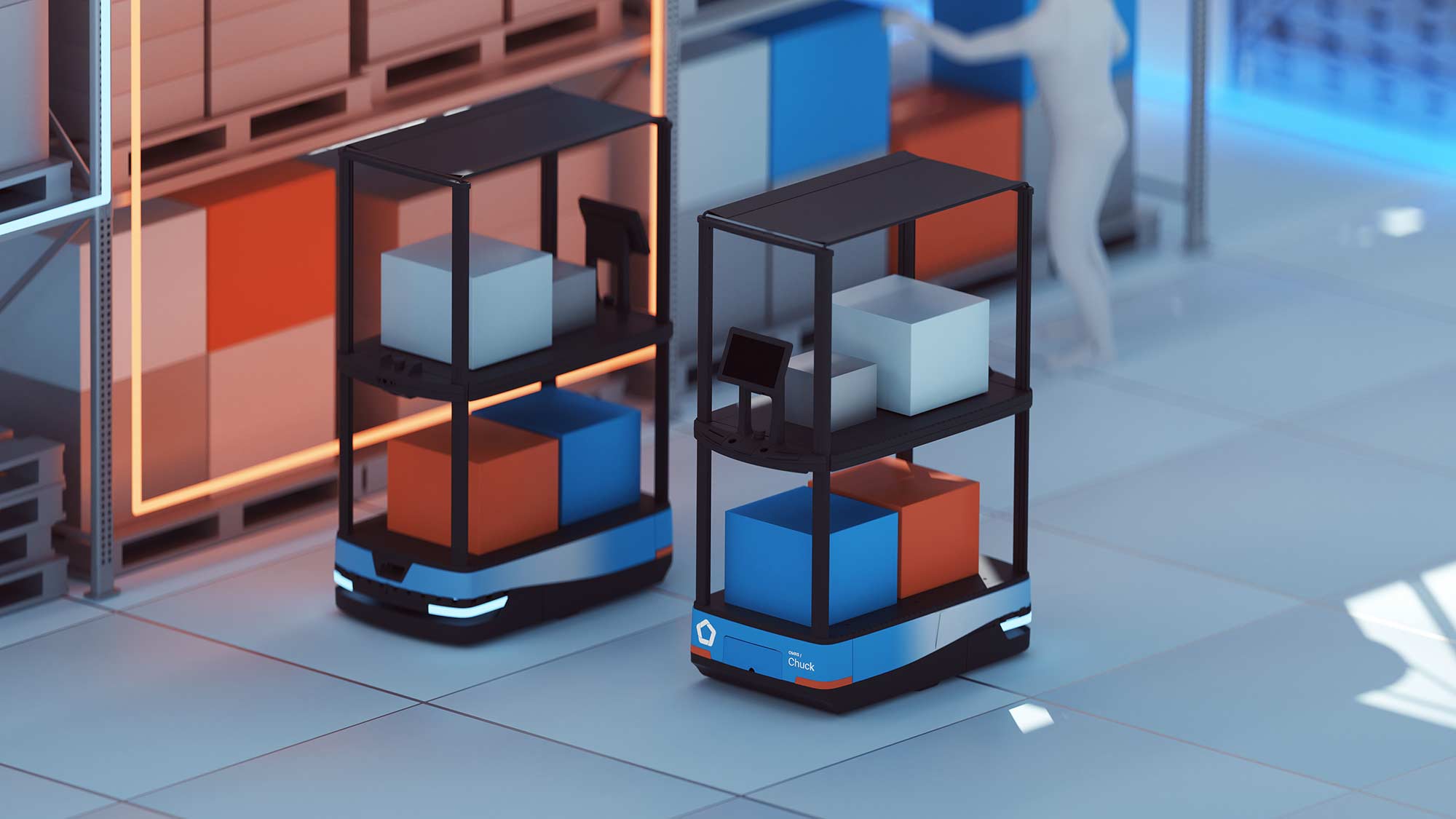
Today, the 6 River Systems technology is marketed as OMRS. Ocado’s May 2026 overview puts Chuck alongside Porter, a pallet-and-cage mover rated for 1,500 kilograms, coordinated by Ocado IQ. The original idea has acquired a larger neighborhood of tasks.
The enduring appeal is still modest enough to test: let people spend more of the day doing the work they were hired to do. In a warehouse, a shorter journey can be a very substantial destination.