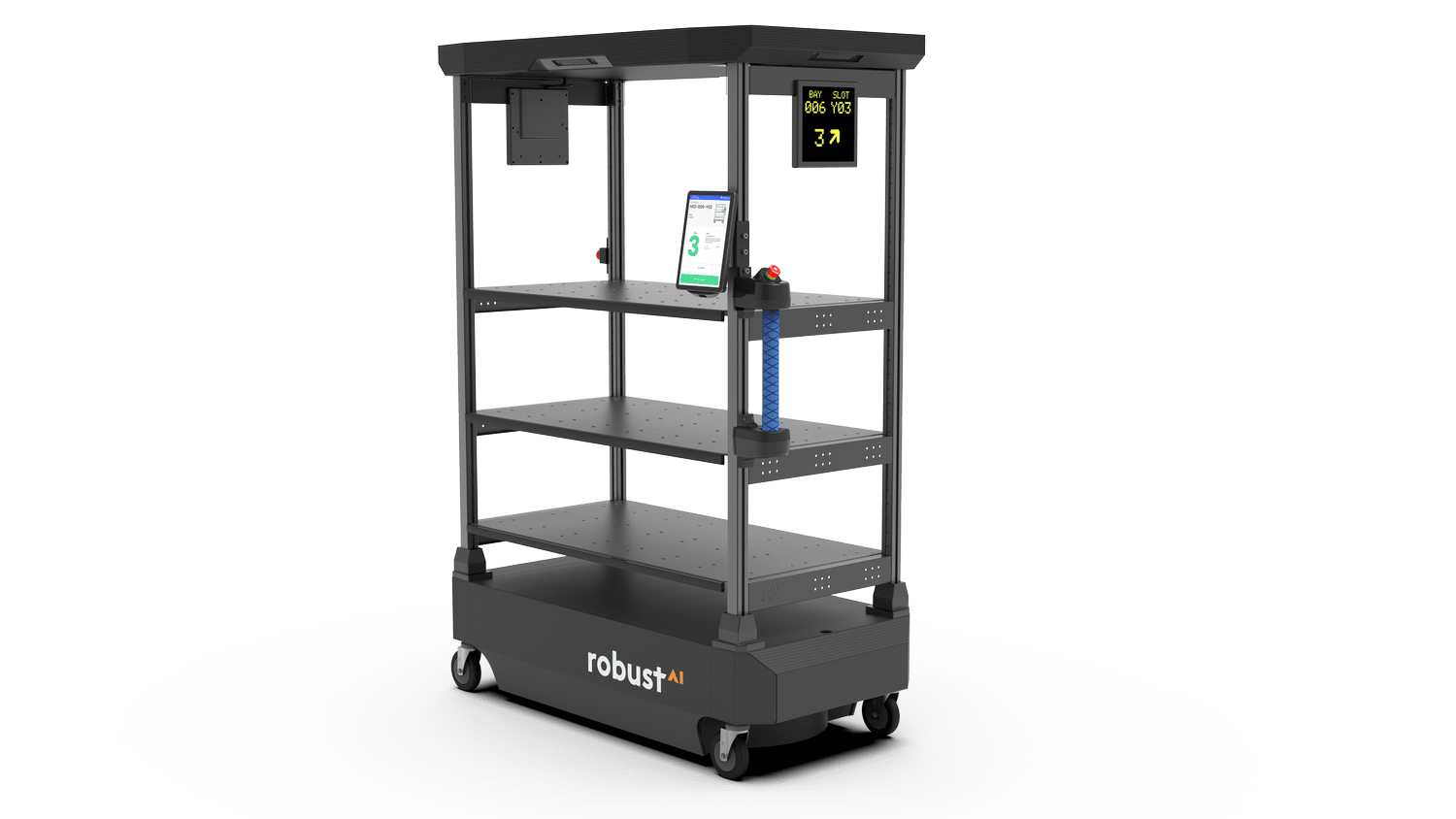
Walk into a DHL fulfillment center in Mexico right now. Past the conveyor belts, past the pickers with their headsets, past the regulation safety vests. You will find a worker pushing what looks like a wheeled cart. Then they let go. The cart keeps going - down the aisle, around a pallet, to the next pick location - while the worker walks somewhere else. The cart is a Carter. It is a robot. It does not look like one, and that is precisely the point.
Robust.AI is the company that decided warehouse robots had been getting their introductions wrong. Most arrive at the loading dock with a sales deck full of arrows pointing at human workers - the ones they intend to make redundant. Carter arrives with a handlebar.
A decade of robots that did not get along
The 2010s were a strange time for industrial robotics. Warehouses filled up with autonomous mobile robots that performed beautifully - so long as you redesigned the warehouse around them. Floors got new markers. Aisles got rerouted. Humans got fenced off, because the robots could not be trusted to share a corridor with a person who might do something unpredictable, like stop walking.
The results were impressive on a spreadsheet and uncomfortable on a shop floor. Operators spent capital expenditure budgets on infrastructure changes, then spent the next eighteen months wondering why their workers were quitting. The robots could move boxes. They could not move with people.
Robust.AI's founders had watched this play out from the inside. Rodney Brooks had co-founded iRobot, which gave the world the Roomba, and Rethink Robotics, which gave the world Baxter - a friendly two-armed factory robot that, for all its charm, never quite found its market. Anthony Jules had run product at Redwood Robotics (acquired by Google) and Formant. Gary Marcus had sold his AI startup Geometric Intelligence to Uber. Henrik Christensen had spent decades running robotics labs. Mohamed Amer was a computer vision researcher with patents to spare.
They had collectively built a lot of robots that did one thing well. They had also watched a lot of customers struggle to deploy them.
Build a cognitive engine. Bolt it to a handlebar.
In 2019 they incorporated Robust.AI in San Carlos, a few exits down from where the Roomba was born. The pitch, condensed: industrial robots needed an "industrial-grade cognitive engine" - a software brain capable of handling the messy, contradictory, half-labeled chaos of a real warehouse. And they needed a body that humans could touch without filing an incident report.
The bet was not subtle. Most of the industry was racing toward more autonomy, fewer humans, taller fences. Robust.AI ran in the opposite direction. They wanted robots that could be physically grabbed, redirected, ignored, recruited. They wanted hardware that admitted - explicitly, structurally - that the humans on the floor knew things the software did not.
It was, to be fair, an unfashionable bet. It is now looking like the right one.
The productCarter, and the strange politics of touch
Carter is the company's flagship - a collaborative autonomous mobile robot for warehouse fulfillment and manufacturing material handling. It has cameras for 360-degree navigation, an adaptive LED system, payload tracking, and an interface a temp can learn in twenty minutes. It scans barcodes. It does point-to-point transport. It runs putaway, picking, and batch sortation. None of that is unique.
What is unique is the handlebar.
Carter Pro, launched in October 2024, has a force-sensitive handlebar that lets a worker grab it and physically push the robot - the same way you would push any other object that happened to be in your way. The robot feels the push, understands the push, and adjusts. You can ask Carter to follow you. You can let it run a route on its own. You can step in for a moment, redirect it, and step out. The robot does not get offended.
Underneath sits Grace, the software suite - mapping, localization, fleet management, scheduling, the parts of robotics that have to work even when no one is watching. It runs on minimal infrastructure changes: no floor markers, no rewiring, no consultants in hard hats taking measurements for six months. A Carter is supposed to arrive at a warehouse and be useful by the end of the week.
Why customers say Carter sticks
Figures are company-reported. Treat them like a first date - promising, but worth a second look.
Six years, in the order they happened
- 2019Robust.AI founded in San Carlos by Brooks, Jules, Marcus, Christensen and Amer.
- Oct 2020$22.5M seed round - led by Playground Global, with Jazz, Future Ventures and Liquid 2.
- Jun 2022Grace software suite and Carter hardware unveiled together. The "cognitive engine" graduates from slideware.
- Apr 2023$20M raise to scale deployments with pilot customers.
- Jan 2024Named World Economic Forum Technology Pioneer.
- Oct 2024Carter Pro launches - force-sensitive handlebar, active force sensing, the touch model.
- 2025Foxconn manufacturing partnership; additional venture round closes.
- Dec 2025DHL Supply Chain signs five-year strategic alliance to roll out Carter across Mexico - the first cobot in DHL's Latin American operations.
DHL did the math twice
A startup with a clever robot is a story. A startup with a multinational logistics giant committing to a half-decade deployment is something else. In December 2025 DHL Supply Chain announced a five-year strategic alliance with Robust.AI - starting with fifteen Carter units in Mexican retail fulfillment, with the explicit plan to scale to hundreds across the Americas. Carter will be integrated into DHL's Warehouse Management System by 2026. The deployment is the first cobot in DHL's entire Latin American operation.
The number that travels with the announcement is sixty percent. That is the productivity lift DHL has reported from earlier Carter deployments, and the figure has been consistent enough that the company let it appear in formal press releases - usually a sign that legal has stopped flinching at it.
Foxconn, the manufacturer best known for assembling things you carry in your pocket, is now assembling Carter. That is the other kind of proof.
What "for people" actually requires
Most companies put "we work for our customers" on a slide and call it culture. Robust.AI is more specific. Working for people, in their definition, means designing every interaction with the assumption that the human is already pretty good at their job and would like some help carrying things. It means a robot that signals what it is about to do with an adaptive LED system instead of a beeping siren. It means handlebars instead of fences. It means the robot quietly does the dull half of the work so the worker has a shot at being valuable for the interesting half.
Leila Takayama, who came in as VP of Design and Human-Robot Interaction, has spent her career on what people actually do when a robot enters their space - which is rarely what the spec sheet predicted. That research shows up in Carter's small decisions: the height of the handlebar, the friendliness of its movement, the moment of hesitation before it crosses an aisle.
"Human-centered design" gets thrown around in robotics the way "innovative" gets thrown around in everything. Robust.AI has the unusual problem of having to mean it.
Why it matters tomorrowThe labor question, asked honestly
Warehouses in the United States and Mexico are short on workers and getting shorter. The standard industrial answer has been: replace them. This is usually proposed by people who have never personally tried to replace a warehouse worker. The actual rate at which fully autonomous robots can pick up the slack is slower than the headlines suggest, and the deployments are brittle in ways the headlines rarely mention.
Robust.AI is making the less photogenic argument: that the binary between "humans do the work" and "robots do the work" is a marketing simplification. The real productive unit is a human and a robot working in the same square meter, switching off depending on which of them is currently better at the task in front of them. That is what Carter is for. It is also why the company can claim a sixty percent productivity gain without claiming a sixty percent reduction in headcount.
Whether they are right about this is the next five years of the company. DHL has agreed to be the proving ground. Foxconn has agreed to build them at scale. Investors have put up around $42.5 million in patient capital. The bet is unfashionable, durable, and increasingly unlonely.
Back at the DHL site in Mexico. The worker pushes the cart, lets go, and walks somewhere else. The cart - the Carter - finishes the aisle on its own. A second worker, on the next row over, grabs a different one by its handlebar and redirects it without saying a word. Nobody is wearing a hard hat. There is no fence. The robots do not look surprised, because they do not look like much of anything at all. That is precisely the point.