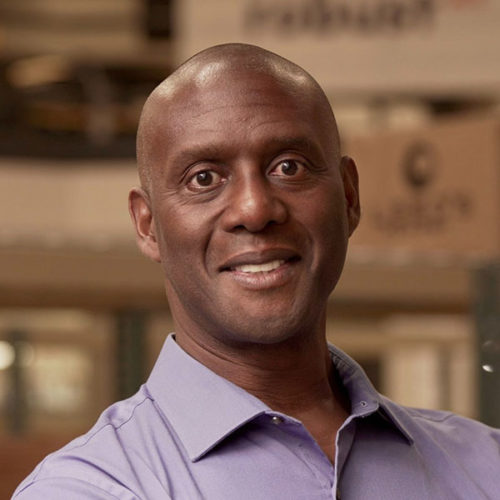
There is a DHL warehouse in Las Vegas where a floor associate calls the robots "her babies." She did not arrive at that feeling because someone ran a focus group. She arrived there because Anthony Jules spent eighteen months before launch talking to workers, running diary studies across 120 warehouse employees, watching how people move around shelves, and asking what they actually hate about their jobs. The robots that emerged from that process have an orange handlebar. You can grab it and push. The robot remembers. That detail is not an accident.
Jules is the Co-founder and CEO of Robust.AI, and he is building something specific: warehouse robots that workers want to work alongside. Not robots that make workers redundant. Not robots that require $2 million of infrastructure before you flip them on. Robots that show up, learn the space, follow the people who know it best, and do more picking per hour than any human-only floor has ever managed.
Eleven Years Old. Programming. No Manual.
Jules grew up in Trinidad and Tobago. At eleven, he taught himself to code. By his teens he had built a video game. He moved to the United States to attend MIT, where he studied Computer Science before AI was a career path most people recognized, before deep learning existed, before anyone used the word "robotics" in a pitch deck. He came out knowing how feedback loops work and convinced that systems that use them outperform systems that do not. He applies that principle to robots and to the companies that build them.
Things that use feedback loops perform better than things that don't.
Anthony JulesHis first major career chapter was Sapient Corporation. He joined as a founding team member when the company had three people. When he eventually moved on, it had approximately four thousand employees and had gone public. Publicis eventually acquired it for $3.7 billion. Jules did not just write code there - he ran people strategy, recruited, trained leaders, managed client accounts, and learned what it actually takes to scale something from nothing. That muscle memory shows up in how he talks about Robust.AI.
Google Bought His Startup. He Took Notes.
In 2012, Jules co-founded Redwood Robotics, building collaborative robot arms designed to be safe around humans and easy to train. Google came calling. His first instinct was no. Then he thought about what Google's engineering scale would do to his little startup, and reconsidered. Redwood Robotics was acquired by Google in 2013.
Inside Google, he became Head of Product and Program Management for the Everyday Robot project at X - the moonshot factory. He watched deep learning in real time, years before the rest of the world knew what was happening. He has said it was years ahead of what most people thought possible. He also watched what happens when research organizations push toward autonomy at any cost, and he came out skeptical of the infinite chase for perfect autonomy.
The Autonomy Math
Jules has a simple framework he returns to: getting to 99% autonomy costs X. Getting to 99.9% costs ten times X more. The math does not favor chasing the last decimal point. So Carter operates at the level that delivers maximum productivity, then hands control back to the human who knows the floor. That decision is a business model, not a compromise.
Eighteen Months. Online Classes. A Pivot Nobody Planned.
After leaving Google in 2017, Jules spent eighteen months not sitting still. He took online classes, competed in robotics contests, consulted. He was building his mental model of what the next company would be. In June 2019 he co-founded Robust.AI with Rodney Brooks - the MIT professor who founded iRobot and co-invented the Roomba - alongside Henrik Christensen and others. The founding team's combined CV includes most of modern robotics history.
The original plan centered on construction. Then COVID-19 arrived and construction sites closed. Jules pivoted hard toward logistics and supply chain, where the disruption created immediate, visible demand for flexible automation. The companies that survived that pivot were the ones that had been rigorous about customer discovery. Jules had done the diary study. He knew what warehouse workers actually needed.
A floor associate at DHL's Las Vegas facility started calling the Carter robots "her babies." She began influencing other workers' perceptions before any training session was scheduled. Jules has cited this as a signal that Robust.AI got the human-robot relationship right.
Source: Ignite Startups Interview, Anthony Jules
Carter: Eight Eyes, No Lidar, Infinite Patience
The Carter robot is a Collaborative Mobile Robot (CMR) for material handling. Eight cameras. Advanced 360-degree computer vision. No lidar - a deliberate design choice that allows software-defined flexibility instead of hardware lock-in. Carter can recognize people, trucks, ladders, and locations. It can switch between picking, transport, and mobile sorting functions in software, without buying a new robot.
The Grace software suite, launched alongside Carter in June 2022, gives warehouse managers a no-code interface to customize workflows. It provides situational awareness through semantic and people perception. It runs partly in the cloud and partly on the robot itself. The point is that a warehouse manager who has never written a line of code can change what the robot does tomorrow.
Carter Pro: The Robot You Can Push
In October 2024, Robust.AI launched Carter Pro. The headline feature is a bright orange handlebar with active and passive force sensing. A worker can grab it one-handed and physically redirect the robot. The robot reads that force input and adjusts. This is not a safety stop. It is a collaboration mechanism. The worker who knows that shelf is being reorganized today does not need to log into a software console to tell the robot. They move it. The robot learns.
The future of robotics isn't about pure autonomy - it's about collaboration.
Anthony JulesJules argues this design philosophy is not a nice-to-have. It is a competitive moat. The companies building humanoid robots are chasing a general-purpose solution that requires decades of development. Robust.AI is building a specific solution for the world's most common material handling problem - the warehouse - with the intelligence layer that makes it work reliably today.
DHL, Foxconn, and the Proof Points
When DHL Supply Chain - the world's largest third-party logistics provider - chose Robust.AI, the deployment at their Las Vegas facility delivered 60% picking productivity improvement on day one. Not after optimization. Not after three months of tuning. Day one. The partnership has since expanded to Mexico with a 15-unit rollout in retail operations, and continues growing across North American and Latin American warehouse locations.
In May 2025, Robust.AI announced a manufacturing partnership with Foxconn to accelerate and scale Carter production for international demand. It is a significant signal: the company has moved from "we can deploy robots" to "we need a manufacturing partner to keep up with demand."
The Forbes Argument and the Software Bet
Jules has written in Forbes that the long-term U.S. advantage in robotics lies in the embodied AI software and intelligence layer - not in humanoid robot hardware. He is making a specific bet: the companies that win will be those that solve the reasoning and coordination problem, not those that solve the mechanical anthropomorphism problem. Carter does not look like a person. It looks like a shelf on wheels. It thinks like something that has been trained on thousands of warehouse interactions.
His vision for the future is what he calls a "rainforest" of diverse machines working together like species in an ecosystem. Not one general-purpose robot doing everything. A range of specialized machines, each excellent at its function, coordinated by intelligent software. The Grace platform is meant to be that coordination layer.
The Man Behind the Machine
Jules practices meditation. He has spoken about it as a tool for reclaiming attention in an environment that systematically destroys it. Running a robotics startup requires the ability to think clearly about things that have never been done before. He treats quiet reflection not as a luxury but as a professional practice.
He delivers keynotes that are not product demonstrations. His RoboBusiness 2023 opening keynote was titled "Designing the Robot Future We Want to Live In" - a title that puts the human ahead of the machine before the first slide. He speaks at AI for Good and similar forums where the discussion is about what technology should do, not just what it can do.
"Getting to 99% autonomy might cost X. Getting to 99.9% costs 10X more."
"Deep learning was years ahead of what most of the world thought possible."
"We need to answer deep questions about why these things did what they did."
"No one objects to being more efficient. But systems must be humane."
"A 'rainforest' of diverse machines working together like ecosystem species."
"Meditation helps reclaim attention in a world that systematically destroys it."
Career Timeline
Started coding at age 11 in Trinidad and Tobago, built his first video game as a teenager
Carter uses 8 cameras but zero lidar - a design choice that makes the robot software-defined and flexible
Co-founded Robust.AI with the same person who invented the Roomba: Rodney Brooks
Sapient Corporation, where he was a founding team member, was eventually acquired by Publicis for $3.7 billion
The orange handlebar on Carter Pro is specifically designed so workers physically feel in control of the robot
Conducts diary studies across 120 warehouse workers before designing robots - most companies skip this step entirely