Profile
The Builder Who Became the Funder
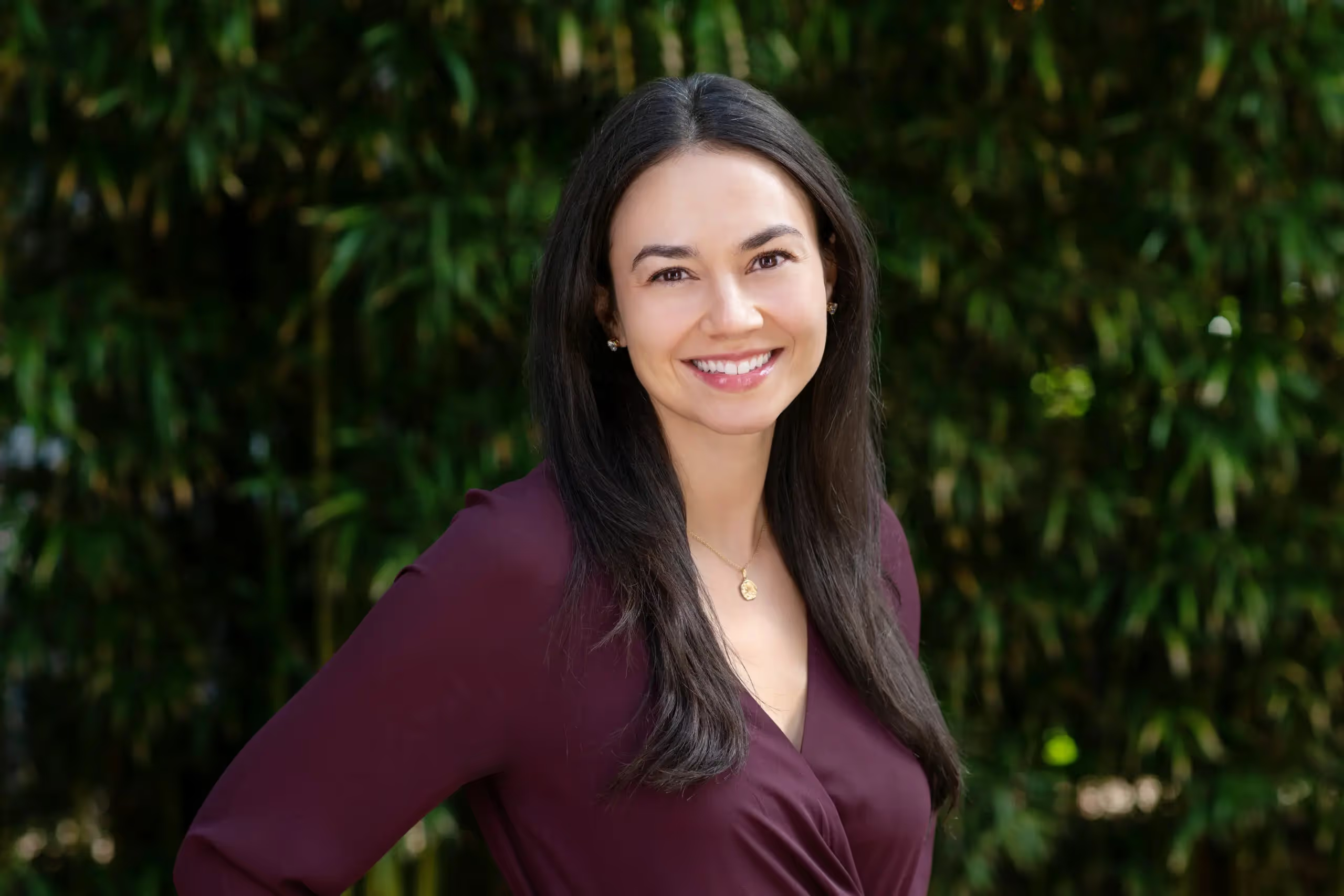
There is a certain kind of investor who has actually shipped something - who knows the feeling of a factory in Shenzhen agreeing to your specs at 2am, who has stood in a Walmart aisle and watched a stranger pick up the product they invented. Alice Brooks is that kind of investor. At Khosla Ventures, where she became Partner in 2023, she brings something most VCs cannot manufacture: the scar tissue of a founder.
Before the term sheets, there was the toy. In 2012, Brooks and her Stanford classmate Bettina Chen founded Roominate - a circuit-wired dollhouse construction kit that put real engineering in the hands of girls aged six to eleven. The idea came from a simple observation: both founders had grown up in households where toys pushed them toward engineering, and that was unusual. Roominate was the fix for that asymmetry.
"Santa brought me a saw instead. It worked out great. I ended up building a dollhouse."- Alice Brooks, on her unconventional Christmas gift at age 8
The Kickstarter launched in 2012 and hit its $25,000 goal in under five days. It closed at $85,000 - three times the target. That kind of early signal does not happen without a product that resonates. Roominate reached Time magazine's number one toy of 2014, appeared in 5,000+ retail locations across North America and Australia, and in September 2014, landed one of the cleanest Shark Tank deals of that era: $500,000 from Mark Cuban and Lori Greiner for 5 percent equity. Cuban's condition? That Brooks and Chen would mentor his young daughters. He knew exactly what he was buying.
PlayMonster acquired the company in 2015. By that point Brooks had logged hard operations work - manufacturing runs in China and Taiwan, retail partnerships, logistics across three countries, and the peculiar pressure of being a STEM brand at a moment when "STEM for girls" was both a cultural moment and a marketing minefield. She navigated it straight. No pink-washing. No condescension. Just circuit boards in dollhouses.
After the acquisition, she went into the deep end of hardware at Wonder Workshop, the company behind Dash and Dot educational robots. Then Khosla Ventures came calling - first as an Entrepreneur in Residence in 2019, then Principal, then Partner. The arc was not accidental. Khosla Ventures wanted someone who had built a supply chain, managed factories, launched consumer hardware, and stared down a tank full of sharks on national television. That is a specific set of credentials.
"We were amazed by what these girls built - it went way beyond a dollhouse."- Alice Brooks, on Roominate user research
At Khosla, Brooks invests across agtech, climate tech, robotics, food and beverage, manufacturing, supply chain, and education - seed through Series B, with checks ranging from $100,000 to $50 million. The connecting thread is not sector, it is depth: she backs companies solving problems that require you to understand how physical things are made, moved, or grown. Digital-only plays are not her territory. Atoms-plus-bits is.
In March 2026, she took the main stage at Future Food-Tech San Francisco to discuss capital strategies in the new food-tech economy - a conversation that matters because deep tech food companies die not from lack of innovation but from lack of patient capital that understands the timelines of biology and hardware. Brooks is precisely that kind of capital.
The San Francisco Business Times named her to its 40 Under 40 class of 2025. Business Insider included her in its 2023 list of women in venture capital who reached partner or higher. The recognition tracks, but it is not the story. The story is an eight-year-old in a workshop, a saw in her hands, a dollhouse taking shape from the scraps. The story is the straight line from that workshop to Khosla Ventures - a line that runs through MIT, Stanford, Harvard, a toy factory, a TV studio, and several hundred thousand square feet of retail floor. Alice Brooks is not someone who pivoted into investing. She arrived.