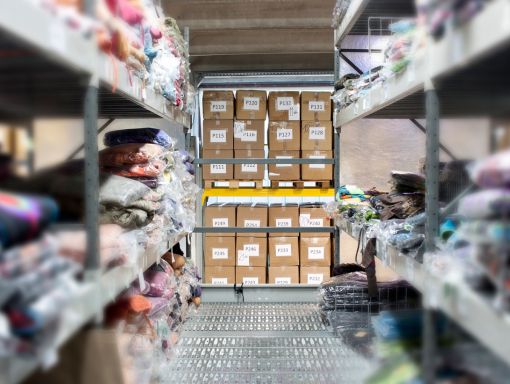
In Gallatin, Tennessee, a returned piece of clothing had a peculiar second life. It went back into storage, sometimes among a muddle of other items. Then somebody had to walk into the racks and find it again. A garment could be ready for another customer while the picking system sent a worker somewhere less convenient. The merchandise was available. The journey was expensive.
Hy-Tek Intralogistics describes this problem in an anonymous apparel retailer’s case study. Its answer was an Exotec Skypod system: robots retrieve segmented totes and bring them to a stationary workstation. Returned items are scanned into those totes; outbound pickers are directed to the right compartment. Hy-Tek reports picking moved from roughly 50–75 units per person per hour to more than 300. Receiving operators processed more than 750 units per hour.
The detail to linger over is the compartment. Less walking helped. So did less rummaging. Warehouse productivity can turn on something as unglamorous as how many shirts share a bin.
- The work: Hy-Tek designs, connects and supports warehouse equipment, robotics and software.
- The distinction: consulting, its own IntraOne software and multiple equipment partners sit within one delivery business.
- The useful lesson: measure the awkward journey before choosing the impressive machine.
Same task. A shorter journey.
The company between the machines
Hy-Tek works in intralogistics, the movement of goods inside an operation. Its customers include retailers, manufacturers, wholesalers, beverage distributors and third-party logistics businesses. Their problems tend to have several owners: operations sees a queue, IT sees an interface, maintenance sees a fault, and finance sees another capital request.
The company sells the expertise to join those conversations. Its services span network advice, facility design, automation integration, installation and support. Equipment can include conveyors, automated storage, picking robots, palletizing systems and ordinary industrial trucks. A warehouse’s useful machinery need not all be equally fashionable.
This gives Hy-Tek a particular place in the market. A robotics manufacturer supplies a technology. A software vendor supplies an application. An integrator must make the selected parts behave as an operation. Hy-Tek combines that integration role with its own warehouse software and a continuing equipment business.
Its commercial model follows the work: consulting and engineering, installed systems, software, equipment sales and rentals, and support agreements. The customer is buying a sequence of decisions and services, often stretching beyond the day the machinery starts moving.
A name borrowed from the future
The business began as Slife Material Handling in 1963. In 1989, Sam Grooms and four other buyers purchased it and chose Hy-Tek Material Handling, a nod to the era’s enthusiasm for “High-Tech.” The name carried the optimism of its decade. The later business had to carry rather more: software, controls, engineers and installation crews.
In March 2021, Dunes Point Capital announced that it had acquired Hy-Tek and WorldSource Integration to form Hy-Tek Holdings. Its Fund II supplied controlling equity; M&T Bank supplied transaction debt. The combination brought together two integration businesses rather than launching a venture-funded robotics startup.
The November 2022 rebrand supplied the broader company with its present name. The announcement identified WorldSource, BP Controls, Fascor, LCS and AHS among the businesses operating together. “Intralogistics” is a cumbersome word, but an accurate one for a company whose remit had grown beyond handling equipment. The corporate history is also a map of the skills needed to deliver a working warehouse.
When the order changes its shape
Ariat offers a different example. The footwear and apparel company’s million-square-foot Fort Worth distribution center had been configured for retail-store fulfillment, with large orders. During the pandemic, eCommerce grew and changed the order profile. A facility suited to replenishing shops faced more of the work involved in serving individual buyers.
Hy-Tek implemented robotic fulfillment capable of handling different order profiles. Its published case describes improved picking rates and a flexible, scalable operation. The point is the mismatch that prompted the change: a building can remain enormous while its process becomes ill-suited to the orders arriving inside it.
A separate furniture-distribution assignment moved the question outside the building. Growth had pushed the client into extra leased and third-party storage, with inventory shuttling back to its main distribution center. Hy-Tek modeled network options and recommended a second center. The model projected $6.2 million in savings over four years, because transportation savings outweighed higher operating costs. Modeled two-day customer coverage rose from 70% to 93%.
Those are planning results. They make an instructive accounting point: warehouse rent and warehouse economics are different calculations. A decision can look worse on one expense line and better across the network.
The software has to know what happens next
Hy-Tek’s IntraOne platform combines three responsibilities. Warehouse management tracks inventory and the receiving-to-shipping workflow. Warehouse execution coordinates work across people and automation. Warehouse control connects to equipment and directs physical movements such as tote routing and sorting.
The distinction matters when a parcel is waiting and several systems have something to say about it. An inventory record, a work queue and a conveyor instruction describe different parts of the same event. Connecting them is the product’s practical purpose.
That work can also extend an existing enterprise system. In March 2026, Hy-Tek announced a partnership with MCA Connect around Microsoft Dynamics 365 Finance & Supply Chain Management. IntraOne supplies warehouse execution and automation coordination alongside the enterprise platform. For a buyer, this opens a route to changing floor operations while retaining the planning system already in place.
A rehearsal with real equipment
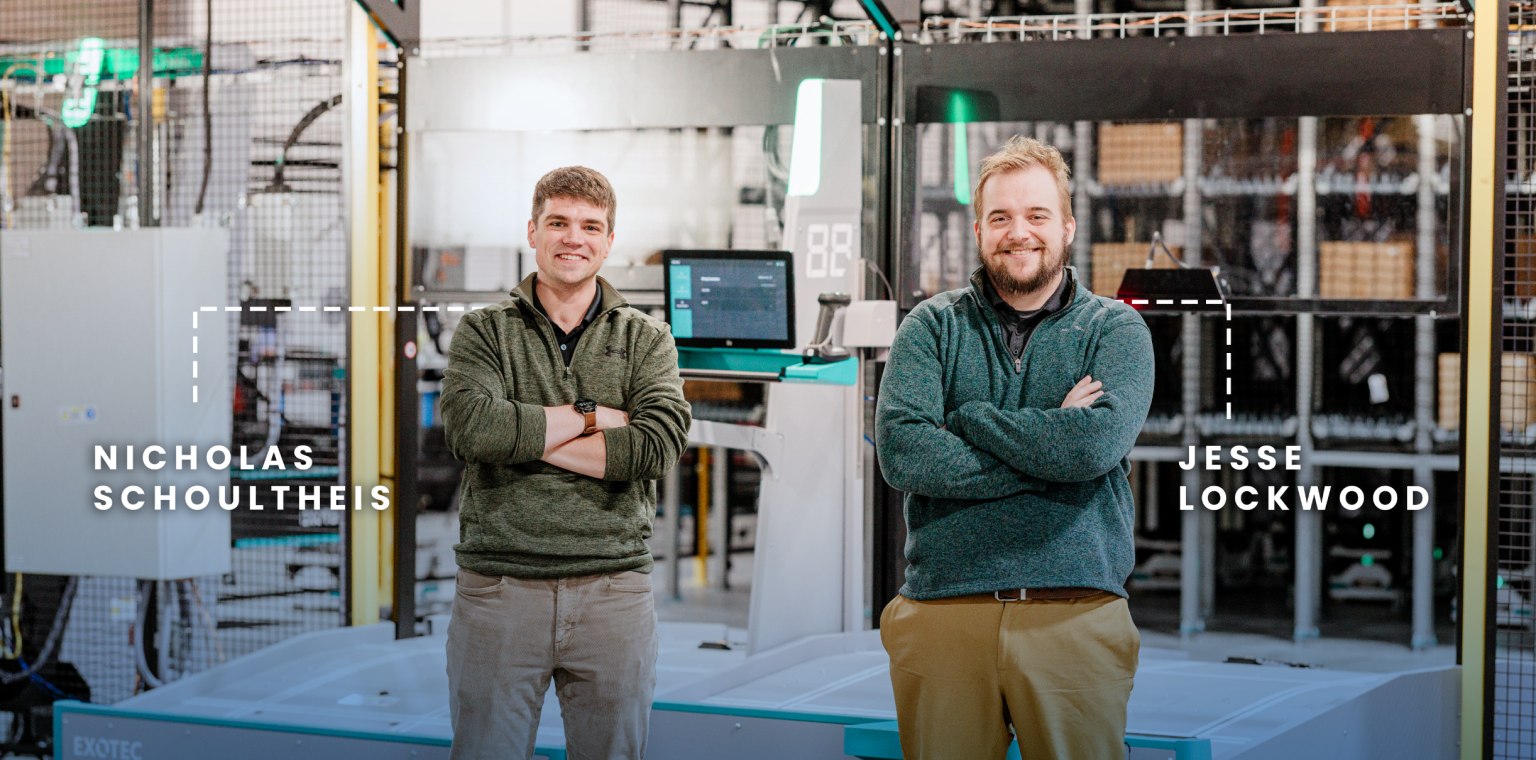
Near Cincinnati/Northern Kentucky International Airport, Hy-Tek’s 20,000-square-foot Innovation Lab offers a place to test robotics, picking, sorting and storage systems. Its stated work includes simulations, interoperability testing and throughput analysis. Multiple vendors’ technologies can be examined together through IntraOne.
Product development engineer Nicholas Schoultheis describes the hands-on appeal as “being a big kid playing with complex LEGOs.” The analogy has a serious edge. Pieces that fit on a diagram still need to exchange instructions and perform under load. A buyer can use the lab to examine the proposed combination, rather than judge each machine in isolation.
The beer aisle has acquired complications
On September 23, 2026, Hy-Tek formally launched Hy-Flo and Hy-Sync for beverage distributors. Its diagnosis is specific: portfolios once measured in hundreds of product codes now stretch into thousands as beer shares space with wine, spirits, seltzers and ready-to-drink products. More choice means more storage positions and more complicated picking.
Hy-Flo combines automated case storage and retrieval with options for robotic depalletizing, palletizing and autonomous pallet movement. Hy-Sync offers a narrower intervention: a dense robotic buffer isolates selected product flows, including slow-moving inventory. These are two approaches to the scope of an investment. One reorganizes a broad flow; the other targets a chosen source of complexity.
The distinction is useful beyond beverages. A proposed system should match the problem’s size. A troublesome slice of the catalog does not automatically justify rebuilding every process around it.
The bill includes the years after installation
Hy-Tek’s published financing discussion urges buyers to establish current costs, compare scenarios and bring finance into the project early. Maintenance, working capital and equipment life belong in that calculation. A payback model that assumes smooth operations deserves the same scrutiny as a demonstration that assumes perfect cartons.
The practical method is available to any operator: record the baseline, identify the constrained step, compare alternatives, and stress-test the economics. Low utilization, unreliable inventory data or an unsuitable product mix can undermine the case for a proposed system. Those are reasons to investigate the design and assumptions before committing capital.
Hy-Tek’s ongoing services include planned maintenance, emergency response, resident technicians, spare parts and training. The company also announced its second consecutive Great Place to Work certification in November 2025, and inclusion in SupplyChainBrain’s 2026 Great Supply Chain Partners list the following August. Both recognitions concern relationships that outlast a product demonstration.
The returned shirt provides a pleasingly small way to understand the business. Somebody needs that item, somewhere else, soon. Hy-Tek’s job is to work out how the inventory record, the tote, the robot and the person can agree on the next move.
See the work in motion
Explore Hy-Tek’s website, IntraOne and the Innovation Lab. Watch the Ariat case-study video or the Automation Insider financing conversation.
Follow LinkedIn, Facebook and YouTube, or browse news, articles and demonstrations.