A pallet of yogurt occupies a modest amount of space. Finding it, reaching it, moving it and keeping it cold require rather more. A warehouse is full of these small arrangements. Taken together, they can determine whether a growing business needs another building.
Westfalia has made a business of reconsidering them. Its automated storage and retrieval systems send machinery along aisles and into deep storage lanes. Software keeps track of the goods and decides what should move next. The company also parks cars this way, which is an amusing expansion until you consider how much of a garage exists to accommodate the driver.
- Westfalia combines storage machinery, conveyors, picking systems and its own software.
- Its customers include yogurt makers, bread makers, beverage distributors and property developers.
- The recurring question: can better use of an existing footprint make growth less expensive?
01 / The aisle is part of the bill
Consider Allied Beverage, a New Jersey distributor whose operations had been spread across four warehouses. Westfalia’s account describes manual work, difficult coordination and inadequate inventory visibility. The trouble began in the arrangement of the business: goods in different places, people trying to keep the movements straight.
Allied consolidated into one facility with automated storage and Savanna.NET warehouse execution software. The published specification lists 31,904 pallet positions, four aisles and storage lanes six or eight pallets deep. Conveyors and automatic replenishment connect reserve storage to picking lanes.
Those details matter more than the word “robot.” A store of wine and spirits must eventually become particular orders for particular customers. Merely putting more pallets inside a building would solve only half the problem. Allied’s project joined storage to the work of getting those pallets back out.
02 / A Satellite that stays indoors
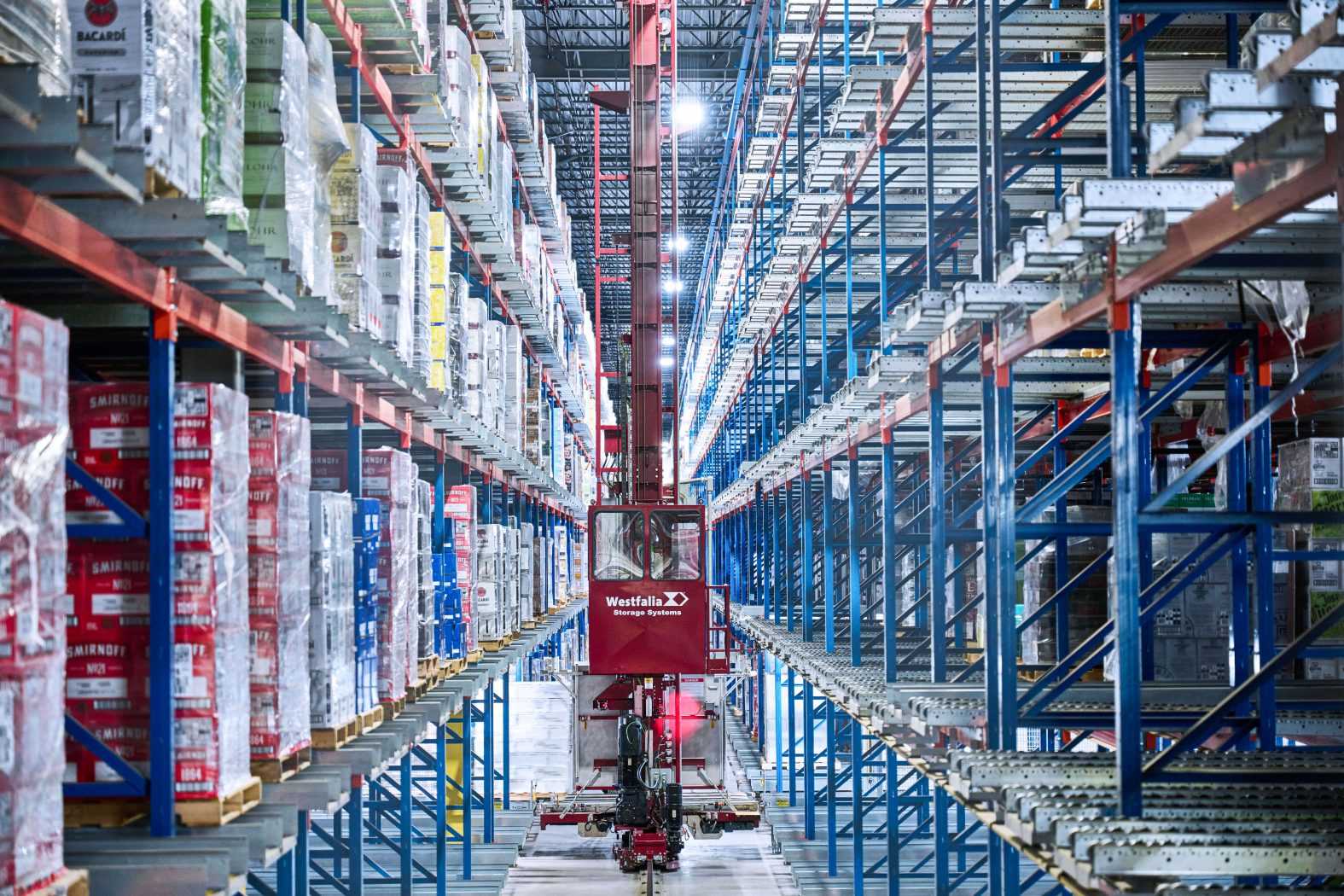
The useful piece of engineering is the Satellite, Westfalia’s rack-entry vehicle. A storage/retrieval machine takes a load to the appropriate rack location; the Satellite travels into the lane to deposit or collect it. This gives storage depth a practical purpose. Goods can sit behind other goods while machinery performs the reaching.
The commercial implications are easy to grasp. Reducing the space devoted to access can leave more room for inventory. But the design has to respect the inventory itself. A business with many product types and little stock of each faces a different puzzle from one holding many pallets of a smaller assortment.
Machine to lane. Satellite to pallet. Six positions shown for illustration; actual layouts vary.
Martin’s Famous Pastry Shoppe offers a smaller example: 1,868 pallet positions in a 15,250-square-foot AS/RS footprint, with six-deep lanes. This is a bread-and-roll business dealing with growing inventory complexity and demanding fulfillment. The installation illustrates why storage automation belongs near a conversation about product mix, rather than a contest over building height.
03 / Cheese buys time; yogurt leaves the wrap off
Sargento’s question was how to keep a distribution center useful as demand grew. Westfalia describes a phased project combining high- and low-bay automated storage, layer picking and outbound staging. The company reports that the solution extended the center’s life by up to a decade.
That is a different way to value machinery. The benefit is partly time: time before another infrastructure decision, time spent handling orders instead of handling the same pallet twice. In this account, automation helped address off-site storage and linked manufacturing more closely with distribution.
FAGE’s yogurt operation adds a smaller, wonderfully specific detail. Pallets travel through its automated storage system without stretch wrap. Westfalia says this permits cooling and case picking while avoiding wrapping waste inside that process. A familiar warehouse habit becomes optional because the surrounding equipment has been designed to handle the load differently.
FAGE’s published configuration grew from an initial 1,600-pallet system to 10,124-pallet capacity. The expansion was considered in the design. For anyone planning a facility, that is the copyable idea: reserve a credible route for tomorrow’s demand while specifying today’s operation.
“no one else touches their vehicle”Tom Scannapieco, on 500 Walnut’s automated parking, quoted in Westfalia’s 2025 partnership account
04 / Then somebody parked a car
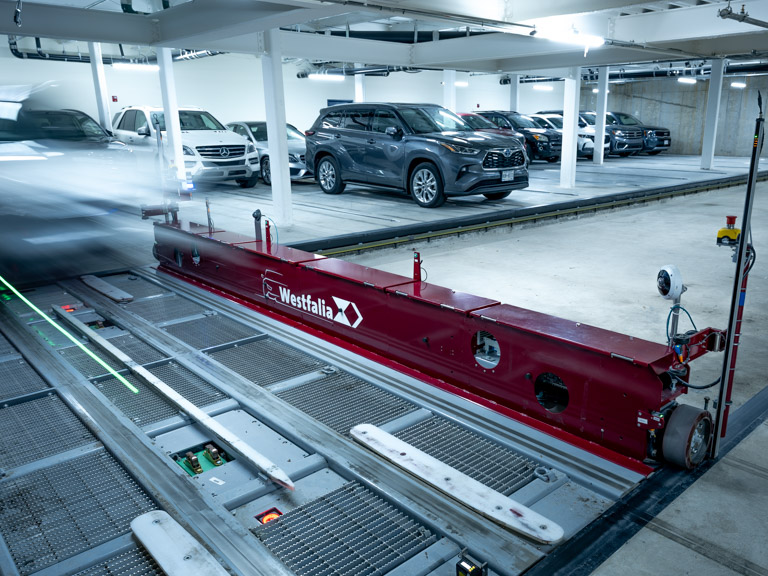
At Philadelphia’s 500 Walnut, the stored load has leather seats. Westfalia supplied an 86-space palletless parking system with two transfer bays, two vertical lifts and Satellite-equipped transfer cars. Residents hand the movement of the vehicle to machinery after leaving the transfer area.
The resemblance to a warehouse is quite literal. There is a load, a storage address, a retrieval request and a sequence of movements. The difference is the customer standing nearby, expecting the whole arrangement to feel uncomplicated.
In July 2025, Westfalia highlighted its Siemens partnership on the project, including S7-1500 controllers and SIMATIC interfaces. Its account describes seven years of operation and weekly client meetings during the project. Here, engineering competence includes the conversation about how a resident actually uses the garage.
WePlug takes the same appetite for rearrangement into charging. An overhead gantry brings a connector to a parked electric vehicle. The driver first inserts an adapter into the charging port. That small manual act gives the moving system a defined connection point; adapters accommodate different vehicle configurations.
The idea is to serve vehicles sequentially with moving charging equipment. It needs an appropriate covered environment and overhead clearance. Its attraction depends on the charging workload, too: the number of cars that can share equipment is a question about time and energy demand as well as floor area.
05 / The software must remember
Savanna.NET sits between the inventory and the machinery. The suite includes warehouse execution, parking control and Firefly visualization. In the warehouse, it joins inventory management to machine control. A pallet’s location becomes useful information because the system can act on it.
Manhattan Beer’s June 2025 update shows how this extends into picking. Its planned Beverage Order Release Module, nicknamed BORM, uses people to feed cases into lanes and software to release them in the sequence needed for pallet layers. The design retains human work at comfortable heights while automating the sequencing problem.
There is also software behind the software. Copia’s customer account says Westfalia adopted its Industrial DevOps platform to improve PLC code management, collaboration and reliable backups. Git-based workflows and recovery tools address a quieter obligation: keeping the engineering record dependable as installations and teams grow.
06 / Steel, service and the price of certainty
Westfalia is an industrial project business. It designs, manufactures, installs and supports systems, producing much of the equipment itself and working with its German sister company. Its offering extends through training, spare parts, support and modernization. The buyer is purchasing a working installation and an ongoing relationship.
For a sense of historical scale, a 2016 federal court order recorded approximately $7.5 million for one Pepsi warehouse AS/RS, drawing on deposition evidence. That figure belongs to that project and period. The economics of a new facility must be worked out from its loads, movements, building and support needs.
Daifuku and Swisslog also offer automated pallet storage. Westfalia’s Satellite architecture and integrated equipment-and-software proposition give buyers concrete features to compare, rather than a reason to assume it owns the category. Conventional racking and forklift operations remain alternatives in the same capital-planning conversation.
The revealing procurement questions are plain ones. How many retrievals must happen during the busiest hour? Which loads need immediate access? Who restores operation after a fault? Does the proposed layout still work when the assortment changes? Extra capacity earns its keep only when the operation can use it.
Westfalia’s customer stories suggest a useful starting point. Trace the goods, count the handling, examine the space reserved for movement. Sometimes the next building is the right answer. Sometimes the building you already have is waiting for a better arrangement.
Keep exploring
Visit Westfalia, explore its customer stories and articles, or watch product videos on YouTube. The 500 Walnut customer video shows the parking experience; the Martin’s customer video covers warehouse automation.
Follow LinkedIn, Instagram, Facebook and X. Read the 2025 Siemens parking update, Copia engineering account and historical project-cost record.