manufacturing-automation
(23)
Path Robotics gives the robot a second look
A welding robot can repeat a movement all day. Path Robotics is building one that notices when the metal has moved - and changes its plan.
Bright Machines Is Teaching the Factory to Remember
AI still needs someone to build its servers. Bright Machines combines robots, simulation and a record of the assembly process - including the moments when a human takes over.
Seegrid and the art of being boring
A warehouse robot earns its keep by making the same journey uneventful, thousands of times. Seegrid has built a business around that modest ambition - and survived a rather less uneventful journey of its own.

The Robot Was Ready. The Next Job Wasn’t.
Trener Robotics bets that the expensive part of industrial automation is often the pause between jobs. Its Acteris software lets operators describe a new task, then turns that request into a checked sequence of robot skills.

Datta Kaligotla Is Building for the Moment the Demo Meets the Factory Floor
After helping build Handshake's AI effort, the young engineer moved into industrial operations. At Faraday, his argument is simple: an agent earns its place only when the work survives contact with the real world.

Vipin Raghavan Is Teaching Old Factories New Instincts
He left a career in corporate finance to put hard-won factory judgment into software. A decade later, Haber's argument is still refreshingly practical: artificial intelligence earns its place on the plant floor one measurable improvement at a time.

Andrew Lonsberry and the Factory That Learned to See
He grew up welding beside his father, studied how machines learn, and stayed in Ohio when the usual startup map pointed west. Now Andrew Lonsberry is asking robots to master the unruly work that factories could never quite automate.

Alex Lonsberry Taught a Robot to Notice the Mess
A childhood spent building in an Ohio garage led to a doctoral lab, a stubborn sheet of shiny steel and a company built around one unfashionable truth: the real world refuses to hold still.
The Robot That Won the Job Before It Existed
Maven Robotics talked its way into a factory with little more than a drawing, won the work, and built the machine around the job. Now comes the harder experiment: turning eight industrious robots into an industrial system that can be made by the hundreds.

The 63-Year-Old Machine Builder Teaching Factories to See Inside Things
LK Metrology helped turn the coordinate measuring machine into a computerized judge of manufactured parts. Now the Derby company is assembling a broader inspection stack - touch probes, blue lasers, software and X-rays - for factories where a few microns can separate a clean delivery from an expensive problem.

Ishaan Makkar Is Running Straight at the Factory Back Office
A physics graduate and national-level distance runner found his next race inside old ERPs, crowded inboxes and the quiet administrative work that keeps industry moving.

Rahul Chipalkatty Is Teaching Factory Robots a Useful Trick: How to Change Their Minds
After years spent studying how people and machines share control, the Boston roboticist built Southie Autonomy around a stubbornly practical idea: the person on the line should be able to teach the robot.

The Factory Floor's Babel Problem - and Botsync's Plan to Make Every Robot Talk
Factories rarely suffer from a shortage of machines. They suffer from machines that cannot coordinate. Botsync is building the traffic controller - and some of the traffic - for the industrial floor.
Forge Automation (YC W25)
Forge Automation runs software-enabled factories that machine custom metal parts and ship them in four days or less. Engineers upload a CAD model to forgejobshop.com, get an instant quote, and pay online. Its in-house software, Foundry, automatically turns CAD files into machine-ready toolpaths, and customers can either order on-demand or reserve a dedicated CNC machine with a guaranteed production SLA. Founded in 2022 in Toronto by Timothy Seto and Walter Raftus, the company went through Y Combinator's Winter 2025 batch and serves hardware, robotics, and hard-tech teams from early-stage startups to Fortune 10 companies.
Prototyping.io
Prototyping.io is a San Francisco startup (YC Spring 2026) building an AI-native manufacturing platform that turns CAD designs into finished mechanical parts in as little as one day. It automates the traditionally manual path from design to production - DFM analysis, sourcing, process planning, machine programming and setups - so hardware teams can iterate in days instead of weeks. The company serves customers from early-stage startups to multi-billion-dollar enterprises across robotics, AI infrastructure, energy, automotive and defense.
Realtime Robotics, Inc.
Realtime Robotics is a Boston-based deep-tech company that gives industrial and collaborative robots the ability to plan collision-free motion in real time. Spun out of DARPA-funded research at Duke University in 2016, its RapidPlan software and RapidSense perception system let robots generate and adjust their own paths in microseconds, cutting the time and cost of programming, deploying, and coordinating multiple robots in a shared workspace. Its technology is used by manufacturers including the BMW Group, and the company is backed by strategic investors such as Mitsubishi Electric, HAHN Automation, and SAIC Capital.

CREAN®
CREAN, Inc. is an Austin, Texas-based aerospace engineering and Smart Factory company that supplies hands-on engineering services and manufacturing-optimization programs to space, defense, and commercial clients. Founded in 2002 by James and Jennifer Crean, the firm fields teams of aerospace subject-matter experts who help customers move systems from concept through full-scale production while modernizing factory operations. CREAN is also developing CelestNet, a proposed lunar communications and navigation network, following its 2023 acquisition of Aquarian Space.

Mbodi AI
Mbodi AI is a New York robotics-software company building an embodied AI platform that lets people teach industrial robots new skills through plain natural language and short demonstrations - no code and no specialized engineers. Founded in 2024 by two former Google Public DNS engineers, the platform combines generative AI, agent orchestration and symbolic reasoning to turn everyday instructions into precise, reliable robot actions that run in production within minutes and transfer across an entire robot fleet. Mbodi is a Y Combinator company with a joint commercialization partnership with ABB Robotics.

Rhoda AI
Rhoda AI is a Palo Alto robotics company building foundation models that teach robots to act in the messy physical world by learning from internet-scale video instead of staged lab demos. Its FutureVision system - a Direct Video Action (DVA) model - watches an environment, predicts what happens next, and converts those predictions into motion in a closed loop that updates every few hundred milliseconds. Founded in 2024 and out of stealth in March 2026 with a $450M Series A at a $1.7B valuation, Rhoda targets high-variability manufacturing and logistics work.
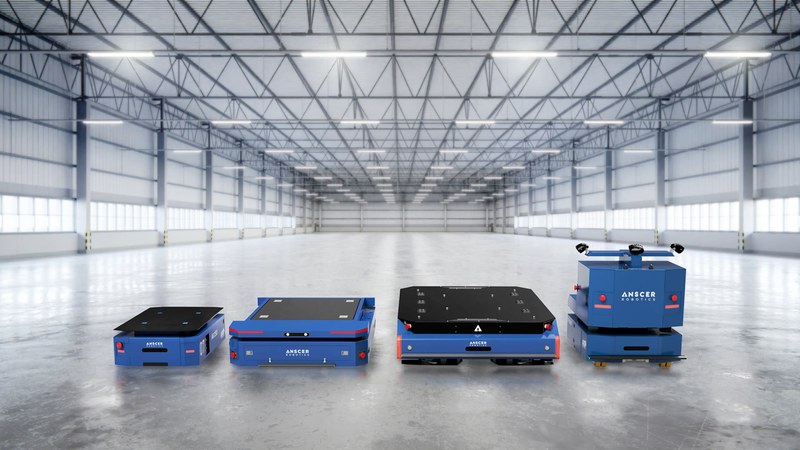
ANSCER Robotics
ANSCER Robotics is a Bengaluru-based industrial automation company that builds hybrid autonomous mobile robots (AMRs) blending the smart navigation of AMRs with the heavy-lift precision of automated guided vehicles. Its robots and fleet-management software move materials inside factories, warehouses and dock areas, sold partly on a Robots-as-a-Service model. After a $5.4M Series A in 2026 led by IAN Alpha Fund, the company is expanding from India and Southeast Asia into North America.

Brett Adcock
Brett Adcock is a serial entrepreneur and founder of Figure AI, the humanoid robotics company valued at $39 billion after a $1B+ Series C in September 2025. Raised on a third-generation farm in central Illinois, Adcock built his first web companies at 16, co-founded and sold talent marketplace Vettery to Adecco for ~$100M in 2018, took eVTOL company Archer Aviation public on the NYSE at a $2.7B valuation, then pivoted to what he calls the hardest problem: building general-purpose humanoid robots. Figure's robots now work autonomously on BMW's production floor and have logged over 30,000 vehicles built. In 2025-2026, Adcock simultaneously launched Hark (personal AI hardware, $700M Series A at $6B valuation) and Cover (school weapon-detection tech). He is currently running three companies at once while publicly estimating his net worth at ~$19 billion.

Fabian Gerlinghaus
Fabian Gerlinghaus is the Co-Founder and CEO of Cellares, a South San Francisco biotech company building the world's first Integrated Development and Manufacturing Organization (IDMO) for cell therapy. An aerospace engineer turned life-science entrepreneur, he co-founded Cellares in 2019 after spotting a critical gap: FDA-approved CAR-T therapies were sitting ready while patients died on waitlists because manufacturing couldn't scale. His Cell Shuttle platform — a fully automated, factory-in-a-box system processing 16 patient batches simultaneously — has attracted $630M in funding, a $380M partnership with Bristol Myers Squibb, and FDA's Advanced Manufacturing Technology designation. TIME magazine named it one of 2025's most important inventions.

Cornelius Menke
Cornelius Menke is a former Partner at Sequoia Capital, where he spent roughly three years building the firm's European investment portfolio from London. A German national educated at the Stockholm School of Economics, Menke moved from management consulting at Boston Consulting Group to venture capital after an earlier stint inside Klarna's CFO office - one of Sequoia's landmark European bets. At Sequoia, he backed companies across industrial automation, AI infrastructure, and enterprise fintech, co-investing in Robco, Tacto, LangChain, Flow, Pennylane, and Rillet while also running the firm's Arc accelerator cohorts for European pre-seed and seed founders. He departed Sequoia in 2025/2026 and his next move remains to be announced.