A robot arm is a monument to commitment. Bolt it down, teach it one motion, and it will repeat the gesture with a monk's patience and none of a monk's complaints. Then Tuesday arrives. The carton changes. The assortment changes. A rush order barges in wearing muddy shoes. The robot remains magnificent, precise, and suddenly rather inconvenient.
Rahul Chipalkatty has built his career around that awkward moment. He is a mechanical engineer turned roboticist, a former autonomy researcher at Draper Laboratory, and the founder and CEO of Southie Autonomy in Boston. His company does not ask factories to admire a robot's choreography. It asks a blunter question: can the person running the line teach the machine a new job without waiting for a programmer?
The proposed answer is a software layer that combines computer vision, artificial intelligence, and augmented reality. An operator shows the arm what to pick up and where to place it. The system translates that intention into robot instructions, then saves the task for another run. The pitch lives in packaging, kitting, and palletizing, where variety is ordinary and a long setup can turn a useful machine into expensive scenery.
01 / The control questionLong before the packing line, there was a rescue robot
Chipalkatty studied mechanical engineering at Carnegie Mellon University, then earned a master's in the subject at the University of Illinois at Urbana-Champaign. At Georgia Tech, the object in front of him grew legs: a quadruped rescue robot meant to cross difficult terrain and do more than peer into it. The machine needed strength and stability. The operator needed a way to guide it.
His doctoral dissertation, completed in 2012, was titled Human-in-the-Loop Control for Cooperative Human-Robot Tasks. The title contains the argument that still animates his work. Machines are adept at lower-level control. People are better at interpreting messy context, uncertainty, and intent. Useful autonomy comes from assigning each side the work it can actually do.
One project let an operator guide the quadruped's gait while a model-predictive controller kept it statically stable. Another paper, co-written with Greg Droge and Magnus Egerstedt, carried the cheerful title Less Is More. In a human-operator study, the simpler prediction methods beat the more complicated ones. It was an academic result with the makings of a product philosophy: intelligence is wasted if the interaction becomes harder to use.
“Our goal has always been to reduce the barriers for using robots - to be able to work with robots like you work with people - making complex technology easy to use.”Rahul Chipalkatty
The research was not limited to machines with feet. Chipalkatty co-authored work on multi-aircraft coordination, collaborative unmanned aerial vehicles, and air-traffic management. A 2010 paper on decentralized aircraft spacing and merging tied for the Best Student Paper Award at the Digital Avionics Systems Conference. The common element was not a particular chassis. It was coordination under uncertainty.
02 / From laboratory to loading dockThe robot was capable. The economics were sulking.
After Georgia Tech, Chipalkatty spent five years at Draper, working on autonomy and robotics for defense research applications. His projects included autonomous mobile manipulation, the difficult business of getting a machine to perceive and act in environments that refuse to stay tidy. He also advised graduate research on multi-agent aerial-vehicle planning.
At Draper he worked with Jay M. Wong, a roboticist whose interests stretched across perception and full-stack autonomous systems. They later co-founded Southie. The company was set up in 2017, and the founders carried a laboratory lesson into a commercial setting: the arm itself was only part of the problem. A robot could be perfectly competent yet financially unpersuasive if every change required an integrator to return.
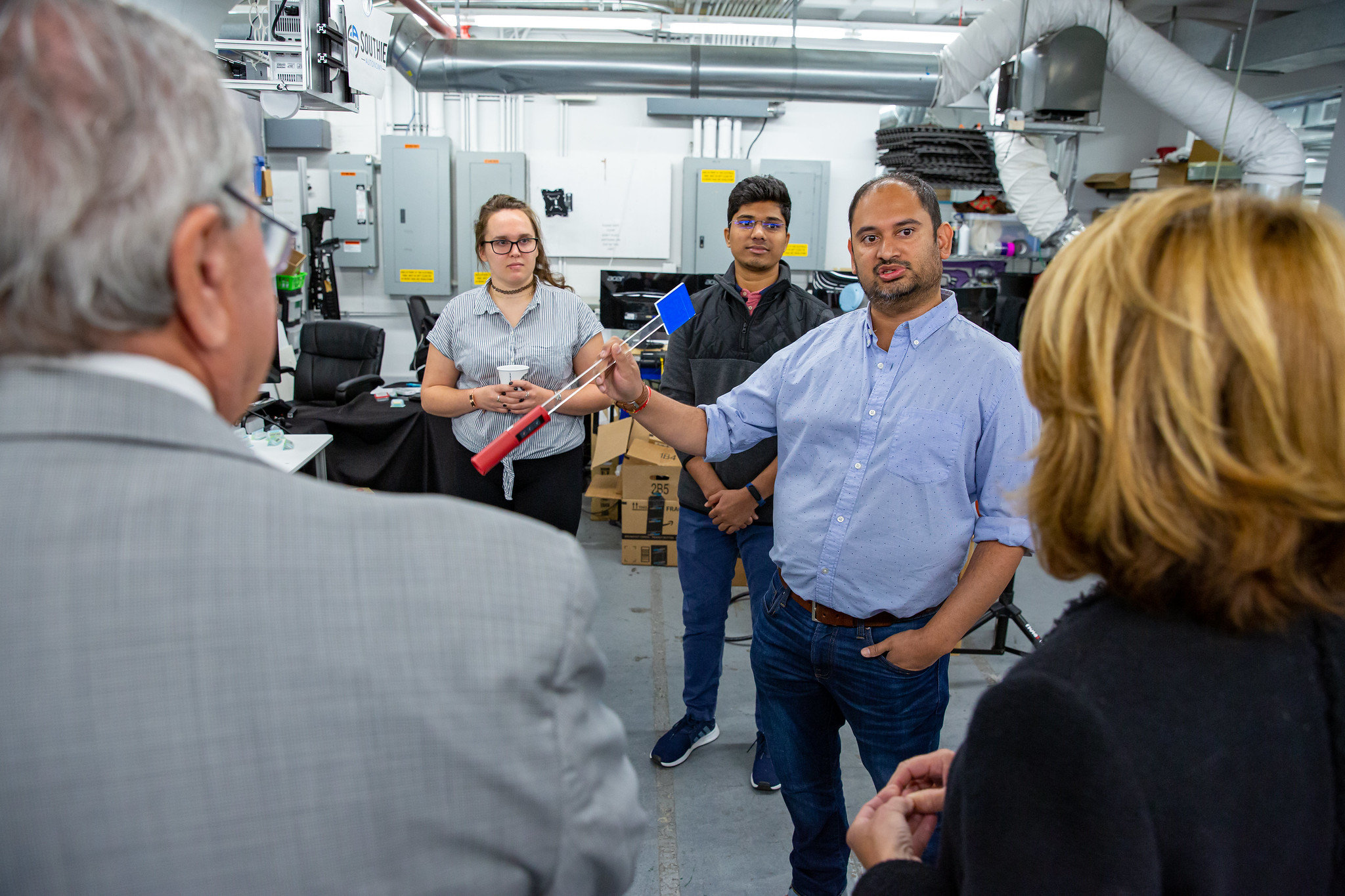
Southie's early system gave the operator a handheld pointer called The Wand. Point to an object, show the destination, and let the software build the task beneath the gesture. Later materials feature a tablet-based app, task libraries, and AI-assisted vision. The interface changed; the underlying bargain did not. Make the robot learnable by the person who knows what needs packing before lunch.
That makes Southie's target market unusually specific. Contract packagers, manufacturers, and logistics providers handle products that arrive in changing sizes, bundles, and runs. Traditional fixed automation can be sensible when one job repeats for years. Southie is interested in the work that changes every few hours, where setup time is part of the production cost and flexibility must earn its keep.
“People and robots don't speak the same language. And so we decided to start this company to bridge that gap.”Rahul Chipalkatty
03 / The commercial proofPrizes are pleasant. Deployments have invoices.
Southie collected early signals. It won the ABB IdeaHub Robotics Accelerator challenge and, in 2018, took first place and a $5,000 prize at RoboBusiness Pitchfire. In 2020 it joined the Air Force Accelerator Powered by Techstars, a Boston program connecting dual-use startups with military users. These were not substitutes for a market, but they gave the company rooms in which its thesis could be tested and questioned.
The Air Force became a customer as well as an accelerator host. In 2021, Southie received a contract worth up to about $1.5 million to develop a movable, two-armed system for assembling aviation kits at the Oklahoma City Air Logistics Complex. The setting sounds far from a contract packer's variety box. Operationally, the problem rhymes: changing collections of materials, tools, and parts need to arrive together, correctly, without turning every variation into a fresh engineering project.
The Boston robotics community supplied another kind of continuity. Southie has operated from the MassRobotics collaboration space on Channel Street, a few blocks from the working waterfront. Chipalkatty first demonstrated the company's interaction concept there while Southie was still at the pre-seed stage. Years later, MassRobotics listed him among its mentors and experts. The arc is pleasantly circular: a founder once borrowing the ecosystem's room and attention now helps newer robotics teams explain what their machines are for.
Commercial partnerships filled in other pieces. Nulogy brought access to contract manufacturing and co-packing workflows. Mitsubishi Electric Automation supplied robot hardware, support, and a distribution relationship. Southie's software is designed to remain hardware-agnostic, but physical automation is a team sport. Arms, grippers, cameras, safety systems, software, installers, and operators must agree on what reality looks like.
Financing followed the deployment model. In 2022, Southie announced a $2.5 million seed round led by BootstrapLabs, with Ocean Azul and Kineo Finance participating. Kineo also provided a $5 million leasing facility to support Robot-as-a-Service installations. The distinction matters. A leasing facility is not another equity round; it is capacity to put robots at customer sites without demanding that every buyer make the same large purchase upfront.
04 / What the operator keepsAutonomy can be a tool without becoming the boss
Chipalkatty's language around automation is consistent. He says autonomy should empower the people using robots, not replace them. During the upheaval of 2020, he described a worker's possible reassessment in plain terms: “I can be more productive by having a robot be my tool.” Southie's interface turns that belief into a division of labor. The human chooses the objective and handles exceptions. The machine performs the repeatable motion.
There are limits, because factories are merciless editors. Vision must find the product. A gripper must hold it. The arm must hit the required cycle time. The cell must satisfy safety rules. Operators need training, even when they do not need code. Hardware-agnostic software also encounters a growing menagerie of cameras, arms, boxes, lighting conditions, and factory layouts. Easy to use is an outcome earned in the details.
That is why Chipalkatty's story is less about a wand than about control. His rescue robot shared stability with its operator. His aircraft research distributed decisions across moving agents. His factory software gives production workers a language for directing a machine. Different industries, same negotiation: let automation manage what it can repeat, and keep human intention close enough to correct it.
The factory of the future is often advertised with cinematic darkness, polished floors, and no people in sight. Chipalkatty's version is brighter and busier. Someone notices the next run is different. They teach the arm. The line moves again. The useful trick is not that a robot can work without a person. It is that the person no longer needs to become a roboticist before the robot can work.