Consider the robot that has nothing to do. It has an arm, a controller, perhaps a camera, and a price tag substantial enough to make an accountant frown. The factory has work waiting. Yet the arm stands still because tomorrow’s part differs from yesterday’s. Someone must rewrite the routine, check the reach, account for a fixture, and make sure the machine and robot agree on the sequence. In a shop that changes parts often, the work between jobs can eat the benefit of automation itself.
- Trener Robotics builds Acteris, software for setting up and running reusable skills on existing industrial robots.
- Its first practical targets are CNC machine tending and pick-and-place in factories with frequent changeovers.
- Operators describe a job conversationally; the system configures and validates it for a supported cell.
- The company sells through manufacturers and integration partners, with deployments in Europe and the United States.
One case Trener tells is unusually blunt: a precision machining company in Norway had a $125,000 robot sitting idle because reprogramming it for each new part took too much effort. That figure is the cost of the robot, not a price for Acteris. After deployment, Trener says the shop could create new production jobs in under two minutes. It is the sort of claim a factory manager can test with a stopwatch, which is more useful than another speech about the future of AI.
The pause is the product
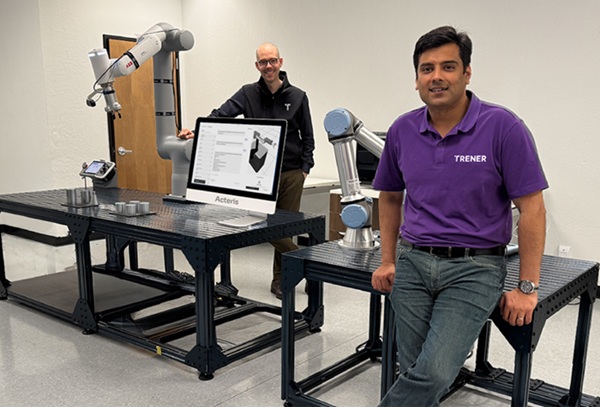
Trener Robotics was founded in 2024 by Asad Tirmizi, its chief executive, and Lars Tingelstad, its chief technology officer. It began under the name T-ROBOTICS. Tirmizi had worked at Vicarious and on robotics and haptics at ByteDance; Tingelstad had been an associate professor of robotic production at Norway’s NTNU. Their company now spans San Jose and Trondheim. It is a research story with a factory floor address.
Acteris is the company’s answer. An operator specifies a production job in ordinary language: batch size, part dimensions, where raw stock waits, perhaps whether the finished piece needs a blow-off or an inspection. The software turns that intent into a configuration using tested robot skills. It can use vision to locate parts when presentation varies, plan motion, and monitor execution. The plain-language interface gets the attention; the less photogenic work is checking whether a proposed movement fits the robot, the tool, the machine, and the cell.
That distinction matters. A sentence cannot make a gripper fit a part or certify a workcell as safe. Trener’s own technical writing says the machine interface, tooling, safety setup, and cell-specific validation still belong in the job. The ambition is to make each new task less like a fresh software project, within the bounds of a commissioned cell.
A test with metal, not metaphors
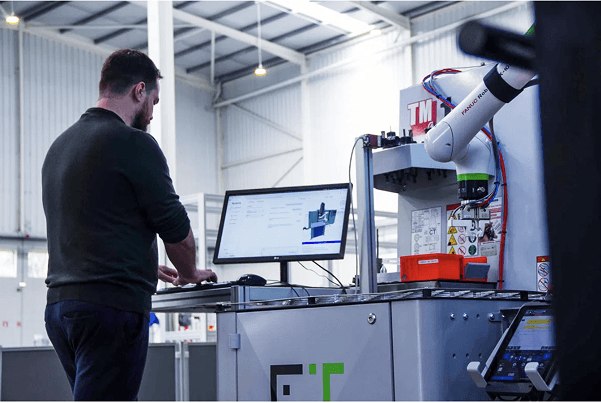
At Fluidotronica, an integration partner in Portugal, Acteris runs a FANUC CRX-10iA collaborative robot beside a Haas TM-1P milling machine. Raw cylindrical and cuboid blanks sit in an EasyRobotics ProFeeder tray. Operators specify geometry, batch size, inspection frequency, blow-off routines, and outfeed handling through the AI agent. The robot picks a blank, loads the mill, tends the machining cycle, and routes the part onward. Trener reports a 30 percent faster deployment for this case; it has not published a full cost comparison or the underlying calculation.
A second published case, with SE Automation in Sweden, pairs a Universal Robots cobot with a DMG MORI machining center. The customer makes fine mechanical components for engineering, pharmaceutical, and electronics work. That mix brings prototypes, short runs, tight space, and older equipment into the same room. Trener says operators there can create a new job in less than two minutes. The company does not publish a plant-wide utilization series, so the number should be read for what it is: job creation time at a named deployment, not a universal factory result.
These examples also reveal the customer. It is the manufacturer whose product mix keeps changing, and the integrator asked to make automation work anyway. A very stable, high-volume line can justify painstaking custom programming. The smaller batch shop has to ask a harsher question: will the robot be ready before the order changes again?
Same instruction, different arm
Robot makers have their own programming environments. A plant might have an ABB cell, a Universal Robots arm, and a FANUC machine, each taught in a different dialect. Trener’s software-defined approach separates the task description from the hardware commands. Acteris currently lists support for those three brands. A shared task can be adapted to a supported robot through a brand-specific layer, then checked against that actual cell. “Robot-agnostic” is an architecture, not a promise that every controller on earth will understand it.
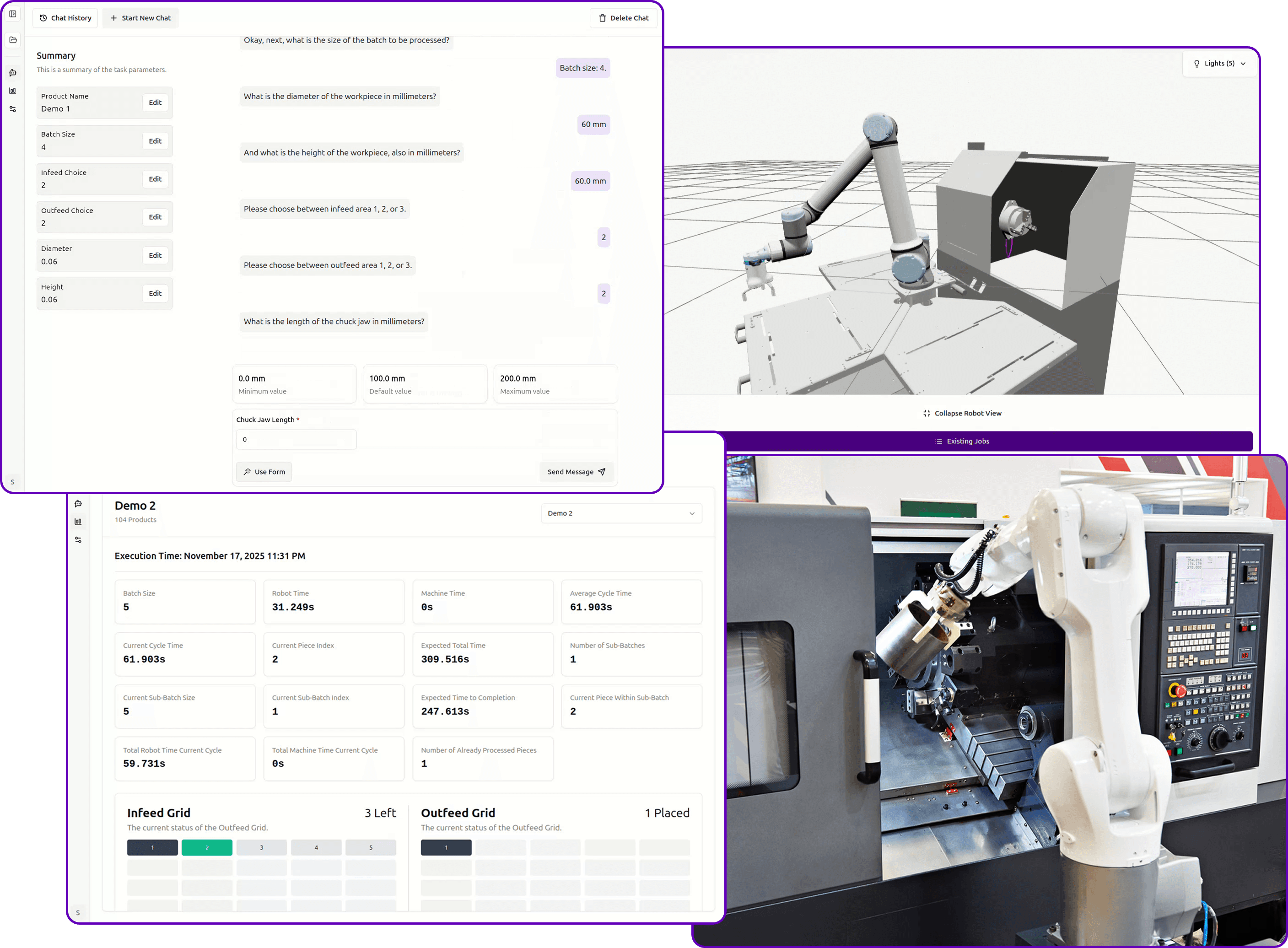
This is where Trener differs from a robot purchase or a one-off integration project. It is selling the reusable layer above the arm: skill definitions, operator workflow, runtime control, and an Integration Suite for partners who commission cells. Its T-Labs group develops the underlying skill learning, perception, and simulation work. The first production environments are machine tending and pick-and-place; a broader library is the promise. Public pricing is absent, so a buyer needs a quote that includes software, integration, hardware changes, and safety work.
The useful question is not whether a robot can obey a sentence. It is whether the next job can begin before the last job’s economics expire.
Distribution is part of the design. In 2025, Trener said it worked with more than 15 solution and integration partners across Europe and the United States. ABB selected the company as a winner of its 2024 AI Startup Challenge, and Acteris became part of ABB’s collaborative machine tending work. Trener also demonstrates with Universal Robots, and the Portuguese cell shows FANUC support in a specific working configuration. In 2026 it joined AMD’s Open Robotics Ecosystem, while its chief executive described work with Arm on physical AI.
Capital for the quiet minutes
The financing has moved quickly: a $5.4 million seed round announced in December 2024, followed by a $32 million Series A in February 2026. Engine Ventures and IAG Capital Partners co-led the latter, with strategic participation from Cadence and Geodesic Capital through Nikon’s NFocus Fund, among others. The company has also won a machine tools innovation award at EMO Hannover and a 2026 startup award at Advanced Factories. Awards do not run a midnight shift, but they show who is paying attention.
The practical lesson is available even to a shop that never buys Acteris. Before purchasing another arm, count the minutes from “new order” to “validated cycle.” Include the engineer’s time, fixture changes, exceptions, and how often a cell sits idle. Then test the next ten jobs, not the easiest demonstration. If those jobs are nearly identical, conventional automation may already be sufficient. If variation is bounded but frequent, reusable skills can have a real advantage. If the tooling, geometry, or safety envelope changes radically each time, no conversational interface can wish away physical engineering.
That is the company’s interesting wager. Factories have spent decades making robots better at repetition. Trener is asking whether software can make repetition less of a prerequisite. The arm is still made of metal. The opportunity sits in the quiet minutes before it moves.