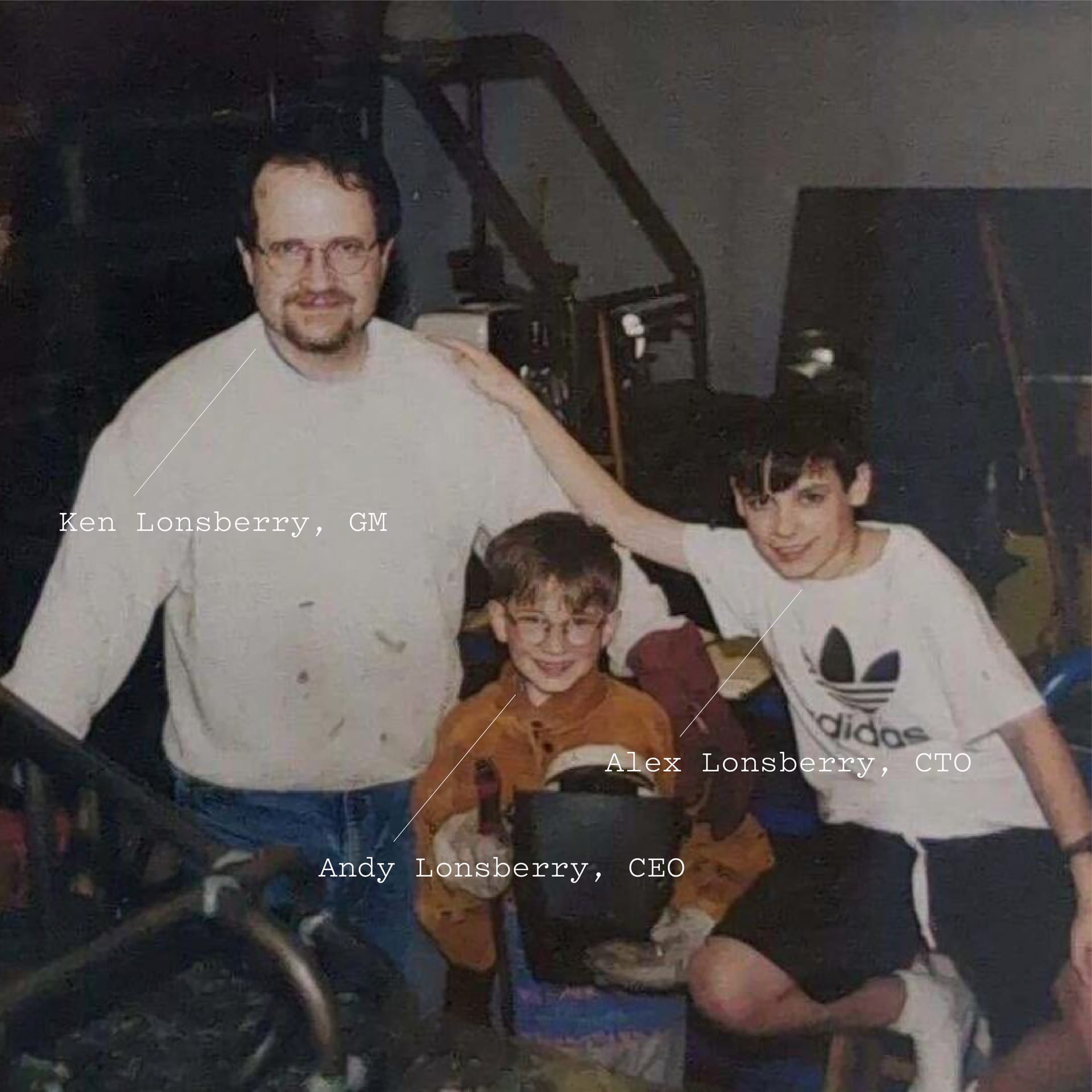
Before Andrew Lonsberry built robots that could find a seam in a slab of steel, he learned that making things begins with noticing what refuses to fit. He was a boy in suburban Cleveland then, reporting on weekends to the family factory with his older brother, Alex. Their father, Ken, was a mechanical engineer. For roughly five years, the business made off-road vehicles, and the boys helped work on the systems. The place smelled of effort: metal, oil, heat, the slightly comic confidence of a machine in pieces.
Lonsberry remembers the lesson without varnish. “Manufacturing was ingrained in us from an early age,” he has said. “We liked working with our hands.” The sentence explains more than a childhood hobby. It explains why, years later, two brothers immersed in advanced robotics would reject the easy temptation to build intelligence that lived entirely on a screen. They wanted software that encountered resistance. Software with a torch.
The education of a machine
At Ohio State, Lonsberry studied mechanical engineering, but the machines that caught his imagination were beginning to behave differently. Boston Dynamics had shown that a mechanical system could appear almost animal in its balance and response. Lonsberry added programming to his education because he wanted to understand both halves of the trick: how a machine was built and how it decided what to do next.
After graduating in 2013, he continued into mechanical engineering and robotics at Case Western Reserve University. His work concentrated on learning and adaptive real-time control. Alex was there too, pursuing related research. They spent long sessions at the university’s think[box], a seven-story makerspace where equations could be made to endure the indignity of becoming prototypes. The brothers have credited that space as the practical beginning of Path Robotics.
The company did not begin with welding as an article of faith. Lonsberry and his collaborators spoke with 100 manufacturers and asked what prevented them from expanding. Again and again, the answer was skilled labor. Companies could buy more equipment and accept more orders, but they could not reliably find, train and retain enough welders, fitters and assemblers to do the work.
Welding was the insolent version of the problem. Factory robots had welded for decades, but only under strict conditions. A conventional arm followed a path that someone had programmed, millimeter by millimeter, for a part that was expected to arrive in the same place and the same shape every time. Real fabrication is less obedient. Gaps widen. Surfaces reflect. Fixtures drift. A skilled welder sees the variation and quietly changes speed, angle, weave or fill.
A Cleveland-area manufacturer gave the young engineering company an almost unfair assignment: give a robot the adaptability of a human welder. The challenge turned the brothers’ research into a business. Their system would need to scan an unfamiliar part, recognize its geometry, plan a path and adjust while the weld was under way. It needed eyes, judgment and a tolerance for imperfection.
How the machine gets from steel to seam
Why Columbus mattered
Startup advice has a migratory instinct. When Path began to attract attention, people told Lonsberry to move west. He declined. Ohio already contained the things the company needed: customers who made physical products, engineers who understood the marriage of hardware and software, and a culture in which manufacturing was a present-tense occupation rather than an exhibit about the twentieth century.
Path moved from Cleveland to Columbus in 2019, partly to recruit from Ohio State. The choice also kept the company near the factory floor, where industrial technology either earns its keep or becomes a very expensive conversation piece. Path grew into a 200,000-square-foot operation in West Columbus. By 2026, it employed about 200 people, with Lonsberry describing plans for more hiring and an eventual move into Europe and Asia.
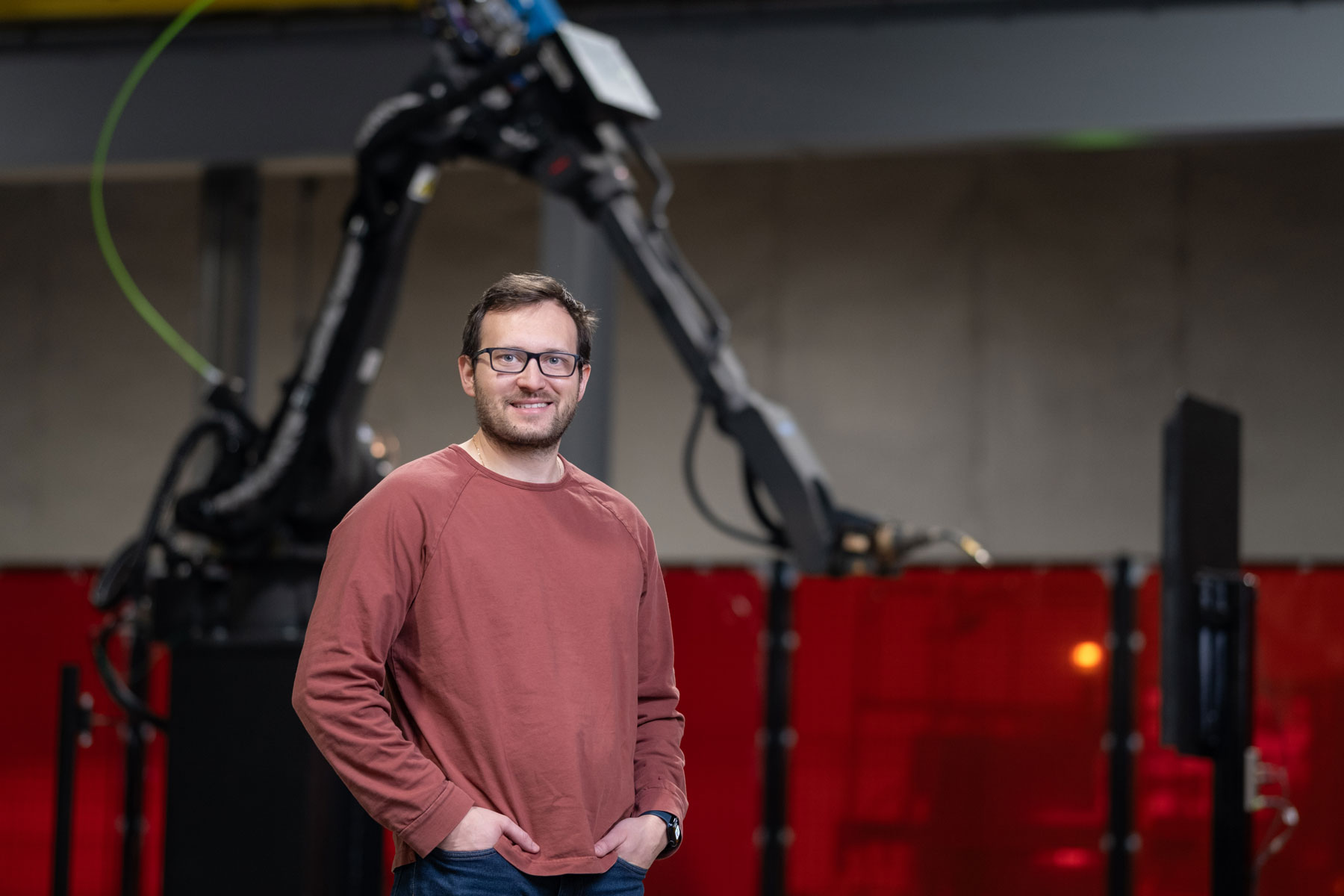
Money arrived in large tranches. Path announced a $56 million Series B in 2021, followed by another $100 million round that summer. In 2024 it closed a $100 million Series D led by Matter Venture Partners and Drive Capital. The most revealing part of the Drive relationship is that Lonsberry once told the Columbus investor to “go away.” Whatever else one might say about investor relations, this was admirably economical. Drive invested anyway and returned for later rounds.
The capital funded hardware, software and the awkward middle territory where the two must cooperate. Path built autonomous welding cells and the AF-1 fit-up system, which handles the work of positioning components before welding. Patent records name Lonsberry on inventions covering reflection-resistant sensing, autonomous assembly and machine-learning adjustments for robotic manufacturing. These are not glamorous phrases. Factories, fortunately, have little use for glamour.
Every weld leaves a lesson
Lonsberry’s most consequential idea may be that the installed fleet creates more than welds. It creates experience. Path systems operate under different lighting, in different temperatures and across different parts. Each machine collects examples that can improve a larger model. “Every single system is collecting data for us every single day,” he has said. Commercial growth and learning become intertwined: more deployments produce more varied data, which can make later deployments more capable.
That is the distinction contained in the fashionable phrase physical AI. The old automation bargain asked the factory to become predictable for the robot. The new ambition asks the robot to become more perceptive about the factory. This does not make steel agreeable. It gives the machine a better chance of coping when steel behaves like steel.
In April 2026, Path introduced Rove, pairing its Obsidian welding model with a quadruped robot. The design reverses the usual geometry of industrial automation. Instead of bringing a large workpiece to a fixed cell, the machine can travel to the work. That matters for ships, infrastructure and components so large that “just put it on the line” sounds less like a plan than a prank.
The shipyard soon became Path’s largest public test. Path joined HII and GrayMatter Robotics in the High-Yield Production Robotics program, known as HYPR. In August 2026, HII announced seven-year, performance-based agreements worth up to $900 million across the two robotics companies. Path’s portion exceeds $600 million, provided the technology and manufacturing milestones are met. The proposed work extends beyond welding into assembly and other fabrication processes for naval ships.
The caveat matters. This is a conditional production program, not a trophy already placed on the shelf. Shipbuilding combines huge structures, strict standards, low-volume complexity and limited room for error. If adaptive robots can become useful there, the argument for assembly, grinding, painting, inspection and packaging elsewhere becomes easier to make. Lonsberry has named all of those as territory the company may eventually enter.
The stubborn future
Lonsberry’s career has a pleasing circularity. A child learns to weld in a family workshop. A student becomes fascinated by machines that can control themselves. A founder returns to the labor problem that family manufacturers discussed at the dinner table. Then the company grows large enough to attempt work on ships.
The circle is not neat, because manufacturing is not neat. Path has spent roughly a decade designing sensors, training models, supporting equipment and discovering the many ways a production environment can embarrass a laboratory assumption. That persistence is more characteristic of Lonsberry than any theatrical founder mythology. He chose a hard trade, stayed near the people who practiced it and kept working when the gaps varied by a few millimeters.
The larger aspiration is abundant skilled capacity: machines that can help factories produce more when people with the required training are scarce. Lonsberry talks about complementing workers and widening what a plant can make. The measure will be prosaic and exacting. Does the weld hold? Can the system repeat its success on a different part? Does the next robot learn faster because the previous one worked the night shift in another time zone?
For all the talk of intelligence, the story returns to the oldest manufacturing virtue: attention. A good maker sees what the material is doing and responds. Andrew Lonsberry has built Path Robotics around the possibility that a machine can learn that habit too.