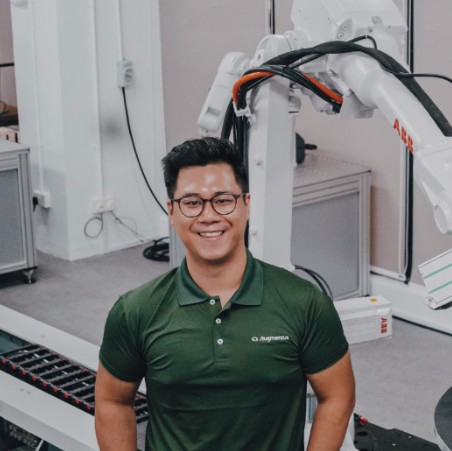
A repair-shop kid who set out to fix the factory floor
Most factories buy robots and then barely use them. Daryl Lim looked at that waste and built a company around closing the gap.
Daryl Lim built his first computer at twelve. By his teens he was running Infofix, a phone and PC repair business that he grew into a computing distribution venture. Before most of his peers finished university he had co-founded Edge Neo, a hardware distributor, and Illuminate Singapore, a social enterprise teaching communication skills. The pattern was set early: spot a friction point, build something that removes it.
The friction that became Augmentus showed up while Lim and his co-founders worked on aerospace automation projects tied to Singapore's research agency. Factories had spent fortunes on industrial robot arms, yet the machines sat idle for hours whenever a new part came through, waiting for a specialist to reprogram them by hand. Lim calls it a billion-dollar paradox: the hardware was capable, the software was the bottleneck.
In 2019, after meeting Chong Voon Foo and Leong Yong Shin at a hackathon, he co-founded Augmentus to attack that bottleneck directly. The idea was deceptively simple. Instead of writing code or building CAD models, an operator scans a physical part in 3D. Software reads the scan, generates the robot's toolpath automatically, and the machine goes to work — sanding, welding, spraying or finishing surfaces. Scan, plan, run.
Lim likes to reach for a web-design analogy. Building a website once meant hand-writing HTML and CSS; then Wix and Webflow arrived and anyone could do it. Augmentus, he argues, is that shift for robotics. The target user is not a robotics engineer but a process operator on the floor, working from an iPad and a sensor camera rather than a programming manual.
The approach found customers quickly. Augmentus lists manufacturers including Hyundai, Johnson & Johnson, Procter & Gamble, Fujitsu and Applied Materials among its users, with more than fifty systems deployed across six or seven countries. The platform speaks to a fleet of robot brands — ABB, FANUC, KUKA, Universal Robots, Kawasaki and others — so a factory is not locked into one vendor.
Recognition followed the traction. In 2022 Lim was named to the Forbes 30 Under 30 Asia list in the Industry, Manufacturing and Energy category. Augmentus had already taken GOLD at Singapore's National Youth Entrepreneurship Awards in 2021, and added a TechBlazer Silver Award in 2023. Along the way the company opened an Austin experience center and, in a notable strategic move, relocated its headquarters from Singapore to Pflugerville, in the Texas manufacturing belt.
The relocation reflects Lim's read on where the demand is heading. He talks often about reshoring — the return of manufacturing to developed economies — and argues it only works if automation carries the load. His favorite illustration: a paint shop that once needed twenty painters could instead run with five people, each overseeing four robots. Same output, fewer bottlenecks, and a job that looks more like supervision than manual labor.
In July 2025, Augmentus raised roughly $11 million in a round led by Woori Venture Partners, with Singapore's EDBI joining and earlier backers Sierra Ventures and Cocoon Capital returning. Lim framed the money as fuel for two things: clearing a growing backlog of deployments, and pushing research into what he calls hyper-adaptive robotics — machines that perceive and respond on the fly in chaotic, high-mix environments where no two parts are alike.
That phrase captures where his ambition points. Lim's stated vision is a fully autonomous plant overseen by one or two operators, with Augmentus acting as, in his words, the eyes and the brain of the robots. He is careful to frame it as democratization rather than displacement: automation, he insists, should not be reserved for elite manufacturers.
Only about 20 per cent of manufacturers use robots. This is surprising, since nearly every manufacturing process can be automated.
— Daryl LimFunding, round by round
Augmentus capital raised
Approximate, by disclosed round · USD
Backers: Woori VP, EDBI, Sierra Ventures, Cocoon Capital.
What "scan, plan, run" replaces
The old way of deploying a robot for a new part meant a specialist, a CAD model and hours of downtime. Augmentus collapses it into three operator-led steps:
1. Scan — capture the physical part in 3D with a sensor camera.
2. Plan — software auto-generates the toolpath, no coding.
3. Run — the robot executes and adapts, across 10+ brands.
From Infofix to Austin
Builds first computer at 12; founds Infofix, a phone and PC repair business, later a computing distributor.
Co-founds Edge Neo (hardware distribution) and Illuminate Singapore (social enterprise).
Co-founds Augmentus after a hackathon, aiming at the pain of manual robot programming.
Wins GOLD at the National Youth Entrepreneurship Awards; raises seed funding.
Named to Forbes 30 Under 30 Asia, Industry, Manufacturing & Energy.
Raises $5M Series A led by Sierra Ventures; opens Austin experience center; wins TechBlazer Silver.
Raises ~$11M led by Woori VP with EDBI; scales US operations from Pflugerville, Texas.
Daryl Lim, on the record
“We're just a bunch of engineers trying to change the world.”
“We're like the no-code platforms for robotics.”
“Augmentus essentially becomes the eyes and the brain of robotic automation.”
“Automation shouldn't be reserved for elite manufacturers.”
“Imagine having only one or two operators overseeing the plant.”
“Automation is the only way to make reshoring feasible.”
Daryl Lim on video
Five things to know
Built his first computer at age 12.
Ran a phone and PC repair shop as a teenager before robotics.
His platform speaks to ABB, FANUC, KUKA, Universal Robots and more.
All an operator needs is an iPad and a sensor camera.
Moved the company's HQ from Singapore to the Austin, Texas area.