A robot has located the connector. It has planned the movement. It has reached the port. Then a loose cable gets in the way. In Intrinsic’s 2026 AI for Industry Challenge, one team’s sophisticated insertion strategy ran into precisely this undignified problem. Another solution cleared the route by gently flinging the cable aside. The machine needed a little housekeeping before it could demonstrate its intelligence.
- The problem: changing a robot’s job can demand expensive specialist work.
- The product: Flowstate combines workcell design, reusable skills, simulation and deployment.
- The buyers: integrators and manufacturers building inspection, machine-tending and assembly systems.
- The latest turn: Intrinsic joined Google, then opened foundational tools through Intrinsic Core.
That cable is a useful introduction to Intrinsic, the industrial robotics software group now inside Google. Its business concerns everything between a promising machine and a dependable application: seeing a part, planning a grasp, avoiding an obstacle, applying the right force and recovering when something goes wrong. A factory buys the finished performance. Someone has to assemble the repertoire.
The robot’s expensive education
When Intrinsic emerged from Alphabet’s X in July 2021, it had spent roughly five and a half years developing its technology. The founding argument was economic as much as technical. Industrial robots could perform impressive work, but teaching them remained a bespoke occupation. Intrinsic described specialists spending hundreds of hours hard-coding particular tasks. Change the product, and much of that effort might need doing again.
In an early experiment, the team reported training a robot to make a USB connection in two hours. That was a company-reported demonstration, rather than a promise about every future installation. Still, it identified a tempting target: the labor required to make capable hardware useful. The purchase price of the arm is only one entry in the ledger.
Wendy Tan White, Intrinsic’s founding CEO, had previously co-founded Moonfruit, a website builder. The resemblance is interesting. Both projects ask how much expertise a person must acquire before making a tool do something valuable. In December 2022, she wrote, “We want to make programming intelligent robotic solutions as simple as standing up a website or mobile application.” A robot, of course, has more opportunities to collide with the furniture.

Expertise came partly through acquisitions. Intrinsic announced a deal for Vicarious’s business in April 2022, followed by Open Robotics’ commercial businesses that December. The latter distinction matters: the nonprofit Open Source Robotics Foundation remained separate, stewarding open tools including ROS and Gazebo. A commercial team changed employers; the community’s software did not become a private possession.
Expansion was followed by a setback. In January 2023, Intrinsic cut about 40 jobs, roughly a fifth of its workforce at the time, according to contemporary reporting. Flowstate arrived four months later. The chronology is a reminder that even an Alphabet-backed robotics business has to turn research into a product under financial constraints.
A browser, a twin, a real machine
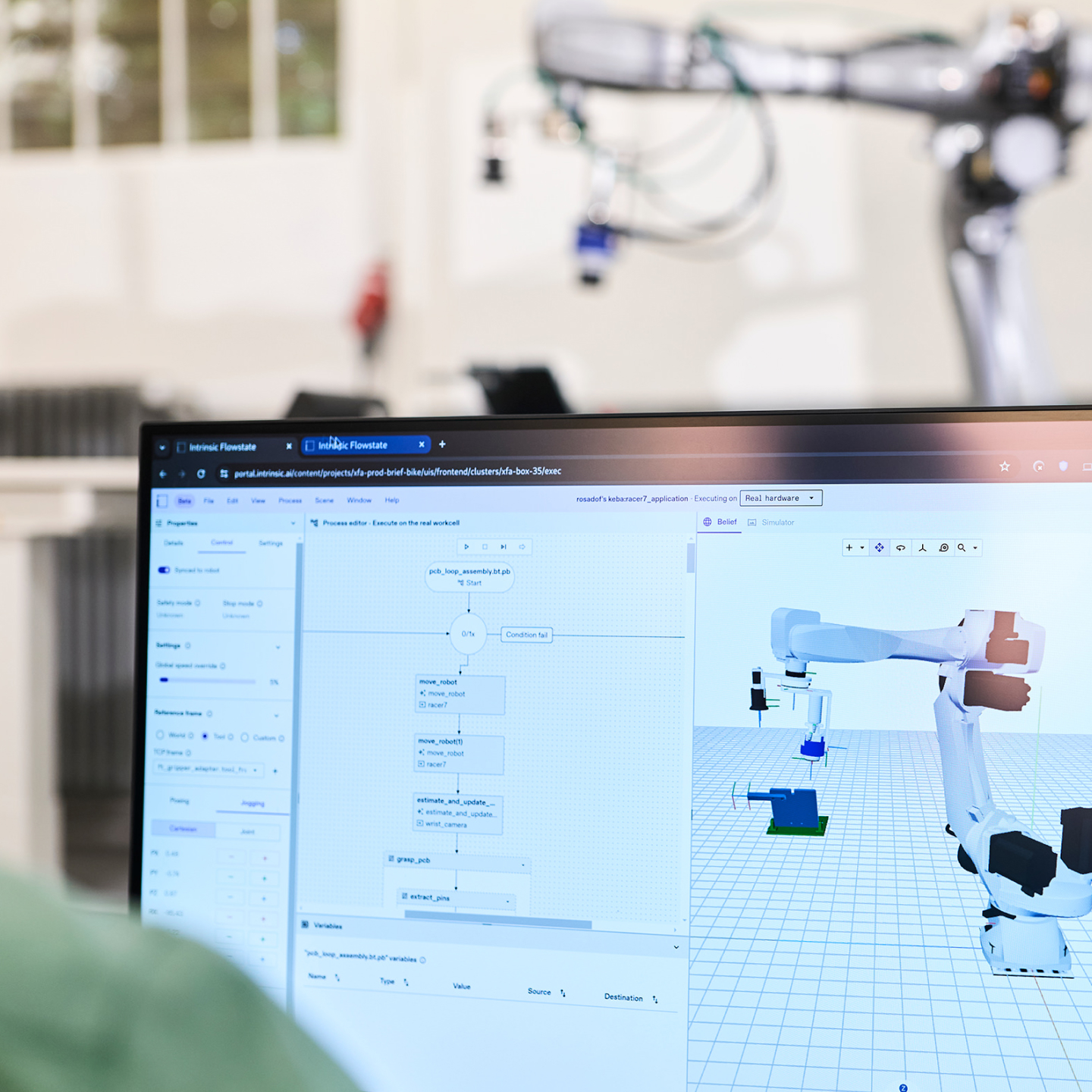
Flowstate is the front door: a web-based environment for designing robotic applications. A developer lays out a digital version of the workcell, including supported robots, sensors and equipment. Skills are arranged into behavior trees, a way of expressing what should happen next, under which conditions, and how the process should respond to a failure.
The useful abstraction is the skill. Instead of rebuilding every operation, a solution builder combines capabilities such as perception, motion planning and sensor-based control. Perception identifies where a part is. Planning proposes a route. Force or distance feedback helps the machine adjust while moving. A graphical editor makes those relationships easier to inspect; it does not abolish the engineering inside them.
- 01ModelLay out the workcell
- 02ComposeConnect robotic skills
- 03RehearseTest the digital twin
- 04ValidateRun on real hardware
Underneath sits IntrinsicOS, a Linux-based environment that runs containerized applications using Kubernetes. An industrial PC connects the solution to robots and other shop-floor equipment. Cloud services support development, data management and remote troubleshooting. The real-time control framework handles motion and sensor feedback. This division of labor explains why calling the whole offering an AI model misses most of the work.
The early beta tested more than screen design. Intrinsic reported that more than half of participants chose to run their applications remotely on physical workcells in its labs, using a browser. It also received over 1,000 beta applications; more than 60% came from people at small or medium-sized businesses. Those are expressions of interest and participation, not a count of paying customers.
The integrator is the customer, too
Intrinsic often reaches a factory through the people who build its automation. Comau, its first announced industry partner, worked with the platform on assembling rigid components of a plug-in hybrid vehicle supermodule. The relationship put a robot manufacturer and systems integrator close to the product’s development, testing whether the software could address industrial tasks.
At Automatica 2025, NEWSTON Automated Solutions demonstrated an optical-inspection application for Bürkert Fluid Control Systems. The problem was variation: Bürkert manufactures a wide range of differently shaped products, while inspection had involved scanning individual parts by hand. The Intrinsic-based system used robot-guided sensing and adapted to the part’s position. The appeal lies in avoiding a separate fixed robot program for every arrangement.
Machine tending offers another entry point. Trinity Robotics Automation and MartinSystems have worked with Intrinsic on systems that pick and place changing workpieces around CNC machines. For a shop running varied jobs, setup effort can determine whether automation is worth buying. The software must make the next part manageable, as well as move the current one.
“what once took weeks now happens in days.”
Derek Goodwin, Trinity Robotics Automation, on development and integration, May 2025
Goodwin’s statement is a partner’s account, not a controlled benchmark. Its significance is the unit of improvement: development time. Intrinsic sells to solution builders who must deliver working systems economically, then support the operators using them. Better integration can matter before any robot moves faster.
Open foundations, paid services
In September 2026, Intrinsic released Core, an open-source toolkit under the Apache 2.0 license. It supplies a local runtime and ROS-compatible building blocks, including control, planning, perception and simulation. An accompanying Open Machine Tending Solution gives developers a reference application to adapt. This is a concrete route into the technology for teams with some robotics proficiency.
The commercial business sits alongside that opening. Intrinsic’s published platform terms describe recurring subscriptions, usage allowances, possible overage fees and separately ordered deployment services. Its enterprise offerings include Flowstate, advanced AI models and cloud services. Open-source availability removes a software-license barrier for Core; it does not pay for an arm, camera, gripper, integration or commissioning.
Software + hardware + integration + commissioning
Evaluate the whole installed application, including changeovers and ongoing support. A free toolkit is one line in the budget.
The alternatives include a robot maker’s own programming environment or a custom stack assembled from ROS 2, Gazebo and specialist software. Intrinsic’s proposition is to connect more of the development and operating process, with reusable capabilities across supported equipment. The market is untidy: robot makers, open-source tools and integrators can be both alternatives and collaborators.
Google moves closer to the factory
On February 25, 2026, Intrinsic announced that it had joined Google as a distinct group. Its stated plan was to continue developing the platform while working closely with Google DeepMind and using Gemini models and Google Cloud. The move brought a deployment business closer to the AI research and infrastructure already contributing to its work.
Other connections remain important. NVIDIA and Intrinsic have integrated foundation-model grasping and previewed a connection between Flowstate’s digital twin and Omniverse. In May 2026, Intrinsic announced expanded support for FANUC robots, including collaborative CRX models. These relationships concern making existing industrial equipment and software work together, a substantial undertaking in its own right.
Foxconn supplies a larger manufacturing test. The companies launched a US-based joint venture in November 2025, targeting electronics assembly, inspection, machine tending and logistics. The stated objective is to move beyond product-specific automation that requires substantial re-engineering when designs change. In June 2026, Intrinsic previewed its Intelligence Cell and said a customized electronics-assembly version would be piloted in Foxconn facilities later that year. A planned pilot should be read as a planned pilot.
Start with the next part
The cable challenge supplies a practical lesson. Teams found that contact physics and flexible objects transferred poorly from simulation. Successful approaches often combined AI perception with explicit, sensor-guided insertion logic. The useful question became which method suited each operation, rather than whether an entire application could carry an AI label.
For a manufacturer considering Intrinsic, start with one variable task: a changed workpiece, a different part position, an awkward insertion. Model the workcell, combine skills, then validate with physical equipment and realistic interruptions. Check hardware support and measure setup time, recovery behavior and total installed cost. An unchanging, high-volume task may already be served well by established automation; a variable task earns the more interesting investigation.
Intrinsic’s opportunity is to make that investigation less expensive and less bespoke. Its tools can give solution builders more of the machinery they otherwise assemble themselves. Whether the resulting application is worth buying depends on the shop, the task and the integration. Somewhere near the end of the evaluation, a real cable will offer its opinion.
See the tools in motion
Explore Intrinsic, Flowstate and Intrinsic Core on GitHub. Follow the company on LinkedIn and X, or browse its product news and company blog.
Watch the Flowstate product keynote More demonstrations on Intrinsic’s channel