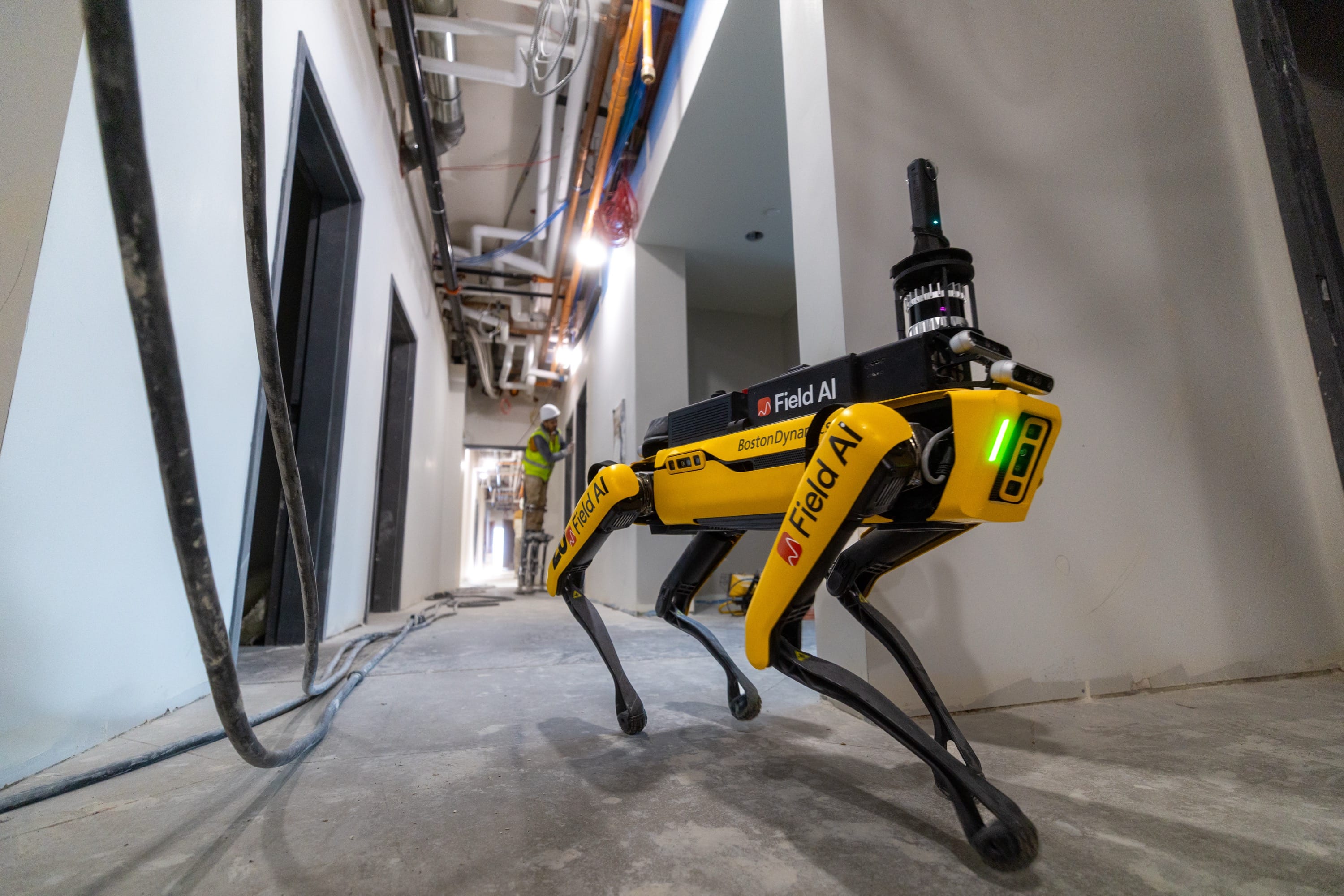
The revealing detail in Big-D Construction’s account of FieldAI is a walk. Superintendent Bronson Dupaix described spending five hours on job walks with cameras, scanners and other sensors. A construction site needs a record of itself: what has been built, what is missing, what might hurt someone. Obtaining that record can consume the people who are supposed to act on it.
Now give the camera legs. The machine has to cope with unfinished rooms, moving equipment and routes that change between visits. A floor plan is helpful until the floor acquires a pallet. The interesting question is how much human work remains after the robot arrives.
- FieldAI sells autonomy: an intelligence layer for different robot bodies, with industrial work as its proving ground.
- Construction is the test: DPR and Big-D use robots for site data and documentation.
- Caution is part of the design: the models account for uncertainty and can choose a slower, more conservative route.
- The business grows through deployment: useful site work leads to more robots, more data and wider contracts.
01 The five-hour walk
Big-D executive Shaun Orr’s turning point came when he saw a robot walking a project with its schedule and model attached, identifying missing work and safety issues and relating them to existing project information. The attraction was the connection between observation and action. A photograph is considerably more useful when someone knows what ought to be in it.
“Seeing it in a way that we just couldn’t see it.”Shaun Orr / Big-D Construction
FieldAI’s April 2026 account describes more than two years of collaboration and feedback. Positive reactions from project teams helped persuade Big-D to invest further. One superintendent asked when the robot could join his next job. That is a pleasingly unglamorous adoption test: would the person who has to live with the machine request another visit?
02 A cave is a demanding classroom
FieldAI was founded in 2023, but its instincts were formed earlier. Ali Agha, its co-founder and CEO, worked at MIT and Qualcomm before seven years at NASA’s Jet Propulsion Laboratory. His projects included cave exploration, off-road vehicles and coordinated autonomy for a prototype Mars helicopter and rover. These were assignments where the operator could not assume a tidy map or dependable communications.
The company traces its research lineage through NASA’s BRAILLE work in terrestrial lava tubes, used as analogues for planetary caves. Agha led Team CoSTAR to victory in the 2020 Urban Circuit of the DARPA Subterranean Challenge. The team brought together machines with legs, wheels and wings. Later came DARPA RACER, applying autonomy to larger vehicles on difficult off-road terrain.
Those milestones belong to the team’s pre-company research. They explain the choice of commercial problem. Construction looks ordinary beside planetary exploration, until you consider what a machine must understand in a half-built room. The team had practiced in places where preparing the entire environment was an unreasonable demand.
Shayegan Omidshafiei leads FieldAI’s science work after years at Google and DeepMind. David Fan brings experience as a chief technologist and engineer on DARPA autonomy programs. FieldAI’s public team material combines theoretical mathematics, machine learning and field deployment. The combination matters: a mathematically elegant policy still has to survive an awkward staircase.

03 A robot with permission to hesitate
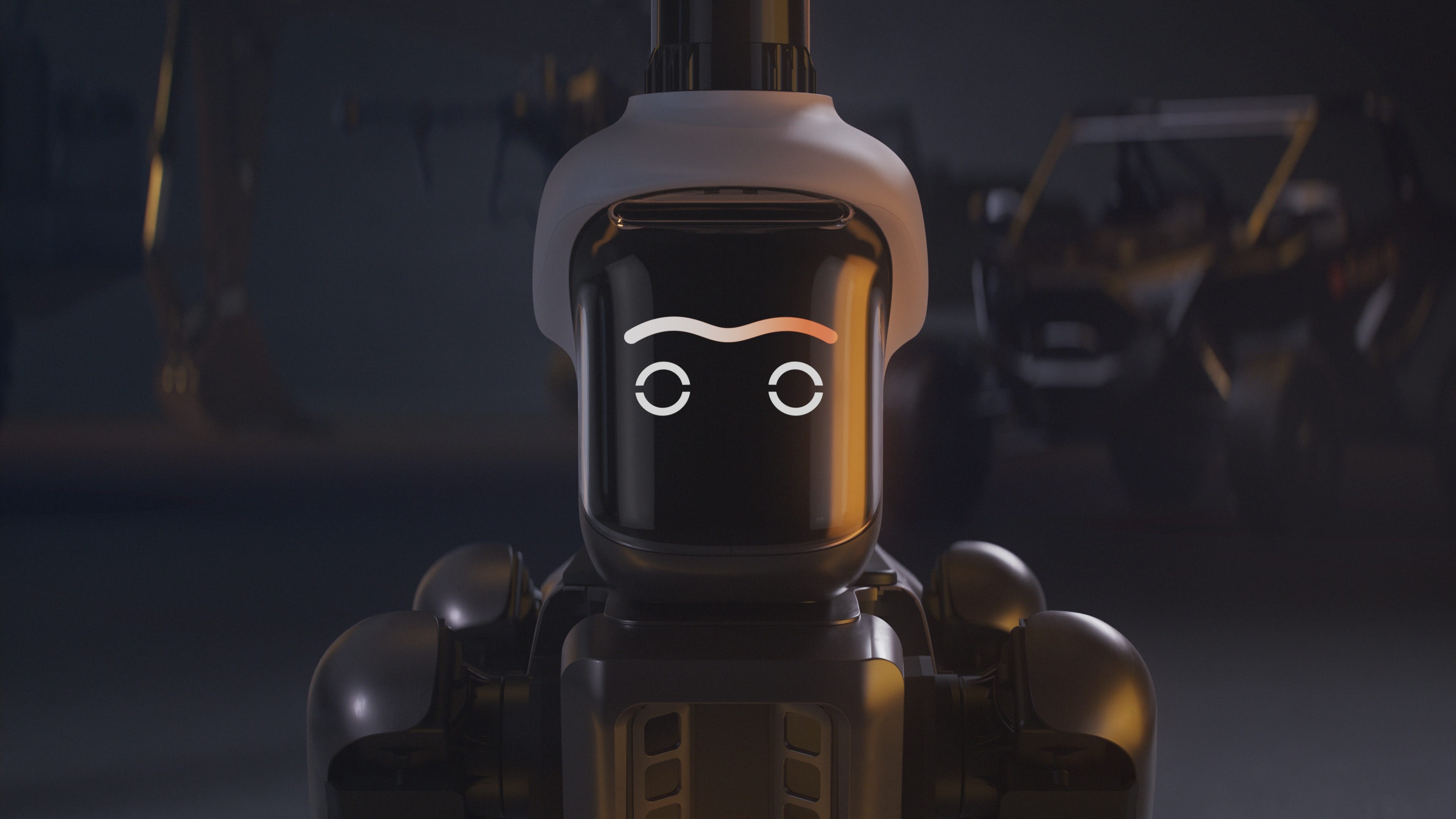
FieldAI’s core technology is its Field Foundation Models, or FFMs. The company describes them as physics-first models combining data-driven learning with reasoning about physical constraints, risk and uncertainty. Its website presents EDGE as a general-purpose robot brain, with a Belief World Model as the predictive engine.
In plain English, the machine needs an estimate of what is happening and how sure it should be. FieldAI’s technical account describes unfamiliar conditions prompting a robot to slow down or take a more conservative path. That creates a tradeoff: extra caution reduces throughput. The company uses reconstructed environments to help test those situations and improve efficiency.
Conceptual illustration of the company’s approach, not a published model architecture.
The operating promise is autonomy without prior maps, GPS or predefined routes. Processing can happen on the robot, which is useful underground or where a cloud connection is unreliable. “Without prior maps” does not mean the robot has no spatial understanding. It means the customer need not supply a finished representation of the place before work begins.
Hardware still sets limits. Software cannot make a machine physically fit through a passage, carry more than its payload allows or inspect something its sensors cannot detect. For a buyer, the sensible question is which combination of body, sensors and autonomy fits the actual mission.
04 The camera grows legs
DPR Construction supplies a more concrete picture of the work. FieldAI’s November 2025 case study describes engineers previously walking a data center project with cameras. With the robotic system, they set a mission through a dashboard and let the machine collect the record.
During one deployment phase, the company reports more than 45,000 photographs, more than 100 miles walked, four floors mapped, 125,000 square feet of roofing documented and 500,000 square feet of interiors scanned. Those numbers describe coverage, not a promise that every photograph found a problem. They show how a repetitive duty can become a regular machine assignment.
One DPR deployment phase, as reported by FieldAI. These are cumulative activity figures.
In their March 2026 partnership announcement, Boston Dynamics and FieldAI report more than 90% less inspection and documentation time compared with manual processes. That is a company-reported outcome for those tasks, rather than a 90% reduction in the cost of a building. Catching deviations earlier can avoid rework; collecting more images alone cannot guarantee that result.
The customer lesson is easy to copy. Begin with a recurring task whose time and output can be measured. Feed the results into tools the team already uses. Ask whether people act on the information. Expand when the workflow improves and the crew wants the machine back.
05 Every walk leaves a second asset
A robot’s journey also produces data about the place it traverses. FieldAI’s NVIDIA collaboration uses operational sensor information to build digital twins: interactive three-dimensional representations of customer sites. A routine inspection can contribute to a model used for visibility, planning and analysis.
FieldAI describes using NVIDIA Omniverse NuRec for reconstruction, Isaac Sim for testing, Isaac Lab for training and OSMO to coordinate workflows. The appeal is that field data can become a simulation environment without commissioning an entirely separate scanning exercise. The same difficult workplace that challenges the robot supplies material for testing it.
This gives construction a second attraction. A changing site repeatedly offers new conditions. FieldAI’s bet is that doing paid work in these environments can improve its models and expand the usefulness of the data delivered to customers. Whether that advantage persists depends on the quality of the collected information and the improvements it actually produces.
06 The price of getting useful work done
FieldAI disclosed $405 million raised across two consecutive rounds in August 2025. Its announced investors included Bezos Expeditions, Canaan, Khosla Ventures, Intel Capital, NVentures, Prysm and Temasek, among others. Reporting put the financing valuation at $2 billion. Venture capital pays for the company’s expansion; it does not establish what a contractor should pay for a deployment.
The commercial offering is enterprise autonomy software and deployment work on third-party machines. Public customer accounts show pilots turning into wider relationships. Assessing a purchase means adding hardware, integration, operation and support to the software bill, then comparing that total with saved labor and useful discoveries. A robot that spends its shift gathering ignored data is an expensive archivist.
FieldAI occupies the intelligence layer of robotics, alongside companies pursuing general-purpose robot brains such as Skild AI. Hardware independence is therefore a competitive ambition shared by others. FieldAI’s distinctive case rests on uncertainty-aware autonomy and its industrial deployment record. Boston Dynamics is a partner here, supplying Spot and its own software capabilities.
A fixed, well-controlled workflow may already suit conventional automation. A robot facing inadequate sensing, inaccessible terrain or tasks beyond its physical capabilities still needs another solution. The practical standard is successful work under specified conditions. A broadly advertised brain deserves a narrowly measured pilot.
07 Caterpillar enters the picture
In September 2026, Caterpillar announced a collaboration with FieldAI covering autonomous inspections, digital twins, situational awareness and operational optimization. The announcement names early applications in jobsites and manufacturing. It extends the relationship between mobile observation and industrial decision-making without pretending every heavy machine has suddenly become autonomous.
FieldAI’s wider market includes energy, mining, urban operations and federal applications. The company and Boston Dynamics describe deployments across Asia, Europe and North America. Its opportunity is wherever obtaining a timely picture of a changing, difficult workplace costs people too much time or exposure.
The five-hour walk remains a useful place to begin. Before admiring the robot, count the hours spent collecting information. After deploying it, see whether the information arrives sooner and leads to a better decision. The floor plan will change again tomorrow. The purchase order should survive that fact.