The first robot Ali Agha remembers building followed a line. Later came little soccer machines that chased an orange ball. The task sounds modest, and that is part of its charm: give a machine a rule, give it a field, then watch the field refuse to behave quite as expected. Agha kept building. By the time he was working on rescue robots with tracks and flippers, the line had disappeared entirely. The terrain was uneven; the machine had to work out where it was and how to move safely through it.
That progression, which Agha described in a founder interview, explains more about his career than a list of employers can. He liked mathematics and tinkering as a child, including batteries, motors and toys that could do a little on their own. Robotics let him combine that curiosity with a harder question: how much can a machine know about a place it has never seen? As the robots grew more capable, he found that the answer demanded better mathematics and more honest assumptions about the world.
He eventually carried the question through a doctorate at Texas A&M, postdoctoral work at MIT, research at Qualcomm and seven years at NASA's Jet Propulsion Laboratory. Now he is co-founder and CEO of FieldAI, an Irvine company selling autonomy software for machines that work amid changing construction, industrial and security environments. The scenery has shifted from a soccer field to a building site. The uncertainty has stayed.
The orange ball was an early warning
Agha's undergraduate thesis at the University of Tabriz concerned small RoboCup soccer robots. His master's work at K. N. Toosi University of Technology moved toward sensor fusion and mapping. He has recalled a rescue robot team winning a mobility award at a RoboCup competition in Atlanta around 2006 or 2007. Those machines could scramble over difficult ground, yet they made visible a deeper problem. Moving a robot was only one part of the work. It also had to estimate its position, interpret imperfect sensor readings and choose an action with consequences.
So he went to Texas A&M to study computer science and engineering. His 2013 dissertation dealt with robot motion planning under uncertain movement and noisy measurements. In a later interview, Agha said he took an unusual number of mathematics courses for a robotics researcher. The appeal was practical. A neat model can assume friendly noise and predictable motion; a real machine meets friction, dust, bad light and the occasional missing landmark. If the robot's confidence is fiction, its next move may be fiction too.
At MIT, Agha's work expanded from the decisions of one machine to the coordination of several. There he met Shayegan Omidshafiei, who would become a FieldAI co-founder and lead its science work. Different machines have different strengths: a wheeled rover covers ground efficiently, a legged one can climb, and an aircraft can look ahead. Making them cooperate in an unfamiliar place is a more interesting problem than making each one look clever in isolation.
A secret helicopter and an underground contest
The next stop was Qualcomm Research, where Agha worked on autonomy for small, low-power processors. He recalls NASA approaching the team about a helicopter intended for Mars, then still a secret project. Weight and power mattered acutely for flight in the planet's thin atmosphere, and Qualcomm's Snapdragon processor was under consideration. The encounter introduced a robotics problem with unusually strict limits: a machine far away from its operators would have to make useful decisions with little energy and little room for error.
At JPL, Agha became a robotics technologist and group leader. His projects included the DARPA RACER program for off-road autonomous vehicles, Mars cave exploration and work on coordination between a prototype Mars helicopter and rover. The most public proving ground was the DARPA Subterranean Challenge. Teams sent robots into tunnels, underground urban spaces and caves to explore, build maps and locate objects. Radio links were limited. The robots could not count on a tidy route waiting ahead.
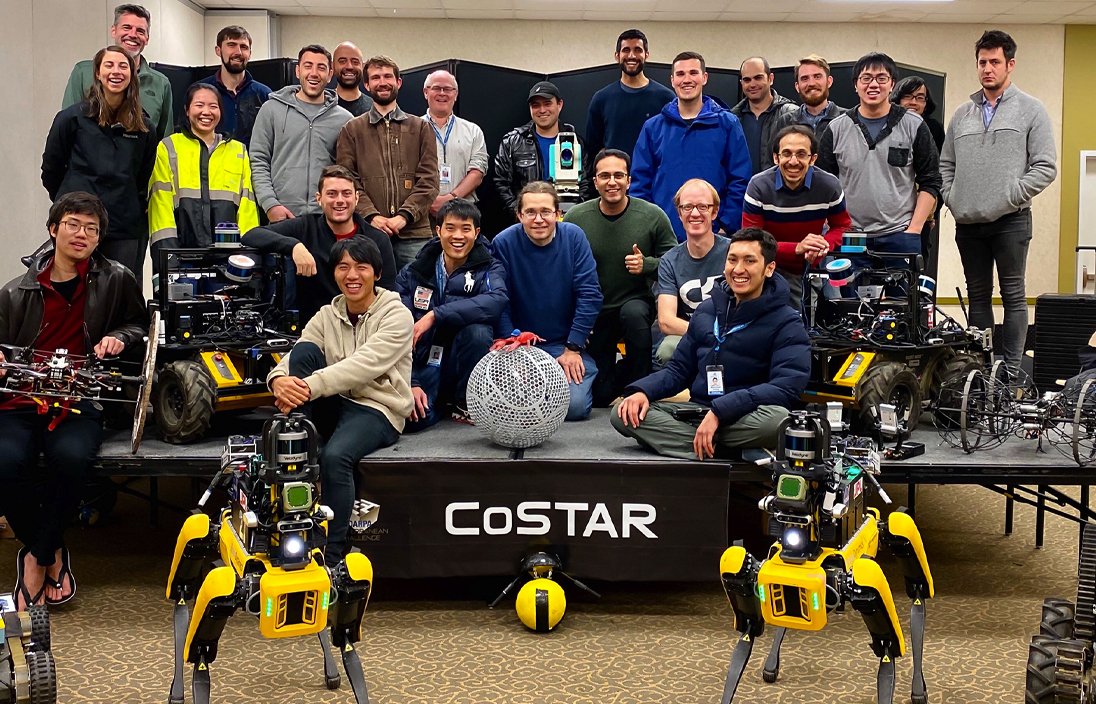
Agha led Team CoSTAR, a collaboration that included JPL, Caltech, MIT and other institutions. The team placed second in the 2019 Tunnel Circuit and won the 2020 Urban Circuit at an unfinished power plant in Washington state. Their fleet used different forms of movement, including legged, wheeled and flying machines. The contest's search-and-rescue setup gave the work an immediate human purpose, while its difficult communications and unknown geometry echoed the demands of planetary exploration.
“Our focus in SubT is not the competition.”Ali Agha, speaking during the DARPA challenge
He saw the contest as a way to speed up autonomy research for future exploration. The engineering lesson was just as portable. A robot sent into a cave cannot ask for a fresh floor plan every time the route forks. A robot on an active construction site faces its own version of the problem, only with more people, equipment and daily changes. Agha's phrase for the difficulty is plain: in the real world, everything soon becomes “off-nominal.”
The world changes between shifts
FieldAI was founded in 2023, when robot hardware, onboard computing and AI models had advanced far enough for Agha and his colleagues to pursue a broad software layer. The company's ambition is a shared “brain” that can work across types of robots and tasks. Its Field Foundation Models combine learned behavior with calculations about physics, risk and uncertainty. Agha argues that a machine should have some sense of how confident it is before acting, particularly when people and heavy equipment are nearby.
The company's choice of workplace reveals the test. Construction sites are not designed to flatter robots. Walls appear, access routes move, light changes, and a space that was clear yesterday can hold equipment today. FieldAI says its systems can navigate without prior maps, GPS or predefined paths and can process decisions on the robot without relying on a cloud connection. That combination matters when a machine is sent to inspect a new site before a human crew begins its day.
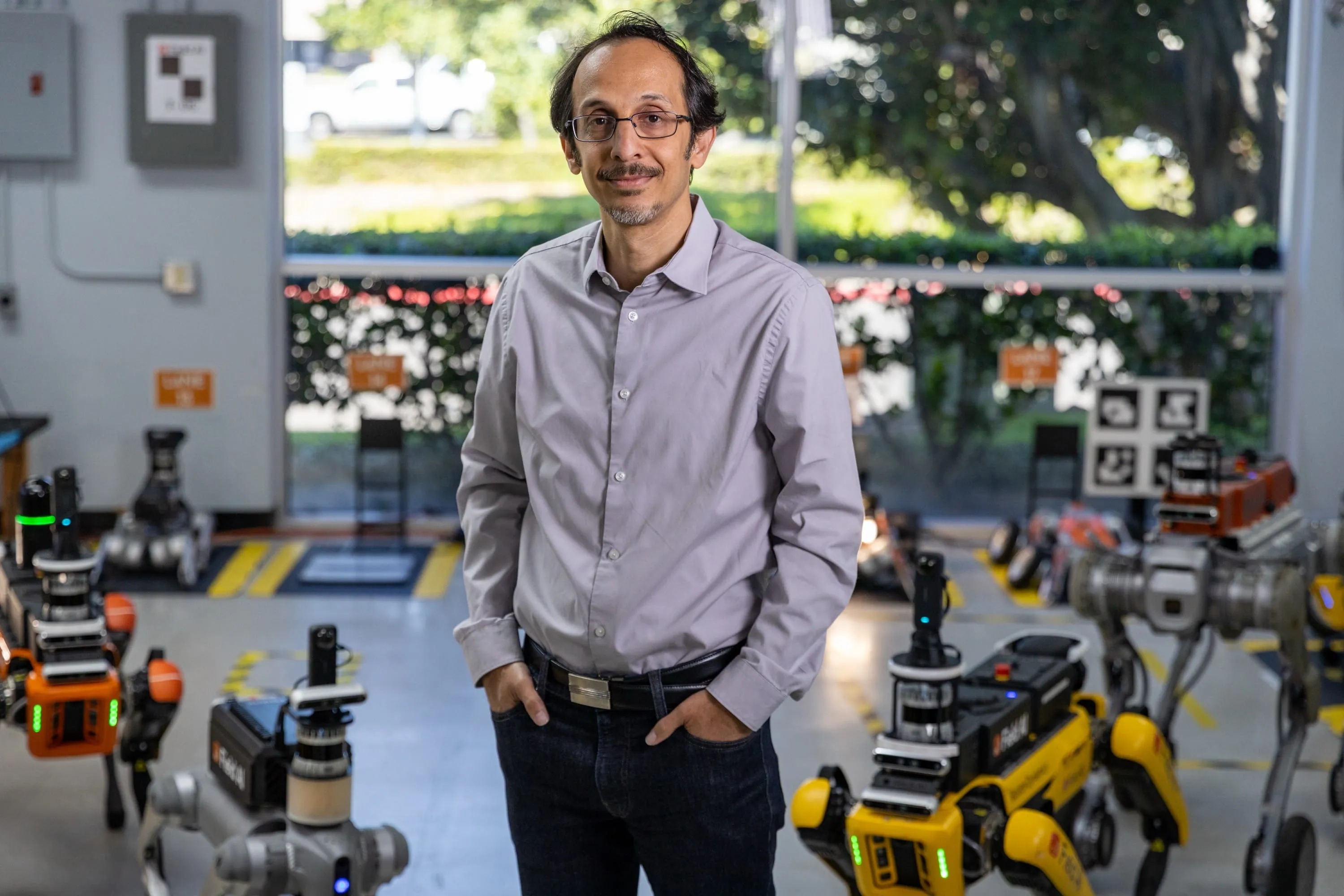
FieldAI's public account of its work with Big-D Construction shows the appeal in ordinary terms. A superintendent had been spending hours collecting site data with cameras and sensors. A robot could make a regular walk, compare observations with project information and return a clearer view of what had changed. Big-D executives described expanding use across projects. The useful result is a fresher picture of the site for the people running it. A robot's performance, in this setting, is measured by how well it fits into the day's work.
FieldAI and Boston Dynamics formalized a partnership in March 2026, bringing the company's autonomy software to Spot robots in changing construction environments. Boston Dynamics founder Marc Raibert said his team had known Agha's group since the CoSTAR win, when Spot robots were part of the underground challenge. That connection gives the partnership a satisfying continuity: the machines once explored an unfamiliar contest course; now the software is being tested against the untidy routines of commercial job sites.
Funding buys a bigger experiment
In August 2025, FieldAI announced $405 million raised across two rounds. The investors named in its announcement included Bezos Expeditions, Canaan Partners, Emerson Collective, Khosla Ventures, Temasek and NVIDIA's venture arm. The amount gives the company room to hire and expand. It also raises a straightforward expectation: the software has to keep working as fleets spread across more sites and more kinds of machines. A cave course can be reset. A customer's workday cannot be designed around a demonstration.
The partnerships have widened since. In February 2026, FieldAI and Singapore-based Certis announced plans to combine robot autonomy with security operations and human teams. Caterpillar announced a collaboration in September on inspections, digital twins and industrial operations. These agreements span different machines and businesses, which makes Agha's idea harder to prove and more meaningful if it holds up. A site camera, a legged robot and a heavy industrial machine face different problems. The shared challenge is deciding what the world is doing now, rather than what it was expected to do.
Agha is candid about a founder's other uncertainty. In one interview, he warned that a technically strong team can enjoy solving problems so much that it forgets to ask whether customers will adopt the result. He recommends an early obsession with the product and the customer. That sounds less romantic than building a Mars helicopter or sending a robot deep into a cave. It is also the discipline that determines whether field robotics becomes a repeatable service.
“When you go to the real world, everything is gonna become off-nominal very soon.”Ali Agha, Automated podcast, 2026
That sentence is the hinge of his story. The child who enjoyed motors and autonomous toys became a researcher who studied the gap between a model and the ground beneath a robot. He then became an executive trying to make that gap manageable for customers. The robots have gained better sensors, stronger processors and richer training data. The world has retained its stubborn habit of changing the route. Agha's work asks whether machines can learn to meet that habit with judgment.