6thSense Wants to Give Robots the One Thing Cameras Can’t: a Sense of Touch
Robots learned to see years ago. They still fumble a coffee mug. A four-person startup in San Francisco is strapping sensors to human hands to capture the tactile data robot hands have been missing - and selling it to everyone racing to build them.
A robot in 2026 can look at a kitchen counter and name every object on it. Ask that same robot to pick up a wet glass without either crushing it or letting it slip, and the demo gets a lot shorter. Vision, it turns out, was the easy sense. Touch is the one that keeps dexterous robots stuck in the lab - and it is the one 6thSense, a Y Combinator Summer 2026 company in San Francisco, has decided to build.
The company’s framing is disarmingly plain. Robots, they point out, have effectively been given five senses. 6thSense is building the sixth. The pitch is not that touch is a nice add-on but that it is the missing layer beneath everything a robot hand is supposed to do - gripping, folding, wiping, loading - the fine motor work that humans do without thinking and machines still botch.
01 / The ProblemThe data that doesn’t exist yet
Modern robots learn the way modern AI learns: from data. For vision, the internet handed the field a near-infinite supply of images and video. For touch, there is almost nothing. No one has been quietly recording what a human hand feels as it wrings out a dish towel or peels a banana. The pressure maps, the micro-adjustments in grip, the moment a finger senses slip and tightens - that signal is invisible and, until now, uncollected.
The obvious workaround is to generate touch data in a lab: a rig, a controlled object, a repeatable motion. 6thSense argues that this is exactly the trap. Lab conditions are too clean to teach a robot how the real world resists, deforms, and surprises. Their answer is to leave the lab entirely.
02 / The ProductA glove that pays attention
The core device is a wearable tactile rig - a data glove worn on a human hand. As a person goes about ordinary contact-rich tasks, the rig records not one signal but a synchronized stack of them: tactile pressure and contact, egocentric RGB video, RGB-D depth, 3D hand pose, motion and IMU, multiple camera viewpoints, human-written labels and commentary, and whether the attempt succeeded or failed. Eight aligned modalities, captured together, calibrated per channel.
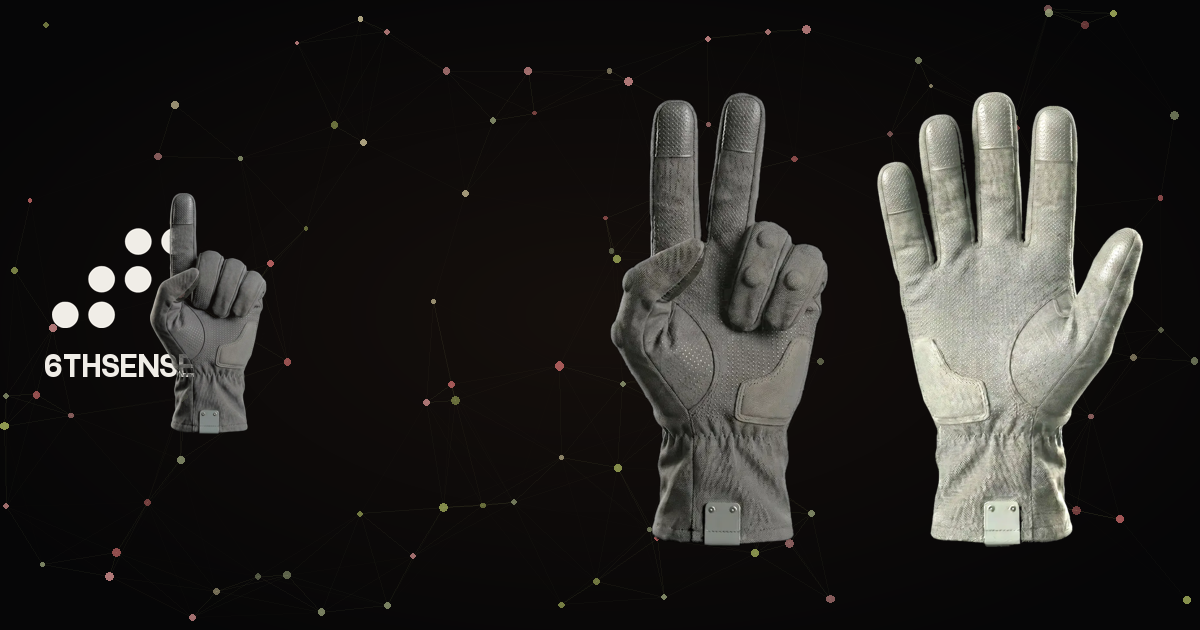
What makes the hardware more than a fancy motion-capture setup is where the signal is aimed. 6thSense designs and manufactures its sensors in-house, and every channel is built to map one-to-one onto how robotic skin needs to sense. The company also builds custom tactile skin molded to robot hands, so the data a human hand generates can transfer directly to the machine that will eventually replace it. Capture and destination are engineered as two ends of the same wire.
Eight aligned modalities, one capture
Every stream is time-synchronized and calibrated, so a robot-learning team gets meaning, not a pile of raw sensor logs.
03 / The BusinessSelling the shovels, not the gold
6thSense does not sell robots. It sells the data that robots need to become useful, and, where a customer wants it, the tactile skin to receive that data. That places the company in a familiar and durable position: supplier to a gold rush. While dozens of teams and well-funded labs compete to build the best dexterous robot hand, all of them face the same shortage of real-world touch data. 6thSense wants to be the shared answer.
The product is deliberately packaged to be, in the company’s phrase, model-ready. Rather than shipping raw sensor dumps that a customer’s ML team then has to clean, align, and interpret, 6thSense delivers pre-calibrated, synchronized datasets with documented boundaries and semantics. The buyer is a robot-learning team; the thing they buy is time.
04 / The CustomersWhat a dishwasher teaches a robot
The tasks 6thSense points at are aggressively ordinary: washing dishes, folding laundry, vacuuming, preparing a drink, loading a dishwasher. These are the chores that populate every home-robot demo reel and almost never survive contact with an actual home. They are contact-rich, meaning success depends less on seeing correctly than on feeling correctly - the difference between a fork placed and a fork dropped. By collecting demonstrations of exactly these tasks, in real settings, 6thSense is building a library aimed squarely at the manipulation problems its customers are trying to solve.
05 / The DifferenceWhy not just use a camera?
Plenty of groups collect robot-training data. Teleoperation captures a human puppeting a robot; vision-heavy pipelines record RGB and depth. Tactile hardware itself is not new - research sensors have existed for years. 6thSense’s wager is that the value sits at the intersection nobody has fully occupied: wearable capture, in real environments, of touch data that is packaged for training and hardware-matched to the robot skin that will use it.
| Approach | Real-world | True touch | Model-ready |
|---|---|---|---|
| Lab tactile rigs | Limited | Yes | Raw |
| Vision-only capture | Yes | No | Partial |
| Teleoperation logs | Yes | Thin | Varies |
| 6thSense glove | Yes | Yes | Yes |
The comparison is the company’s, and it is a bet rather than a verdict - the field is early and moving fast. But the logic is clean: if touch is the bottleneck and real-world touch data is the scarce input, then owning the best pipeline for capturing it is a defensible place to stand.
06 / The TeamRockets, Tesla, and a homemade start
6thSense was founded by James Baek, Ronak Agarwal, Alex Hyungwoo Noh, and Matt Wulff. Baek, the CEO, reaches customers at james@6thsense.dev. The founding group is hardware-heavy by design, with experience pulled from Tesla, Mecka, Samsung, DoorDash, and Amazon - a mix of people who have shipped physical robots, built data infrastructure at scale, and worked at the sensor-and-ML layer where this company lives. It is a small team building its own hardware and going out to capture its own data, which is roughly the opposite of a pure software play.
That in-house posture matters. Because 6thSense makes its own sensors rather than buying off the shelf, it can tune what it captures to what robot skin actually needs - the kind of vertical control that is hard to bolt on later.
07 / The MarketA quiet layer of physical AI
“Physical AI” has become one of the loudest phrases in technology, mostly attached to the robots themselves. 6thSense sits one layer down, in the part everyone needs and few are building: the nervous system between sensor and skill. It is not trying to win the robot race. It is trying to supply it. Backed by Y Combinator’s Summer 2026 batch and a pre-seed round of roughly $660K that includes Krew Capital, the company is early - but the gap it is aimed at is specific, and it is real. Whether robot hands ever match human ones may come down, in part, to whether someone finally bothered to record what a hand feels. 6thSense is betting the answer is worth a glove.