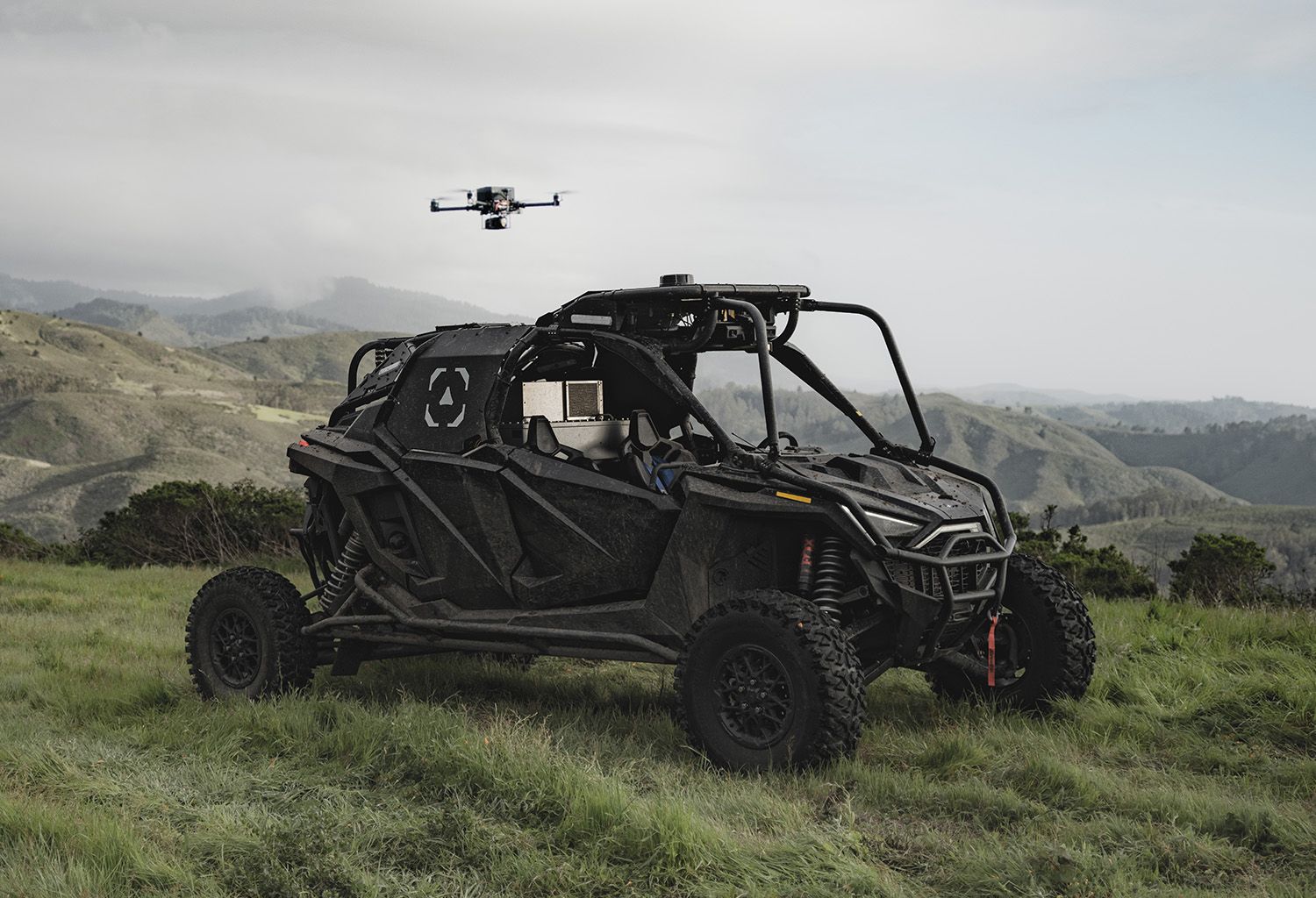
There is a useful way to think about Scout AI, which is that most of artificial intelligence has been, so far, a business of being confidently wrong at scale. A chatbot invents a citation, everyone shrugs, you regenerate. The cost of a hallucination is a mild annoyance and a wasted GPU-second. Scout AI has decided to work in the one corner of AI where that arrangement does not hold, because the model is not writing sentences - it is issuing motor commands to a physical robot, in a place with no GPS and no radio, on behalf of the U.S. military. You cannot regenerate a motor command.
The company, founded in 2024 by Colby Adcock and Collin Otis and based in Sunnyvale, calls itself a frontier AI lab for defense. Its product is a model named Fury, and the category is Vision-Language-Action, or VLA - a system that takes in what a camera sees, takes in an instruction in plain English, and outputs the actual movements a robot should make. Adcock's framing is that "the most important frontier in AI is the physical world, and it should be pursued in service to the men and women who defend this country." You can agree or disagree with the mission, but the technical claim underneath it is specific and testable, which is more than most AI marketing manages.
"The U.S. military has been promised true, one-to-many autonomy for years. Fury finally delivers it." - Collin Otis, CTO
The specific claim is one-to-many autonomy: one human, many machines. This has been the promised land of military robotics for roughly a decade, and it has mostly stayed a promise, because coordinating a fleet of drones and ground vehicles usually requires either a small army of operators or a brittle web of custom software. Scout's answer is almost cheeky in its simplicity. The robots coordinate by talking to each other in natural language - the same kind of language a human would use - and the operator commands them by voice, text, or by tapping a spot on a map. No special training. The machine was taught to speak like a person so the person would not have to learn to speak like a machine.
The engineering constraints are where it gets genuinely interesting. Fury is designed to run on minimal hardware: a single camera and a low-power inference chip, no cloud, no continuous connectivity. This is not a cost-saving detail. It is the whole point. The environments Scout is designing for are precisely the ones where the cloud is unavailable and the GPS is jammed - so an autonomy system that phones home for every decision is not an autonomy system, it is a liability with a latency problem. Fury is also hardware-agnostic, which is the second half of the strategy: Scout wants to own the brain and let everybody else build the body. It has shown reference prototypes - a ground vehicle it calls G01, an aerial one called A01 - but the vehicles are demonstrations. The model is the company.
This is a classic and often lucrative place to stand. If Fury becomes the layer that any defense robot runs, then Scout is not competing to build the best drone; it is selling the thing the drones need regardless of who builds them. It is the Android-of-defense-robots pitch, and investors have clearly heard it that way.
Own the reasoning layer. Stay hardware-agnostic. Let everyone else build the robots.
The money has arrived accordingly. Scout emerged from stealth in 2025 with a $15 million seed round and, unusually for a company that new, two Department of Defense contracts already in hand. Then, in April 2026, it announced an oversubscribed $100 million Series A, co-led by Align Ventures and Draper Associates, which the company described as the largest defense-tech Series A in U.S. history. Draper's Tyrone Lee put it plainly: "Scout AI is exactly the company this moment demands as uncrewed systems reshape the battlefield." That "moment" is doing a lot of work in the sentence, and it is real - the economics and politics of unmanned systems have shifted fast, and a lot of capital is looking for a way in.
What separates Scout from a pitch deck is that it has customers before it has a finished product. In its first year the company booked roughly $11 million in contracts with the Department of War, working with organizations including DARPA and the Army Applications Laboratory. It won the Army's xTechOverwatch competition. Its technology is among about twenty autonomy systems the U.S. Army's 1st Cavalry Division has used during training at Fort Hood. And it has done the thing every autonomy company eventually has to do to be taken seriously, which is run the demo: a fully autonomous, end-to-end mission executed by AI agents, start to finish. In defense tech, the demo is the argument.
The founders are worth a look because their résumés explain the bet. Adcock came out of tech private equity and sits on the board of Figure AI, the humanoid-robotics company, which means he has watched embodied AI get funded from the inside. Otis was a founding engineer and Director of Autonomy at Kodiak Robotics and worked at Uber ATG - the self-driving world. The through-line is that the talent which spent the last decade teaching trucks to drive themselves has started moving into defense, and Scout is one of the places it is landing. In 2026 the company also unveiled Ox, a command-and-control orchestrator that sits above Fury and coordinates heterogeneous fleets - the layer that turns a single smart robot into a coordinated group of them.
None of this settles the harder questions, and it would be dishonest to pretend it does. Autonomous systems that can act decisively also raise real questions about human control, safety, and where the line sits between logistical support and autonomous force. Scout is upfront that it is building for defense, which is at least more honest than the companies that build the same capability and call it something softer. What Scout has actually done, so far, is narrow and concrete: build a model that can perceive, understand an order, and move a machine - reliably enough that the Army will let it onto a training range, and credibly enough that investors will write a nine-figure check. Whether that scales into the reasoning layer for a generation of unmanned systems is the open question. The people paying to find out are not shy about their answer.