The trouble began with a familiar indignity: a large project was late and over budget, while the information needed to explain why was scattered across a solar construction site. In January 2016, the overruns became a crisis at the company where Swarup Mavanoor and Rahul Sankhe worked. Two months later, during a break in an executive staff meeting, the colleagues began discussing a software answer. SenseHawk's official history starts there, in the pause between the alarming meeting and whatever came next.
It is a pleasingly unvarnished origin. No garage mythology, no thunderclap beside a whiteboard. Just two operators confronting the price of not knowing what was happening on the ground. The solar industry was getting larger, but its working memory still resembled an overstuffed drawer: drone images here, drawings there, progress notes in a spreadsheet, conversation in a messaging thread, and the person who understood the whole arrangement boarding a flight to another project.
Mavanoor and Sankhe spent roughly a year testing drones and software across 20 sites. The drone was an obvious attraction. It could look across hundreds of acres without becoming thirsty, and its camera could collect evidence at a speed no clipboard could match. Yet an image, however crisp, does not assign a repair or preserve the reason a design changed. The founders' more consequential insight was that the photograph was only the opening sentence.
“Access to high-quality information from projects was a major issue across all infrastructure classes.”
A career spent at the edge
This was not Mavanoor's first encounter with computing far from a comfortable desk. An engineer by training, he worked as a designer on Simputer, the Indian handheld computer created around the idea that useful computing should travel. He later served as lead designer on SATHI, a handheld intelligence system built for counter-insurgency settings. The contexts were very different, but both demanded a severe kind of practicality. A field device earns no points for being elegant in a meeting. It has to work where the work is.
He then moved into semiconductors, launching product-development programs at Cypress Semiconductor. After completing an MBA at the Indian Institute of Management Kozhikode, where LinkedIn lists him in the 2005 to 2007 class, his route bent toward energy. At SunEdison he worked in product and strategic marketing for solar pumps and irrigation systems, then managed the solar irrigation business globally. His co-founder Sankhe also came from SunEdison. They arrived at software with the memory of having operated the thing it was supposed to improve.
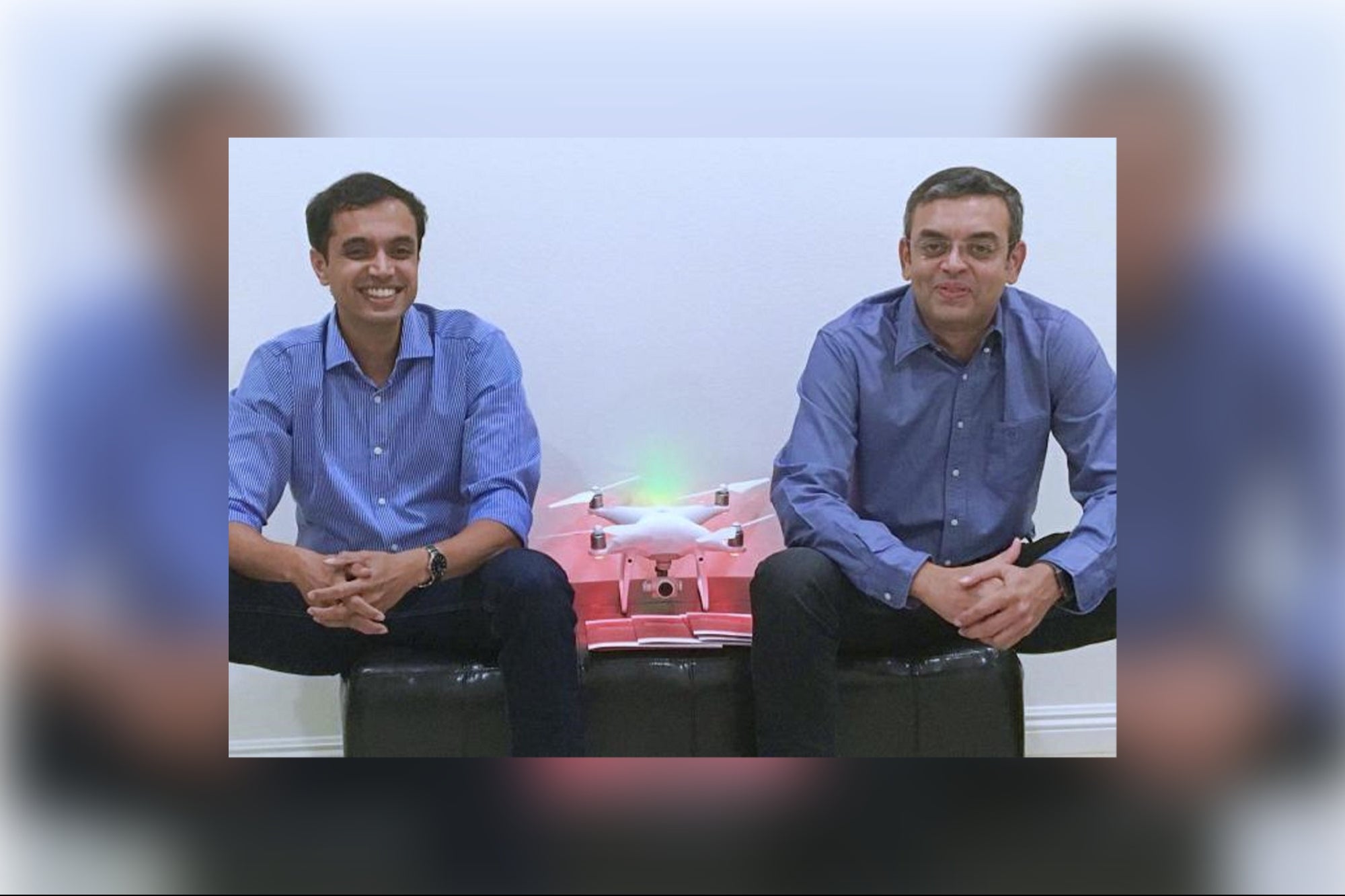
In a 2018 interview, Mavanoor described the early thesis with useful restraint. The team began with drones as a possible answer to information availability, then realized that market acceptance depended on analysis made for a particular industry and job. Generic aerial cleverness was less valuable than knowing what a solar developer, contractor, inspector, or operator needed to decide next.
The image was never the whole job
SenseHawk Technologies was established in India in 2016; SenseHawk Inc. followed in the United States in June 2018. That September, a $2 million round led by SAIF Partners gave the company capital for engineering and expansion. At the time, its machinery could be explained in three parts: software planned a drone's flight, an artificial-intelligence engine identified patterns in the data, and a web interface delivered the result. It was a clean description of a drone-analytics company.
The customers complicated it, which is usually a compliment. Solar projects pass through development, construction, commissioning, and decades of operation. A terrain map may help the first team. Progress imagery may help the second. Thermal scans can identify defects for the fourth. But the expensive gaps live between those phases. If an issue has no durable asset identity, owner, document trail, and location, it can be rediscovered with great professionalism several times.
The platform widened accordingly. SenseHawk launched its core solar applications in 2019. By March 2020 it said it served 80 customers across 15 countries and had analyzed 28 GW of assets. A $5.1 million round that September, led by Alpha Wave Incubation with participation from SAIF Partners, supported product development and expansion into the Middle East and North Africa.
TaskMapper became the clearest expression of the larger idea: a map-based place to connect dashboards, plans, tasks, forms, conversations, equipment, files, inspections, inventory, and field updates. A detected hotspot is no longer merely a bright blotch in a thermal image. It has a coordinate, a component, a severity, an assignee, a status, and eventually a repair record. Bureaucracy, when properly attached to geography, can be rather beautiful.
The majority stake, and the work after it
By January 2022, SenseHawk said it had crossed 100 GW of solar analytics. That July it formally launched the SenseHawk Digitization Platform for process automation and asset information management. Then came the conspicuous number: in September, Reliance Industries invested $32 million for a majority stake. Reliance said it planned to use the platform in its push toward 100 GW of solar capacity by 2030, while the investment would finance growth, commercial rollout, and research and development.
Corporate filings put some hard edges around the transaction. Reliance held 79.4 percent of total SenseHawk stock at the end of 2023; Mavanoor and Sankhe each held 6.01 percent. Mavanoor remained a director and continued as CEO. When rumors later suggested the founders were stepping aside, his public response was not misty. “We're not selling out. We're scaling up,” he wrote, adding that any material event would be publicly disclosed. The wording had the clipped quality of someone who would prefer the meeting to return to its agenda.
A construction crisis prompts the founding conversation.
Drone and software pilots run across 20 solar sites.
US incorporation and two institutional funding rounds support product and geographic expansion.
SenseHawk crosses 100 GW; Reliance invests $32 million for a majority stake.
NaaviX and BI tools extend the platform's reporting and AI layer.
Artificial intelligence needs a memory
Mavanoor's present argument is less about adding AI than about feeding it a coherent past. At Intersolar Europe in June 2026, his session focused on data integration for reliable solar and storage performance. The premise is sensible: a model cannot reason well about an asset if drawings, field logs, inspection histories, warranties, alarms, and work orders remain in unrelated systems. Confidence is cheap. Context takes years of unglamorous organization.
SenseHawk now describes TaskMapper through three connected twins. The map twin supplies the geospatial foundation, including drone mosaics and design layers. The equipment twin follows serialized components, warranties, performance curves, and alarms. The process twin ties inspections, approvals, and documents to the asset. The phrase “digital twin” can sound as if a power plant has acquired an expensive online ghost. Here it means something more useful: the site has an address book, a diary, and a list of unfinished chores.
The company says it now manages more than 200 GW of solar and storage analytics in over 20 countries. In late 2025 it launched NaaviX and business-intelligence tools for AI-driven reporting. Its 2026 announcements include a cybersecurity gold assessment for TaskMapper and an end-to-end implementation by the solar-EPC arm of Gransolar. Those milestones broaden the platform, but the founding irritation remains visible beneath them: people should not have to reconstruct a project's truth every Monday morning.
A solar plant can operate for decades. Its memory should last at least as long as the teams that built it.
There is a founder lesson inside the story, and it has little to do with drones. Begin with the failure that everyone can already feel. Test close to the work. Let a narrow tool earn the right to expand. Then follow the customer's task past the impressive moment. Detection must become assignment. Assignment must become repair. Repair must become history. The useful product is often hiding one handoff beyond the demo, patiently waiting in the work nobody puts on a conference slide.
Mavanoor's route from handheld computers to semiconductor programs, solar irrigation, aerial imagery, and asset-lifecycle software looks eclectic from far away. Up close, it is remarkably consistent. Put information where a person can use it. Make it specific to the job. Preserve it long enough for the next person to understand. Solar's great physical promise is that sunlight keeps arriving. Its digital challenge is to ensure the context does too.