The first thing SenseHawk's founders built was not a grand platform. It was an answer to a very expensive bad day. In January 2016, cost overruns at a large solar construction site set off a crisis at the company where Swarup Mavanoor and Rahul Sankhe worked. During a break in an executive meeting, the two colleagues began talking about software that might keep the same failure from happening again. The origin story is refreshingly concrete: before the solution, something broke.
They spent the next year testing drones and software across 20 sites. A drone could cross hundreds of acres faster than a person with a clipboard, and its imagery could reveal terrain, progress and defects. But the useful insight was not merely that a camera could fly. The expensive part of a solar project lived in the handoffs - from image to engineer, schedule to subcontractor, inspection to repair, and construction record to long-term operator.
SenseHawk incorporated in the United States in 2018, raised $2 million from SAIF Partners and angel investors, and initially looked like a drone-analytics company. That label was accurate in the way calling Amazon an online bookstore was once accurate. The founders had found a sharp entry point into a much larger mess.
The spreadsheet has no idea where the pile is
A utility-scale solar farm can spread across 1,000 acres and contain millions of components. Its teams juggle CAD drawings, Primavera schedules, PDFs, photographs, forms, inventory records, thermal scans and messaging threads. A spreadsheet can say a tracker row failed inspection; it cannot walk a technician to that row, show the warranty, display last week's drone image and record the repair without a collection of other tools.
TaskMapper, SenseHawk's core product, gives all of that information a place. The company calls its architecture a triple digital twin. The equipment twin models components from module to substation and holds details such as serial numbers, test results and maintenance history. The map twin layers GIS, CAD, terrain surveys and orthomosaics onto the site. The process twin attaches schedules, approvals, punch lists, inspections and quality events to the physical assets and locations where work happens.
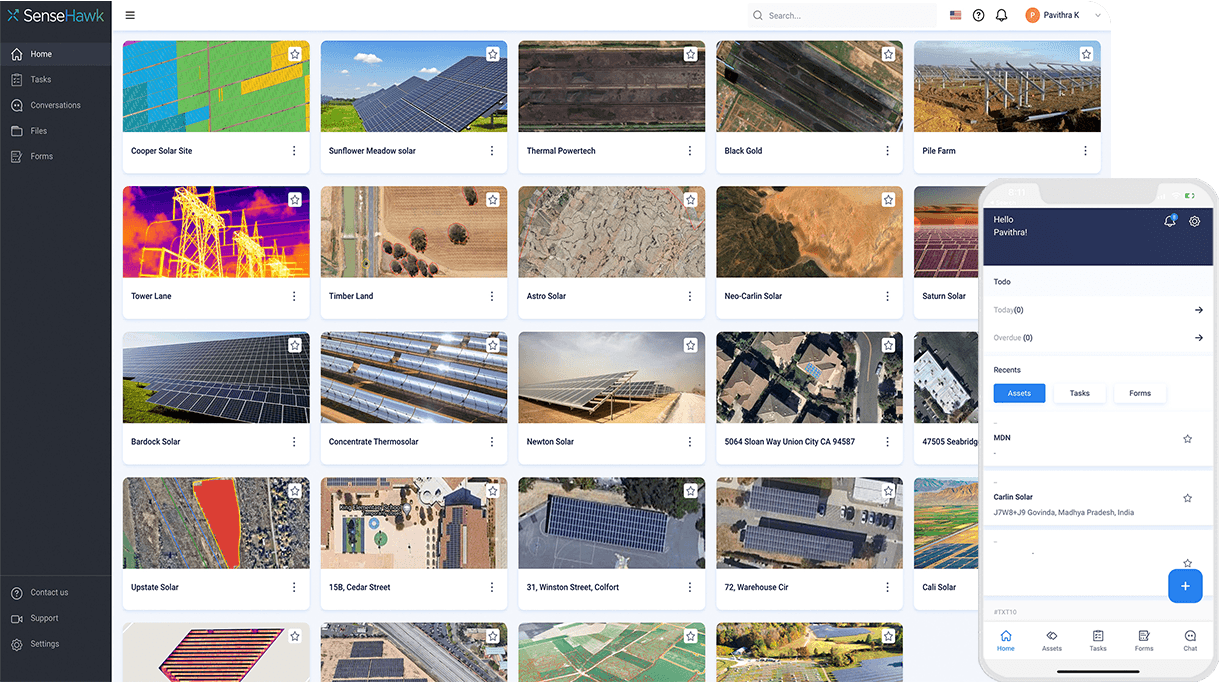
This is the company's clearest difference from a general construction platform or a standalone drone report. Procore can manage a project; Esri can map one; a drone vendor can photograph one. SenseHawk's pitch is that solar needs those jobs joined around a solar-specific asset model. Owners, EPC contractors, QA teams and field crews see the same site, but at the level each needs.
The inspection is not finished when the drone lands
Therm, SenseHawk's infrared-inspection product, makes the expansion strategy easy to see. A drone with an IR camera scans a solar array. Machine-learning models flag hotspots, string faults, diode failures and other anomalies. The software geolocates and classifies each issue, estimates likely impact, and lets a manager prioritize what deserves attention.
Many inspection businesses stop at the report. SenseHawk keeps going. A finding can become a punch item or field task inside TaskMapper. A technician uses the mobile app to navigate to the affected asset, review its history, attach photographs, complete a form and close the issue. Owners gain evidence for warranty claims; EPCs get a cleaner commissioning trail; operators can focus scarce crew time on the faults most likely to hurt yield.
The closed-loop advantage
The scale can become faintly absurd. After a hailstorm in Andrews County, Texas, SenseHawk's tools mapped more than 27,000 cracked modules. In another case, thermal analytics on a vast project initially flagged many apparent cell failures; field checks found that more than 60 percent were benign light visible through panel scribes. The point was to find real problems and avoid sending people after the wrong ones.
A separate EPC case study reported that remediation raised forecast yield by more than 4 percent. That is the sort of number that moves the conversation away from software seats and toward plant economics. A pretty heat map is decoration. A heat map that helps recover generation is a product.
What changed their mind
The pilots changed the founders' scope. Drone data answered questions about the physical site, yet customers still had to manage what happened next. By 2019 SenseHawk had launched a core platform and suite of solar applications. By March 2020 it said it served 80 customers in 15 countries. The pandemic then made remote visibility less of a convenience: in its first 12 months, customers used the construction-management module across more than 3 GW while travel and site-access restrictions complicated ordinary oversight.
Capital followed the broader ambition. Alpha Wave Incubation led a $5.1 million Series A1 in September 2020, with SAIF Partners investing again. SenseHawk crossed 100 GW of analyzed solar assets in early 2022 and formally launched its unified Digitization Platform that July. Two months later Reliance Industries agreed to invest $32 million and become the majority shareholder.
The fit was not mysterious. Reliance was planning a 100 GW solar program by 2030 and said it intended to use SenseHawk's platform in that rollout. For a startup selling software to giant infrastructure projects, the investor was also a customer with a laboratory measured in gigawatts. Public filings later put Reliance's stake at roughly 79.4 percent.
The newest interface is a question
SenseHawk now says it has supported more than 200 GW across over 20 countries. Its named users and testimonials span Adani Group, Sterling and Wilson Renewable Energy, Blue Ridge Power and SB Energy. GRS, the EPC arm of Gransolar Group, has standardized construction, inspection and commissioning work on TaskMapper across a portfolio of more than 1.5 GW in Europe, Africa and Australia.
The product's latest layer is NaaviX, an AI copilot introduced with new business-intelligence tools in late 2025. A user can ask which electrical activities are lagging, which strings have repeated thermal anomalies, or which contractor owns open torque issues. NaaviX is less interesting as a chat window than as proof of the earlier strategy: natural-language answers become valuable only after years of project data have been structured by asset, location, time and workflow.
There has also been a revealing boundary around the company. Nextracker licensed a SenseHawk elevation-analytics module and access to its legacy Workspace for use with TrueCapture. When reports muddied the transaction, SenseHawk publicly clarified that Nextracker had not acquired the company or TaskMapper. The distinction matters. Some drone-era IP can be licensed away; the continuing bet sits in the operating platform.
What another founder can copy
First, begin with a costly event, not a fashionable technology. SenseHawk's founding question was how to prevent a construction failure from recurring. Drones and AI were tools attached to that bill. Second, use a narrow technical service to enter the account, then follow the customer's unfinished work. Detection led to mapping; mapping led to assignments, evidence, reporting and asset history.
Third, design around the object the customer already cares about. In SenseHawk's case, every record eventually points to a place, component or process on the plant. That makes the data more durable than a generic dashboard. Fourth, sell the removed ritual. Blue Ridge Power's reported reduction of weekly reporting from 20-25 hours to about two is more persuasive than a catalog of features because everybody knows exactly whose Friday evening was returned.
When the playbook breaks
This model is a poor fit for a small, simple project with few contractors, little repeat work and no appetite to maintain structured asset data. A digital twin also fails socially when teams keep the real decisions in private chats and update the platform later. The software needs scale, process discipline, field adoption and reliable onboarding. Without those conditions, the “single source of truth” becomes one more source.
SenseHawk does not publish list pricing, which is normal for enterprise deployments but prevents a clean seat-by-seat comparison. Cost will vary with project scale, modules, analytics, onboarding and integrations. The public numbers that can be stated are the financing milestones: $2 million, $5.1 million and $32 million. Buyers have to ask for a quote and should measure it against reporting labor, avoided rework, faster commissioning, recovered warranties and yield protected.
The company's lasting idea is not that solar needs more data. Solar sites already produce an exhausting amount of it. The idea is that data becomes useful when a person can point to the exact block, panel, contractor and next action. SenseHawk started by teaching a drone to see a site. It grew by teaching the site to remember what happened.