The useful unit of solar power is not always the dramatic farm stretching to the horizon. Sometimes it is a warehouse roof, a municipal parcel, a carport or a few megawatts tucked beside a town. Each can produce electricity near the customer and avoid some of the cost and friction of moving power across a crowded grid. Each can also be a nuisance to finance. The projects are small, contracts differ, regulations change by state and somebody still has to notice when an inverter stops behaving.
True Green Capital Management, founded in 2011 and headquartered in Westport, Connecticut, made that nuisance its specialty. The private infrastructure manager invests in distributed solar and storage across the United States and Europe. It provides project equity and developer loans, buys operating assets, takes control positions in solar businesses, supervises construction, monitors production and ultimately sells seasoned portfolios. The recurring trick is aggregation: collect many local power plants and make them legible to institutions that prefer scale.
The middle is the market
True Green Capital sits between several familiar categories. It is not a venture fund betting on an unproven solar technology. It is not primarily a utility-scale developer pursuing one enormous project. And it is more operational than a passive buyer of finished plants. The firm's territory is sub-utility-scale power: commercial and industrial systems, community solar, storage and related companies whose projects can generate long-lived, contracted cash flows.
The customer map has two sides. Pension plans, insurers, endowments, foundations, wealth managers and family offices supply capital to TGC's funds. On the other side, municipalities, military bases, universities, utilities, companies, households and small businesses buy or subscribe to the electricity produced by portfolio assets. Developers are customers and counterparties too. They may have a construction-ready project and permits, but not the equity or debt structure required to build it.
That two-sided arrangement solves a mismatch. Large investors want diversified exposure, repeatable reporting and meaningful deployment. A five-megawatt project is rarely worth the administrative attention on its own. Developers need patient capital and execution capacity. Power users want predictable prices, local generation or access to renewables without installing panels themselves. TGC's job is to bind those needs with contracts, construction management and operating discipline.
“With community solar, you can truly make and have a local impact.”Panos Ninios, co-founder and co-managing partner
Five jobs hiding inside one fund
Calling TGC an asset manager is accurate but incomplete. Its model resembles a compact power company nested inside a private-equity firm. Origination teams find projects or developer relationships. Investment staff underwrite power contracts, tax incentives, equipment and regulatory risk. Project-finance specialists arrange debt and tax equity. Construction teams get plants into operation. Asset managers then watch the equipment and the revenue long enough to make the portfolio attractive to a later owner.
The aggregation machine
One lifecycle / five disciplinesThe operating phase is where the firm's differentiation becomes easiest to see. TGC says its in-house team applies weather-adjusted analytics to plant data, tracks performance in real time, keeps spare parts available and aims for rapid diagnosis and on-site response. These are prosaic tasks, but renewable infrastructure returns are made or lost in the gap between a model's expected output and a plant's actual production. A beautiful spreadsheet does not tighten a loose electrical connection.
For new projects, the firm favors long-term power-purchase agreements, often lasting 15 to 25 years and frequently involving investment-grade customers. Community solar adds subscriber revenue and utility-bill credits. Operating European assets may carry feed-in tariffs and renewable-energy certificates. TGC preserves some exposure to merchant power prices, but describes downside protection through diversified contracted cash flows as a primary objective.
What makes a small plant financeable
The exits explain the entry
A useful way to understand the business is to look at what TGC has sold. In 2021, Altus Power acquired a 79-megawatt portfolio from TGC-managed funds. The 28 projects crossed seven states and included rooftop, ground-mounted and carport arrays serving mostly investment-grade customers. In early 2023, TGC agreed to sell Altus another portfolio of roughly 220 megawatts for about $293 million. Most of those assets were already operating; some were nearing completion.
Those transactions reveal the assembly line. TGC accepts development and construction complexity, creates a geographically varied operating portfolio, and offers a strategic owner something that is already producing power and revenue. The firm said it had exited about 400 megawatts across its first three funds by the end of 2025. The approach competes with owners such as Altus Power, Generate Capital, Madison Energy Infrastructure and Greenbacker, while larger infrastructure managers can appear on either side of a transaction.
Capital raising supplies the raw material. Fund III closed at its $350 million hard cap in 2017. Fund IV closed in June 2022 with $660.875 million in commitments, comfortably above a $500 million target. Its limited partners included U.S. and Dutch pension plans, insurers, endowments, foundations, global asset managers and family offices. In 2025, the Virginia Retirement System disclosed a $100 million commitment to Fund V, although the final size of that vehicle has not been publicly announced.
Platforms, partners and people
Not every route to scale involves buying individual plants. In 2023, TGC-managed funds agreed to acquire a majority stake in CleanChoice Energy and provide $100 million of equity for its solar pipeline. CleanChoice combines community-solar development with retail clean-energy customers. The investment moved TGC closer to the household end of the electricity market, where customer acquisition and retention matter alongside engineering.
Community solar is a particularly neat expression of the aggregation thesis. A renter, a shaded homeowner or a small shop may be unable to install panels, yet can subscribe to part of a shared array and receive credits through the existing utility bill. The plant gathers many modest customers into bankable demand. TGC's New York program, begun in 2017, had built roughly 130 megawatts and acquired more than 20,000 customers by 2023. The financing becomes large without asking the customer to become large.
A 2024 agreement with Qcells took a different shape. The partners planned up to 450 megawatts of commercial, community and industrial solar and grid projects across the United States, using Qcells Enable for engineering, procurement and construction. In Britain, TGC formed a joint venture with Two Blues Solar to finance capex-free on-site systems for energy-intensive businesses. These partnerships add pipeline and execution capacity without requiring TGC to invent every component itself.
The firm's own culture appears designed around that mix of finance and field work. Its website describes an entrepreneurial, self-directed and collaborative environment, with hybrid work, employer-paid health coverage and retirement matching. Public materials put the staff above 30, split between Westport and London; LinkedIn listed 56 employee profiles in 2026. The leadership combines investment, legal, accounting, human-resources, origination and operating roles rather than presenting climate investing as a purely financial exercise.
Older panels, newer opportunity
TGC's recent acquisitions show the strategy broadening from construction-ready American projects to seasoned operating fleets. In March 2025, Fund IV bought 62 operating solar projects totaling approximately 64 megawatts from Ecofin US Renewables Infrastructure Trust. The assets span several states and four power markets, carry long-term contracts and lifted TGC's operating distributed-solar portfolio above 600 megawatts.
In June 2026, a managed fund acquired six British solar projects totaling 20.3 megawatts from two Gresham House renewable-energy trusts. The plants had operated since 2011 and benefit from feed-in tariffs contracted through 2036, short-term power-purchase agreements and renewable-energy guarantees of origin. Mature equipment changes the work. Repowering decisions, component life and technical maintenance matter more than ribbon cuttings.
“As operating assets mature, technical expertise becomes a key driver of long-term value creation.”Sam Salisbury, managing director, Europe
This is where TGC fits in the market now: a specialist willing to work below utility scale, but with enough capital and operating machinery to behave institutionally. Distributed power can be added near demand, sometimes faster than large centralized generation and transmission. It can serve customers that cannot host their own panels. It can also fragment into a thicket of permits, contracts, subscribers and maintenance schedules. TGC's product is not simply clean electricity or fund exposure. It is the reduction of that complexity.
The thesis carries familiar risks. Interest rates affect project values. Tax and regulatory rules can move. Interconnection queues delay projects. Equipment degrades, subscribers move and merchant prices fluctuate. The firm's response is diversification, contracted revenue, careful entry prices and direct control over more of the asset lifecycle. None removes risk; together they make it measurable enough to underwrite.
Storage adds another variable and another tool. Batteries can shift electricity into higher-value hours, support resilience and help a site use more of its own generation, but their revenue stacks and operating patterns demand different underwriting. TGC includes storage within its mandate while keeping solar at the center. That measured expansion suits a firm whose advantage depends less on predicting a single technology winner than on managing physical assets through changing markets.
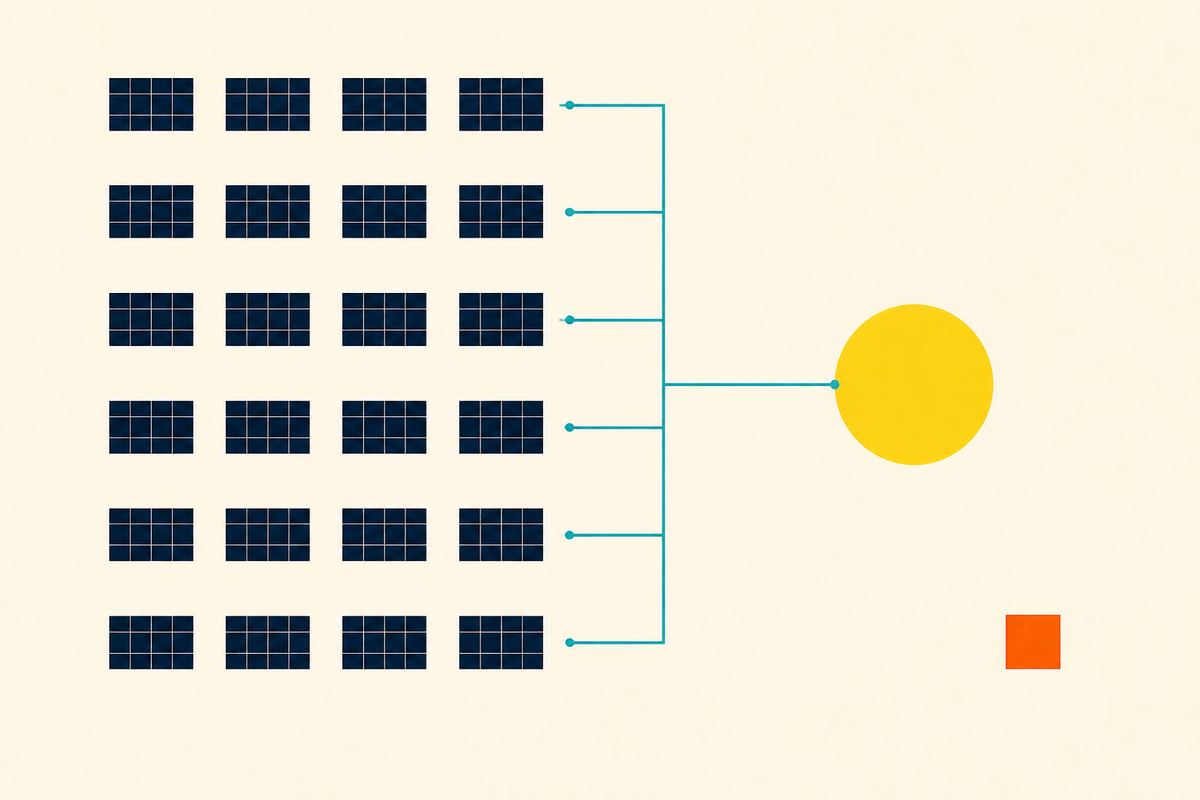
There is a pleasing inversion in the model. The physical system stays distributed - on roofs, fields and parking lots, close to whoever uses the power. Only the finance, data and ownership become centralized. The electrons remain local. The portfolio becomes large. For True Green Capital, that is how a collection of modest plants graduates into infrastructure.