YesPress Dossier · Company
Emeryville, California · Est. 2022
Jacobi Robotics
The Berkeley AI spinout teaching factory robot arms to plan their own moves - and collapsing a month of setup into a single day.
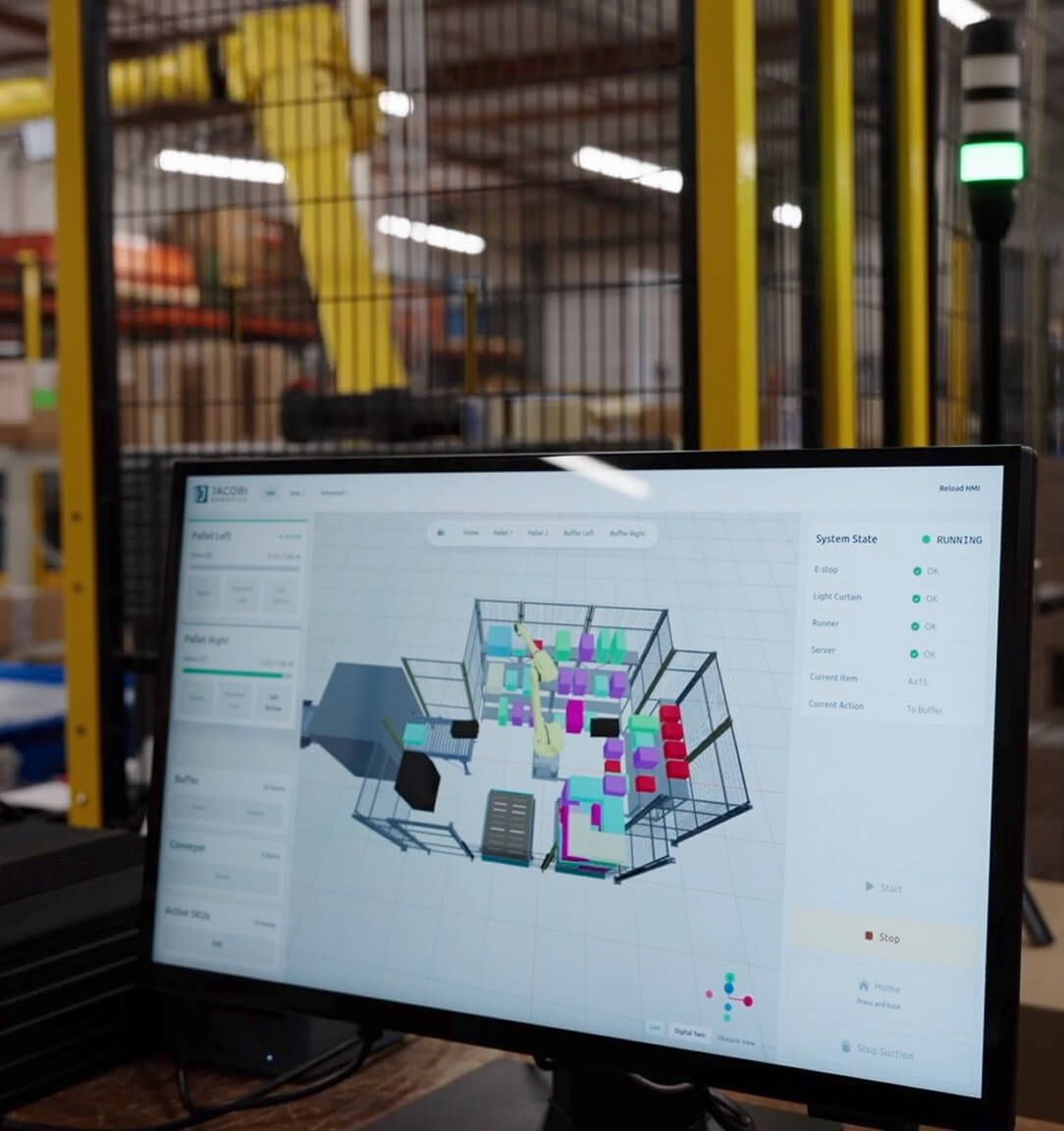
The Berkeley AI spinout teaching factory robot arms to plan their own moves - and collapsing a month of setup into a single day.
There is a durable and slightly embarrassing fact about industrial automation, which is that the robot is usually the easy part. You can buy a perfectly good six-axis arm from ABB or Fanuc for the price of a nice car. What you cannot buy off the shelf is the several weeks a specialist spends hunched over a teach pendant, typing in waypoints one at a time, so the arm knows how to move from box A to pallet B without knocking anything over. Jacobi Robotics, a company founded in 2022 out of the Berkeley AI Research lab, has decided that this is the interesting problem - and, more to the point, the profitable one.
The company's pitch is arithmetic that sounds too clean to be true: what takes about a month with existing tools, Jacobi's software does in under a day. That is roughly 20 times faster. The reason it can make that claim is a piece of AI-powered motion planning that generates collision-free trajectories in under a millisecond, which the company says is on the order of 1,000 times less compute than the classical approaches. When a number is that large you should squint at it, and the honest framing is that Jacobi is not inventing motion planning - it is the product of a decade of academic research finally leaving the lab.
That lineage matters. The founding team came out of Berkeley's AI Research group under Ken Goldberg, a roboticist whose name carries weight in the field, plus Carnegie Mellon. The company is named, with an engineer's sense of humor, after Carl Jacobi - the 19th-century mathematician whose Jacobian matrix is the exact tool that translates a robot arm's joint motion into where its hand actually ends up. It is the kind of name that a room full of PhDs finds funny and everyone else has to have explained.
What Jacobi actually sells is software, not hardware, and that distinction is the whole strategy. Rather than build yet another robot to compete with the incumbents, it embeds its motion-planning and palletizing brains inside other people's robots. The flagship product, the OmniPalletizer, does mixed-case palletizing - the genuinely hard, injury-prone job of stacking boxes of varying sizes onto a pallet in real time, without anyone pre-computing the order they'll arrive in. The arm figures out each placement as the box shows up. For anyone who has watched a human do this job for eight hours, the appeal is obvious.
The customers, so far, are reached mostly through partners. Formic, a robotics-as-a-service provider, folded Jacobi's software into its rental fleet and reported deployments dropping to under a day and productivity rising about 20 percent. In 2026 ABB Robotics - one of the incumbents Jacobi pointedly did not try to replace - agreed to bring Jacobi's palletizing to its integrator network. When the giants license your software instead of building their own, it is a reasonable signal that you found a real gap rather than a marketing one.
None of this guarantees the ending. Jacobi is roughly 18 people with a $5 million seed round, competing in a capital-intensive field against the likes of Realtime Robotics, Dexterity, and Mujin, all chasing versions of the same idea. But the wager is a clean one: if you can turn a specialist's month-long art into something closer to a software install, the market is not the factories that already automate. It's the enormous long tail that never could.
Programming for industrial robots is ripe for a massive shift.- Max Cao, Co-founder & CEO
AI software for motion planning, perception and grasping. Generates collision-free trajectories in real time - under a millisecond - across major robot arm brands.
Real-time mixed-case palletizing that stacks varying box sizes with no pre-sequencing, plus a studio interface to design and standardize palletizing across projects.
Lets robot solution providers program and reprogram cells in under a day - the tools that turn a month of integration work into an afternoon.
Partner-reported figures: ~95% reduction in deployment time, ~24% savings in overall project cost, ~20% higher robot productivity. Approximate, from Formic and Jacobi disclosures.
CEO Max Cao studied mechanical engineering at UC Berkeley and Imperial College London, and was a consultant at McKinsey before returning to robotics.
Seed Round · $5,000,000 · July 2024
Emerged from stealth alongside the raise. Investors included:
Robotics-as-a-service provider. Integrated Jacobi's motion software into its rental fleet - sub-day deployments, ~20% higher productivity.
Collaboration to bring Jacobi's AI-powered palletizing to ABB's integrator network (2026).
Partnership to deliver AI-powered robotic automation for warehouses (2025).