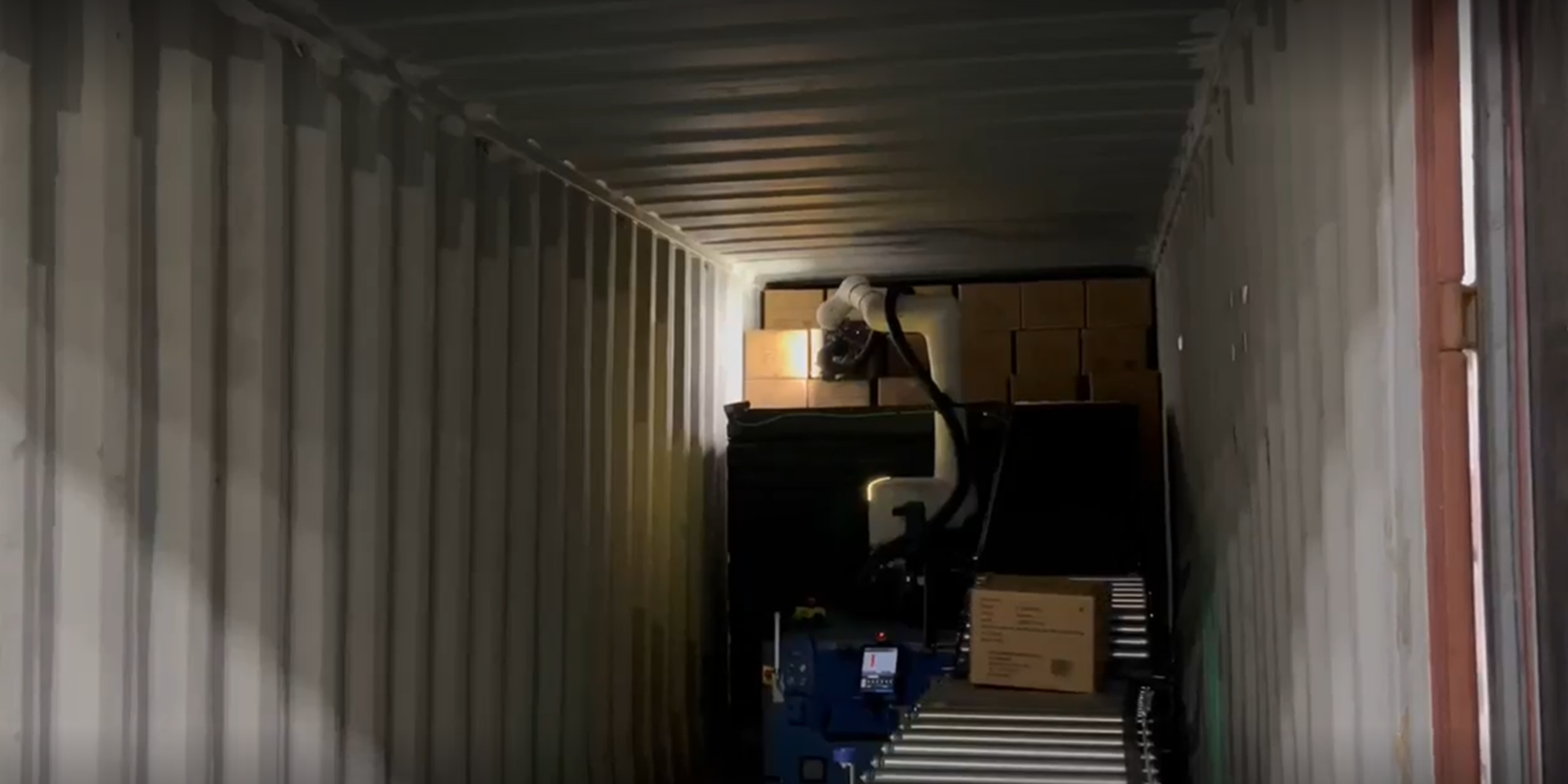
A force-sensing cobot rolls into the back of a 40-foot ocean container at a Saddle Creek dock. For the next hour, it lifts boxes a human used to lift. Then it does another hour. Then another.
Pull up to almost any 3PL on a Tuesday morning and you'll see the same thing: a shipping container backed against a dock, the doors swung open, and two people inside with no air conditioning trying to move four thousand boxes before lunch. It is hot. It is loud. It is the part of e-commerce no one puts in the brochure. Anyware Robotics looked at that scene and decided the people should be somewhere else.
The company's first product, Pixmo, is a mobile robot with a force-sensing cobot arm bolted on top of an autonomous base. It drives into the container, sees the wall of boxes, decides which one to grab first, and starts unloading. A small conveyor add-on funnels the cases out. The throughput claim is roughly one box every four seconds - up to 1,000 boxes an hour - for boxes that weigh as much as a small child.
There are other robots in this space. Most of them are big, fast, industrial machines descended from automotive lines. They want a clean floor, a known box size, and people standing well clear. Pixmo wears a softer hat. Its arm is collaborative, meaning if it bumps something, it stops instead of breaking it. That is a quiet engineering choice with loud commercial consequences: Pixmo can work near humans, on a floor that wasn't built for robots, on the day it shows up.
Pixmo is the body. AnywareOS is the brain. The body is what reporters photograph; the brain is what makes the body interesting. AnywareOS handles perception (where are the boxes, how are they stacked, which one is safe to grab), motion planning (how to move an arm through a tight metal box without hitting a wall), and autonomous decision-making (what to do when the next box is wedged in funny). It ships with over-the-air updates, so a Pixmo bought in March learns from a Pixmo bought in June.
The company's pitch to a warehouse operator is short. You will not redesign your dock. You will not retrain your team. We deploy in a day, you keep your existing receiving workflow, and the robot covers the worst hour of it.
Anyware's founding team is dense with robotics PhDs and industrial-robot scar tissue. CEO Thomas Tang helped stand up FANUC's Silicon Valley research center and led its AI palletization product before leaving to start Anyware. The other three came from UC Berkeley labs and GreyOrange.
PhD, UC Berkeley. Former founding member of FANUC's Silicon Valley R&D center. 14 robotics patents.
PhD, UC Berkeley. 9 robotics patents. Runs the software and AI stack behind AnywareOS.
PhD in Mechanical Engineering, UC Berkeley. Mechanical design lead for the Pixmo platform.
MBA, Kenan-Flagler. Previously at GreyOrange. Owns product strategy and customer-side rollout.
Warehouse turnover in the U.S. routinely runs above 40% a year, and the receiving dock - hot, loud, physically punishing - is where it runs hottest. Hiring a second shift is harder every year. Insurance claims on lifting injuries are not. Anyware's bet is that the cheapest worker on a receiving dock in 2030 will be a mobile robot that shows up on a flatbed, plugs in, and stays.
The bigger bet is what comes after. Anyware describes Pixmo as a general-purpose mobile robot - container unloading is the first job, not the last one. Manufacturing, healthcare logistics, food service, hospitality - anywhere with a repetitive physical task that is hard to staff - sits on the company's roadmap.
The container is empty now. The driver hooks up and pulls away to be replaced by the next one. The two people who used to be inside are at the sortation line, scanning labels and drinking water that is still cold. Pixmo is already rolling toward the next set of doors. Nobody clapped. Nothing about it looked dramatic. That, finally, is the point.
Anyware Robotics didn't replace a worker. It replaced a job - the worst hour of a 10-hour shift - and left the rest of the day to humans. If physical AI works at scale, this is roughly what it will look like. Quietly. On a Tuesday. In Fremont.