●BREAKING Tutor Intelligence closes $34M Series A led by Union Square Ventures
●Cassie palletizes up to 14 cases/minute, deploys in 2 days
●Data Factory 1: ~100 robots, ~10,000 hrs of training data per week
●Robots-as-a-Service from ~$14/hr - no programming required
●Born at MIT CSAIL, deployed coast to coast
●BREAKING Tutor Intelligence closes $34M Series A led by Union Square Ventures
●Cassie palletizes up to 14 cases/minute, deploys in 2 days
●Data Factory 1: ~100 robots, ~10,000 hrs of training data per week
●Robots-as-a-Service from ~$14/hr - no programming required
●Born at MIT CSAIL, deployed coast to coast
The Floor · Right Now
A robot named Cassie clocks in
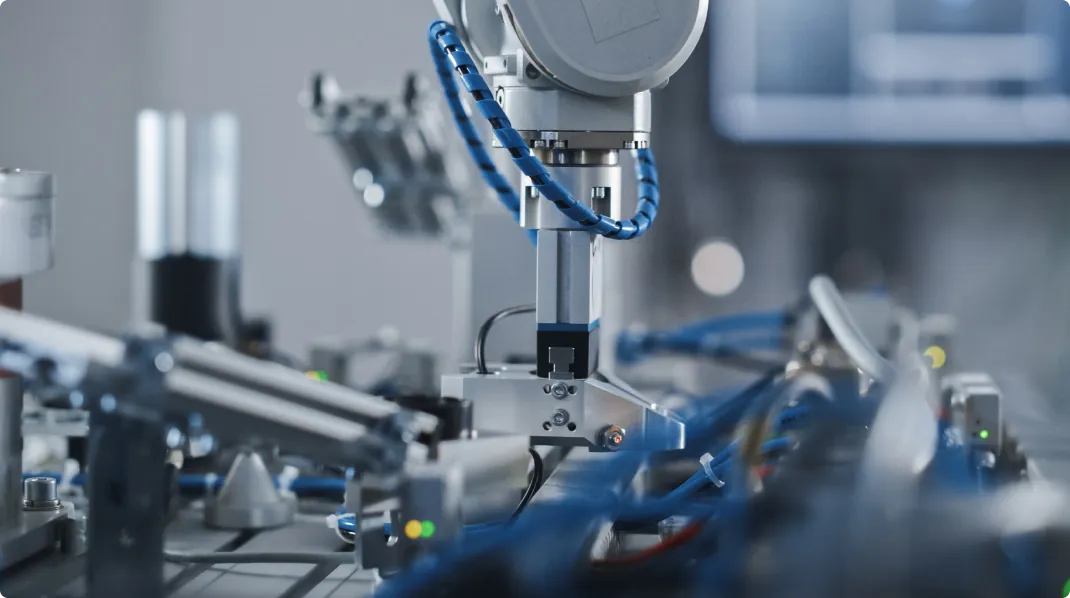
Walk onto a contract-packaging line somewhere in America and you may not notice her at first. Cassie is a robotic arm on a base, stacking boxes onto a pallet with the unbothered rhythm of someone who has done this ten thousand times. She lifts a 50-pound case, sets it down, reaches for the next. Up to fourteen a minute. No coffee break, no overtime form, no quarrel with the schedule.
What is unusual is not that a robot is palletizing. Factories have bolted robots to floors for decades. What is unusual is how Cassie got there: she arrived in a crate, was switched on, and started working roughly two days later. Nobody wrote a line of code for her. Nobody changed the building. And the company that sent her, Tutor Intelligence, did not sell her. It rents her - by the hour, like a tool you give back when the job is done.
Intelligent robot workers for the industrial world.
Tutor Intelligence, company tagline
That small reframing - a robot as a worker you can hire, not a machine you must buy and babysit - is the whole company in a sentence. It is also, conveniently, the thing the rest of the robotics industry has spent years failing to do.
The Problem They Saw
Automation that nobody could afford to turn on
Here is the uncomfortable truth about industrial robots: the robot is the cheap part. The expensive part is everything around it - the integrators, the custom programming, the months of setup, the engineer on call when a slightly different box shows up and the whole line stops. For a big automaker amortizing the cost over a decade, that math works. For a co-packer running short batches of forty different products, it is a punchline.
So the businesses that most need help - the high-mix, low-volume shops drowning in labor shortages - were precisely the ones traditional automation priced out. They were told to either commit six figures and six months, or keep posting jobs nobody applied for. Most chose the want ads.
The central tension
The factories that can least afford a robot are the ones that need one most. Tutor exists to close that gap.
Tutor's founders looked at that standoff and decided the problem was not the hardware. It was the business model and the brittleness. A robot that needs a programmer for every new SKU is not intelligent. It is just expensive.
The Founders' Bet
Two MIT engineers, one full-stack idea
Josh Gruenstein and Alon Kosowsky-Sachs met at MIT, where they shared a faintly stubborn conviction: that robotics had been sliced into too many pieces. One company made the arm, another the software, another did the integration, and the customer was left holding the bag when the seams showed. Their bet, made in 2021 out of MIT's Computer Science and Artificial Intelligence Laboratory, was that you had to own the whole stack - hardware, AI, deployment, support - to make a robot that simply worked.
It is the kind of ambition that sounds reasonable in a lab and terrifying on a balance sheet. Owning the full stack means doing everything yourself, which is roughly four startups in a trench coat. They did it anyway.
More learning unlocks more robots, unlocks more data.
Tutor Intelligence, on its flywheel
The wager underneath the wager is a flywheel. Every robot Tutor deploys generates real-world data. That data trains better AI. Better AI means robots that handle more tasks with less hand-holding, which means more deployments, which means more data. Spin it long enough and you do not just have a fleet - you have a learning system that gets cheaper and smarter as it grows. The founders call the destination "a future beyond labor." It is a grand phrase for a company that, today, is very good at stacking boxes.
The Product
Cassie works today. Sonny is in school.
Tutor's lineup answers the problem from two directions. Cassie is the workhorse you can have right now: a mobile manipulator that palletizes, depalletizes, and picks cases, handling an effectively infinite mix of SKUs with minimal changeover. She deploys in about two days, lifts boxes up to 50 pounds, and runs around the clock. Crucially, she needs no programming - the intelligence rides in Tutor's AI platform, not in a brittle script some integrator left behind.
Working now
Cassie
AI mobile manipulator for palletizing, depalletizing, and case picking. Infinite SKUs, ~14 cases/min, 50-lb boxes, 24/7, two-day deploy, zero programming.
Coming late 2026
Sonny
A semi-humanoid robot built for general manual labor in factories and warehouses - and the star pupil inside Data Factory 1.
The platform
Robots-as-a-Service
Fleet management, a tablet operator interface, 24/7 remote support, maintenance, and continuous AI updates. No contract lock-in.
The classroom
Data Factory 1
~35,000 sq ft in a renovated Watertown mill. ~100 Sonny robots generating ~10,000 hours of real-world training data weekly.
The pricing is where the founders' bet becomes a buyer's decision. Rent Cassie hourly - starting around $14, roughly the cost of a coffee and a sandwich. Or pay per pick on fulfillment work, where Tutor claims to cut costs by at least 20 percent. Or buy outright with a service plan, if you are the type who likes to own things. The point is that automation stops being a capital project and starts being a line item.
You can hire a working robot for about the price of lunch - per hour.
On Tutor's ~$14/hr Robots-as-a-Service model
The Proof
The numbers that make the argument
Skeptics are right to ask whether "robots by the hour" is a slogan or a system. The clearest evidence is Data Factory 1, opened in 2026 inside a historic Watertown mill where machines once moved textiles. Now they move boxes. About 100 robots run there, supervised partly by remote teleoperators scattered across time zones, generating something on the order of 10,000 hours of training data every week. Tutor calls it the largest robot data factory in the United States - the physical engine of that flywheel.
Why the rental model is the pitch
Approximate, illustrative figures drawn from Tutor's public claims
Bars are scaled for readability across different units, not apples-to-apples. *Per-pick cost reduction on fulfillment workflows, per Tutor.
The money agrees. In December 2025 Tutor closed a $34 million Series A led by Union Square Ventures, co-led by Fundomo, with returning seed backer Neo - pushing total funding to roughly $42 million. USV does not, as a rule, write checks for science projects. Its presence is a vote that the next thing software eats is the physical economy, and that Tutor has a credible fork.
By the numbers
$34M Series A · ~$42M total raised · ~110 people · robots in dozens of US facilities.
The Mission
"A future beyond labor" - said carefully
It is the line that makes people lean in or recoil, depending on whether they own the factory or work in it. Tutor is candid that its long-term aim is to build generally capable robot workers, and it has not pretended otherwise even when a Boston Globe headline asked whether the robot training in Watertown might one day replace the reader. To its credit, the company frames the goal as abundance - filling jobs that already go unfilled, in an economy short on hands - rather than a victory lap over the workforce.
A future beyond labor - affordability and abundance in the physical economy.
Tutor Intelligence, Series A letter
Whether you find that thrilling or unsettling, it is at least honest, which in a field fond of soft euphemisms counts for something. The team that has to deliver it numbers around 110 - technicians, engineers, researchers, salespeople, data labelers, operations staff, plus the remote crew watching the robots overnight. A full-stack company, as promised, with all the seams kept in-house.
Back on the Floor
Cassie sets down the last box
Return to that packaging line. The pallet is full. Cassie pivots, waits for the next one, and starts again - the same unbothered rhythm she had two days after arriving, the same she will have a year from now. The line that used to stall when a new product showed up no longer stalls. The job that went unfilled for months is, quietly, filled.
That is the whole argument, stripped of the grand phrases. Not a robot bolted to a floor for a decade, but a worker you can hire on Tuesday and reassign on Friday. The factories that could never afford automation can now rent it by the hour. Whether that adds up to "a future beyond labor" is a question for the next decade. Whether it stacks the boxes today is not in dispute.
The robot is the cheap part. Tutor's real product is the two-day yes.
YesPress dossier