Aisle 14, somewhere in a Fortune 100 warehouse.
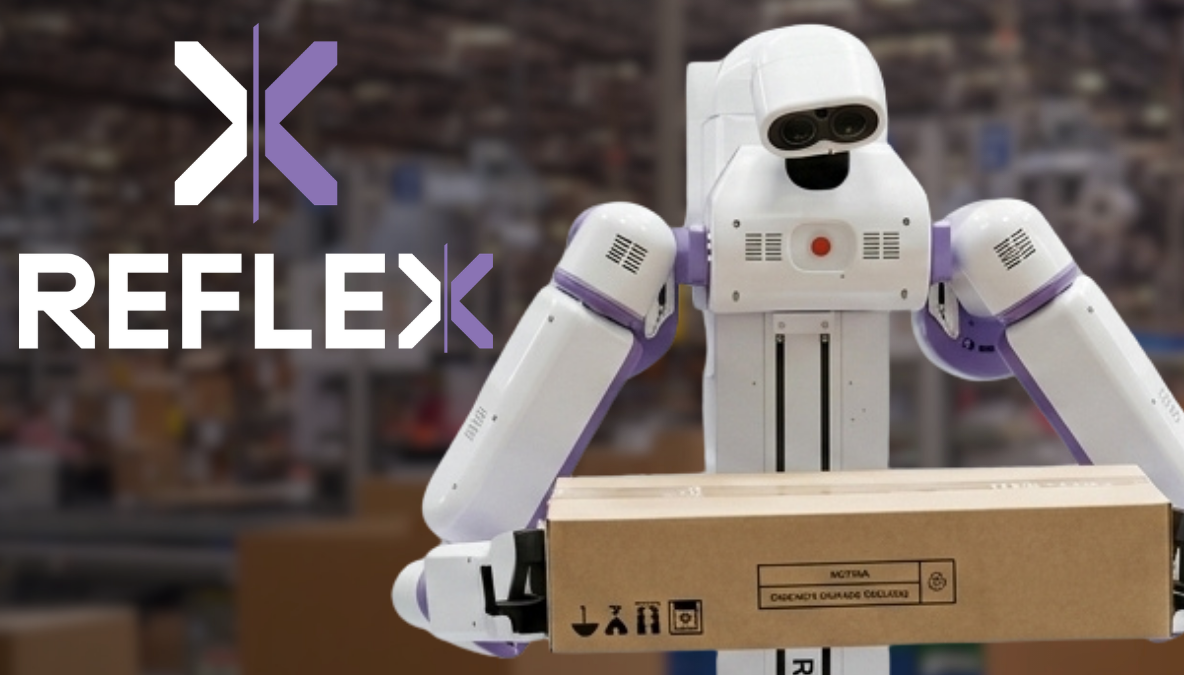
A robot rolls past a forklift. It is roughly the size of a person, but on wheels. Two arms. A camera where eyes would be. It picks a tote off a conveyor, swivels, lowers it onto a cart, and rolls to the next station. The shift supervisor doesn't look up.
This is what a Reflex Robotics humanoid does on a Tuesday. There is no soundtrack. No demo reel. No hype man in a hoodie pacing in front of a stage. The robot is working. That is the entire pitch.
Most humanoid robotics companies have spent the last three years competing for the most cinematic ten seconds of video. Reflex Robotics has spent that same time competing for the least interesting one - the boring, repeatable, this-is-just-Tuesday kind. The kind a logistics operator will sign a contract for.
Wheels. Not legs.
Most warehouses are flat. A floor. Concrete. Maybe a ramp. Reflex looked at that and asked the question nobody in humanoid robotics seemed willing to ask out loud: why are we paying the bipedal tax?
Legs are expensive. Legs fall over. Legs require months of locomotion research before a robot can move a single box. Wheels do not. Wheels are a settled engineering problem. Wheels free up the budget - of time, money, and battery - to do the work people actually want robots to do, which is move stuff with their arms.
The robot's footprint is under two feet by two feet. Each arm lifts more than 25 pounds. It is operational within 60 minutes of being unboxed. It can transition, in the same shift, from tote transfers to product picking to box closing to carton disposal. It does not blog about it.
Twenty times cheaper than the field.
There is a number circulating through warehouse procurement meetings. It is approximately $10,000. That is roughly what a Reflex humanoid costs in hardware. Other humanoids are quoted at one-twentieth the inverse - somewhere in the six-figure range, with operating costs to match.
Reflex sells via a Robots-as-a-Service model: a one-time hardware fee plus a monthly subscription that lands at roughly half of what equivalent human labor costs. The math is not subtle. It is the kind of math a logistics CFO can sign without a 40-slide deck.
Source: Reflex Robotics; Interesting Engineering. Hardware cost ratio, approximate.
A person, holding the robot's hand.
Reflex Intelligence - the software layer that wraps the hardware - starts every job with a human in the loop. Somebody, somewhere, can supervise or steer the robot in real time. The robot watches. It learns the rhythms of the warehouse. The weird angles, the dented totes, the conveyor that sticks a little. Over shifts, it takes more on itself. Less human, more robot. Until, on a Tuesday, the supervisor stops checking in.
This is the unfashionable answer to the autonomy problem. The fashionable answer is: train an enormous model and hope. The unfashionable answer is: ship the robot, get it useful today, and let it earn its independence one tote at a time. Reflex picked the unfashionable one. They are quietly being proven right.
A 25-person company with a Tesla-grade resume.
The Reflex team came out of MIT, Tesla's Model S/X/Y production lines, Boston Dynamics (Stretch), Anduril, Oculus, Amazon, Waymo, Skydio, ASML and Jane Street. The shared trait: they have shipped hardware that millions of people used and never thought about. Which is, ultimately, the goal here too.
A short, loud timeline.
Founded in Brooklyn.
A small team, a workshop, and the belief that warehouses don't need legged robots.
$7M Seed, led by Khosla Ventures.
TechCrunch debuts the wheeled humanoid in a now-famous video where it fetches a snack.
GXO Logistics signs a Robots-as-a-Service deal.
It is GXO's second humanoid RaaS agreement - and the first with a wheeled platform.
Live operational testing inside a Fortune 100 retailer's warehouse.
Palletizing, tote picking, box closing, beverage packaging, carton disposal.
Nuevo Leon factory announced.
Latin America's first humanoid robot manufacturing footprint.
What a Reflex robot can do for you.
If you run a warehouse, a 3PL, a manufacturing line, or a fulfillment operation, the offer is simple. Drop the robot in. It works inside an hour. You pay less per month than you would for a human shift. Your team takes the work that requires judgment - the complex decisions, the customer-facing calls - and the robot takes the work that does not.
Five things to know.
- The robot's footprint is smaller than a typical office trash can.
- Wheels - not legs. The team argues warehouses are flat, so why pay the legged-robot tax.
- Hardware is built in Brooklyn, not Silicon Valley.
- The founding team has Tesla Model S/X/Y line and Boston Dynamics Stretch experience.
- One arm lifts about a full case of soda. Two of them is a real shift.
Demos, interviews, dispatches.
Where to find Reflex Robotics.
Aisle 14, three months later.
The robot is still there. The shift supervisor still doesn't look up. But something has shifted. The supervisor used to check in on the Reflex unit every 20 minutes. Now it is every shift. Then every week. The robot has learned the rhythm of this particular aisle - which tote sticks, which conveyor hums, when the line picks up.
That is what Reflex Robotics is building toward. Not a viral demo. Not a six-figure showpiece. A robot that quietly absorbs more of the work, day by day, until the math just works. A wheeled humanoid that came from a Brooklyn workshop, priced like a used car, supervised by a person on day one and trusted on its own by week twelve.
Most companies in the humanoid race are still optimizing for ten cinematic seconds. Reflex is optimizing for Tuesday. Which is, when you think about it, every day a warehouse opens.