The beverage variety pack is a small monument to consumer choice and factory irritation. Four flavors arrive on separate pallets. The retailer wants them recombined into one cheerful cardboard tray. Next week the count changes. Tomorrow the carton changes. At lunch, somebody changes their mind. A conventional robot loves repetition; a co-packer makes money by surviving exceptions.
Southie Autonomy built its company around that mismatch. The Boston startup sells an integrated robot-arm cell for packaging assembly, kitting, and palletizing, plus software intended to let a line worker teach it a new task without writing code. The operator uses the Southie App on a tablet to show the system what to pick up and where to put it. Vision software recognizes the objects. The control layer calculates the robot motion. A task can be saved, recalled, and adjusted when the pack-out changes.
The important claim is not that a robot can move a can. Industrial arms have been moving heavier, faster, and stranger things for decades. Southie's claim is that the person closest to production can redirect the machine in less than ten minutes. That shifts the scarce resource from robot-programmer time to operator judgment. It also attacks a cost that rarely appears on the robot's price tag: every hour spent waiting for the next configuration.
01 / The job
What Southie actually sells
Calling Southie a software company is accurate but incomplete. Its proprietary layer sits on proven, off-the-shelf equipment: a robot arm, end effector, 3D camera, projector, safety system, and whatever fixtures the production job requires. The company supplies the integration, installation, workflow configuration, support, and maintenance that turn those parts into a working cell. Buyers can purchase the system as capital equipment or use a Robot-as-a-Service arrangement.
That bundle matters because factory software cannot float six inches above a conveyor and hope for the best. A carton might be glossy. A bag might sag. The gripper that loves a can may hate a pouch. A safety review still has to consider speed, payload, reach, and human proximity. Southie's differentiation is less “magic AI” than a disciplined reduction of those decisions into a repeatable product and a simpler interface.
02 / The proof
A useful number beats a perfect demo
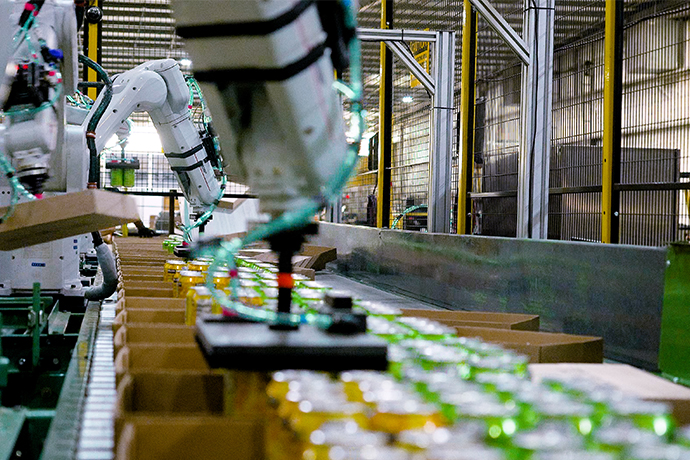
Southie's best public case study is We Pack Logistics, a contract packaging provider serving food, beverage, and consumer-goods customers. Seasonal demand creates production spikes, and variety packs create the kind of high-mix work that makes fixed automation awkward. Mitsubishi Electric engineers and Southie paired the software with Mitsubishi's RV-8CRL industrial arm, a compact six-axis machine designed for speed and a small footprint.
The published result is unusually specific: each robot can pack up to 105 cans per minute on the beverage variety-packing line. A line lead can switch to a new pack configuration, including a change in end-of-arm tooling, in ten minutes or less. The cell fits into the existing process with relatively few changes and is designed to operate safely around coworkers.
“You just stand in front of the robotic arm. Then, using the Southie App, show the robot what you want it to pick up and where you want it to place the object.”Harish Sampathkumar, Southie chief architect
What did it cost? Southie does not publish a dollar price. It has said its solution costs at least 50 percent less than other automation options, but every cell is at least slightly customized. The credible answer is therefore structural, not numerical. A buyer pays for software, hardware, end tooling, safety, integration, and support, with either a capital purchase or recurring RaaS model. The financial pitch is that faster reuse across many SKUs keeps the machine earning instead of marooned between programs.
03 / The wedge
The first thing to fail was the ROI
Southie's founders did not discover that robot arms were incapable. Rahul Chipalkatty and Jay M. Wong came from Draper Laboratory, where they worked on autonomy in unstructured environments. Their observation was more commercial: automation's return collapses when a specialized programmer must revisit the cell every time the job changes. The hardware remains impressive while the spreadsheet quietly becomes embarrassing.
That changed the product question. Instead of asking how to make a more exotic arm, Southie asked how a machine operator could teach an existing arm. Early descriptions called the full solution Codiac and featured a handheld pointer called “The Wand.” Later materials emphasize the tablet-based Southie App, task libraries, AI-assisted vision, and turnkey cells. The interface evolved, but the conviction stayed put: make the changeover feel more like showing a coworker than commissioning a machine.
The market wedge follows naturally. Southie targets contract packagers, manufacturers, retailers, logistics providers, and defense maintenance teams. These customers have repetitive motions but unstable schedules: kit parts for an aircraft toolbox, assemble subscription boxes, pack seasonal beverages, or palletize a shifting product mix. A conventional dedicated line wins when the product never changes. Southie is interesting precisely where that assumption breaks.
Where it fits
Frequent SKU changes, structured pick-and-place work, labor shortages, reusable tasks, available floor space, and enough volume to keep a flexible cell busy.
Where it strains
Highly deformable or unpredictable items, rare one-off jobs, extreme speed or payload needs, safety-heavy layouts, and stable production where fixed automation already wins.
04 / The machinery around the machine
Partnerships are part of the product
A five-person robotics startup cannot manufacture every arm, service every factory, finance every cell, and sell into every industrial account. Southie's partner map is therefore revealing. Mitsubishi Electric supplies hardware depth, engineering help, training, marketing support, and credibility through its e-F@ctory Alliance and Diamond Partner OEM program. Nulogy brings access to the contract-manufacturing and co-packing world through software already used to run shop floors. MassRobotics supplies the local ecosystem and laboratory neighborhood.
The financing stack is similarly practical. In May 2022, Southie announced a $2.5 million seed round led by BootstrapLabs, with Ocean Azul and Kineo Finance participating. Kineo also supplied a $5 million leasing facility to support RaaS deployments. That facility is not the same thing as $5 million of equity in the bank. It is capacity for putting machines at customer sites without forcing every buyer into a large upfront purchase.
The U.S. Air Force offered a different proving ground. A roughly $1.5 million Phase II SBIR contract supported a dual-armed mobile system for assembling aviation kits at the Oklahoma City Air Logistics Complex. Manual kitting consumes hundreds of labor hours and creates repetitive work. The program tested whether Southie's easy-teaching thesis could travel from beverage cases to maintenance toolboxes.
05 / The copyable playbook
Steal the pause, not the robot
The most useful idea here applies well beyond robotics: find the pause that ruins an expensive asset's economics. Southie chose changeover time. A restaurant-software founder might choose menu setup. A lab-tools company might choose calibration. A construction startup might choose mobilization. The glamorous object attracts competitors; the awkward interval is often left alone.
Second, design for the least-specialized competent user. Southie does not promise that anyone can engineer a safe production cell from scratch. It promises that, after deployment, a line lead can handle supported task changes. That narrower claim is more useful. “No-code” works when the product team has already encoded the dangerous, tedious, and repetitive decisions upstream.
Third, sell the complete outcome. Southie did not stop at an app. It sources hardware, integrates it, supports it, and offers a financing path. The cost is operational complexity inside the startup. The benefit is that the customer buys throughput and flexibility instead of assembling a science project from six vendors.
“People and robots don't speak the same language. And so we decided to start this company to bridge that gap.”Rahul Chipalkatty, founder and CEO
There are conditions under which this will not work. Vision must reliably locate the item. A gripper must handle it. Cycle time must meet the line. The cell must pass safety review. Operators need training and a stable process around the machine. If every job is genuinely unique, teaching still costs too much. If one SKU runs unchanged for five years, simpler fixed automation may deliver a better return. And if customization expands without discipline, the supposedly repeatable product can collapse back into an integration consultancy.
That last risk is the quiet tension in Southie's model. Hardware-agnostic software expands the addressable market, but each new arm, camera, gripper, carton, and factory layout adds another edge case. The business becomes valuable when its library of solved tasks grows faster than the burden of bespoke deployment. It becomes painful when every sale arrives disguised as a new product roadmap.
Southie's contribution is to make this tradeoff visible. The future of factory automation may include humanoids and grand general-purpose machines. It also includes a line lead standing beside an ordinary six-axis arm, tapping a tablet, changing a gripper, and getting Tuesday's variety pack moving before the afternoon shift. That is not a cinematic future. It is a useful one.
Links / Watch and read