A customer says yes to the robot. Ribin Mathew knows how much work remains in that small, agreeable word. The machine must reach a workplace, be installed, connect to its software and keep doing its job. The people responsible for it need to understand what is inside. A purchase order can settle a sale; it cannot teach someone how to support a mobile robot on a factory floor.
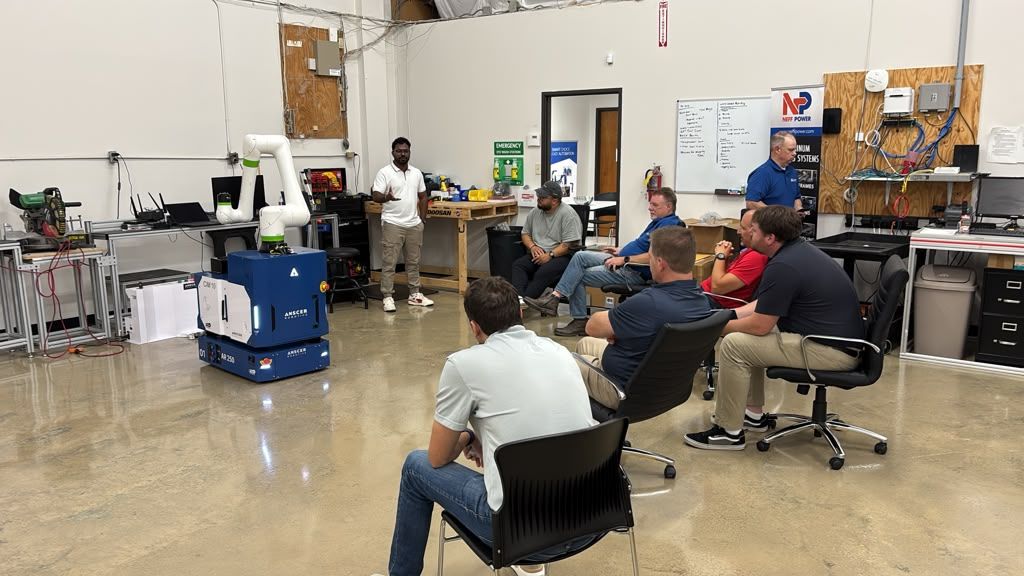
In August 2026, Mathew and his colleague Jees Johnichan hosted integration partners and distributors at ANSCER Robotics’ US office. There were presentations, but also hardware to examine and software to explore. The photographs have the pleasing untidiness of a working session: chairs pulled around machinery, laptops on benches, equipment within reach. The robot is present. So is the company that must make it useful.
Mathew co-founded ANSCER in 2020 after working as a robotics engineer. Becoming CEO added a second engineering problem. He had to help design an organisation capable of making, selling and supporting the things he knew how to build. His public accounts of that transition contain investors, vendors, reading, colleagues and customers. The machine gets the photograph. The surrounding work takes up much of the day.
The friends before the founders
The people came from several directions. Some of ANSCER’s founding relationships reached back to childhood in Kerala; others formed through college, employment and Bangalore Makerspace. Mathew, Ebin Sunny, Raghu Venkatesh and Raj Mohan brought an existing interest in robotics to a new business. Incorporation supplied a date. Their connections already had a history.
Mathew studied mechatronics at Nehru College of Engineering and Research Centre, graduating in 2017. Sunny was a classmate. Mechatronics brings mechanical systems, electronics and software into the same conversation, an apt preparation for machines that must move through a physical workplace. Mathew’s early career included Just Robotics and then Addverb, where he worked on robotics before starting ANSCER.
Money was a constraint before the company existed. Raghu Venkatesh has recalled Mathew and Sunny driving cabs and trucks while trying to establish themselves in Bengaluru. An early attempt to start a venture together lacked the funds it needed. Employment at Addverb followed, while the relationships and smaller collaborations continued. It is a less tidy beginning than the familiar scene of a founder announcing a grand idea over coffee. There were ordinary bills to pay.
By Mathew’s account, the four-person team became 27 people over a year and a half. When he returned to that memory in August 2026, he dwelt on the colleagues who could stay curious and keep working through problems. The headcount was easy to remember. Choosing people who could help the company grow was the achievement he wanted to discuss.
Early team growth, as Mathew recalled it. People, before the funding headlines.
A factory is an exacting customer
ANSCER developed industrial material-handling robots, with an early product introduced at the India Warehousing Show in December 2021. The opportunity looked like warehousing. Conversations at the show pointed the team towards manufacturing, where materials had to reach the right place repeatedly and reliably. Customers were supplying a more precise brief than the founders’ initial picture of the market.
Raghu Venkatesh has described factory conditions that forced changes to the navigation system. Older facilities could be congested and built around human movement. Then the 2022 chip shortage brought another constraint: waits of 54 to 56 weeks for critical components. The company responded with a modular approach using plug-and-play parts. A machine designed for the real world also has to be designed for the supply chain that will produce it.
Mathew had already stressed the importance of rugged factory environments in 2022. An industrial robot cannot assume that every customer has a neatly prepared setting waiting for it. That observation helps explain his interest in practical application. The buyer’s floor, workload and existing processes belong in the engineering conversation.
The company’s name spells out its chosen territory: Autonomous Navigation Systems for Controlled Environment Robots. Its platforms include mobile robots, guided vehicles and pallet-handling equipment. The ambition sits inside a defined working environment, among goods that need moving and people who have other work to do. Even the acronym has brought its own technical brief.
An engineer acquires a second syllabus
By July 2023, Mathew had been doing the founder’s job for three years. He described acquiring responsibilities in team leadership, management, business development and marketing. Investors, customers and vendors all needed his attention. Each conversation asked for knowledge that engineering alone could not supply.
He read about the subjects he needed and used TED talks to encounter different perspectives. He also emphasised acknowledging mistakes. There is a useful lack of ceremony in this account of learning: identify a gap, find something to read or hear, and return to the work with a little more understanding. The CEO title had arrived before the education was complete.
“Starting out, I didn't have all the answers, and that's perfectly okay!”
Ribin Mathew, July 2023
In October 2026, his reflections became more specific about hardware. Another iteration can mean buying parts, building again and spending more time testing. Funding, the founding team, industry knowledge and sales all enter the calculation. A revised robot brings a revised bill. Patience must find a place in the budget.
He also discussed access from outside the IIT route. Institutional reputation can help open doors, he observed, while the product eventually has to earn further attention. His question for an aspiring founder concerned readiness for the particular problems a business would bring. That is an engineer’s way of approaching entrepreneurship: look carefully at the requirements before volunteering for the assignment.
Even the colour was negotiable
Customer feedback sometimes arrived in a very visible form. In June 2023, Mathew shared a white ANSCER robot after a request for an alternative to the company’s blue machines. He credited Ramkumar K and Rahul Krishnan for the work. Beside questions about navigation and payloads, there was room for a question about the colour.
It is a small anecdote with a tangible result. The customer can point to what changed. The founder can point to the colleagues who made it happen. Listening, in this instance, produced something that could be photographed rather than another promise in a presentation.
Mathew’s concern for people also appeared in his account of work inside the company. In January 2022, he described trying to keep the team to five working days and protect weekends. His own schedule put meetings and team updates earlier in the day, with coding and product management after lunch. He was allocating time to two jobs while still doing technical work himself.
A robotics business can make the founder’s day wonderfully crowded. There are employees to hear, customers to answer and code to write. A stated working week and an afternoon set aside for engineering offer a concrete picture of how Mathew was trying to manage that crowd. The calendar, too, needed a design.
The workshop after the handshake
That US training session brought the surrounding work into view. Mathew named the integration partners and distributors who take ANSCER’s systems to customer sites, including Michael McCaffrey, Darren Brown, Rob Peggs, Timothy Preston, Richard Parkhurst, Scott Sams and Timmy Phan. Installation and support depend on their understanding of both hardware and software.
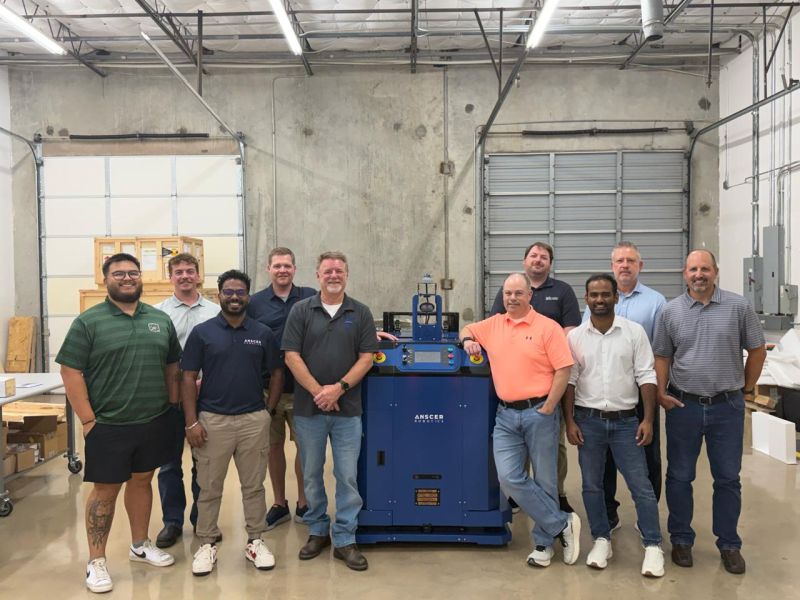
Phan’s own account adds a pleasing detail: the visitors took a robot apart down to its internals and mostly put it back together. He thanked Mathew and Johnichan for answering their questions. Curiosity was allowed to involve tools. The training gave partners something firmer to carry into customer conversations than a sales brochure.
Mathew described these sessions as recurring work. The point was to prepare the people responsible for the system after it left ANSCER’s facility. As the company reaches further afield, that knowledge must travel with it. The workshop is one way to make the distance between manufacturer and customer less troublesome.
A colleague’s earlier account offers another glimpse of Mathew’s role around the technical team. In 2023, robotics engineer Syam Gopi described working on an automatic carton-movement robot in Pune while colleagues in Bengaluru supported him. He credited Mathew and CTO Raj Mohan for their guidance. The work crossed locations before it crossed oceans.
A bigger map, the same practical questions
In February 2025, ANSCER announced a $2 million seed round led by Info Edge Ventures. Its robots had reached customers in India, the US, Singapore and Japan. Mark Messina joined as managing director and CEO for the Americas, adding another leader to the international operation. Geographic growth required people with responsibilities of their own.
Round sizes, shown on the same scale. Company funding, not personal wealth.
A $5.4 million Series A followed in May 2026, with plans to advance the product platform, scale US operations and expand the partner network. Those plans connect back to the workshop: money can support expansion, while trained people help deliver it. The two belong in the same account of company building.
September brought conditional US approval for the AR250, AR650 and AR1250 platforms. Mathew’s accompanying comments focused on customers understanding application fit and regulatory requirements. The approval carries continuing conditions. It is one practical step in entering a market where a robot must satisfy more than an engineering demonstration.
His October reflection ended with an admission that ANSCER was still learning. Six years after co-founding the company, he continued to describe new problems arriving with the next stage. The engineer had acquired a larger set of systems to work on: colleagues, customers, capital and the people who carry the technology into somebody else’s workplace. In the workshop photographs, all of that fits around a robot.
Follow the work
Conversations, company updates and a look at the robots in motion.
Ribin Mathew on LinkedIn ↗ANSCER Robotics ↗ANSCER’s YouTube channel ↗Watch: LogiMAT 2024 panel on digital transformation and human-robot collaboration ↗The 2022 conversation about Mathew’s working day ↗Inside the US partner-training session ↗Read about the 2026 Series A ↗The September 2026 US update ↗