A pallet has been put down at an angle. To a person driving a forklift, this is an ordinary nuisance: adjust the approach, line up the forks, get on with the shift. To a robot, it is a small examination in understanding the world. The pallet is present. The job is clear. The geometry is inconvenient. Industrial automation earns its money in precisely this sort of inconvenience.
Seegrid makes autonomous lift trucks and tow tractors for factories, warehouses, and logistics facilities. Its machines transport the things that must arrive before somebody else can do their job: parts, pallets, finished goods, trains of carts. The glamour budget is modest. The consequences of arriving late are less so.
- The job: automate repeated pallet and cart movements inside industrial facilities.
- The trick: combine predictable travel with flexible local handling.
- The scale: Seegrid reports 20 million production miles and more than 2,500 deployed robots.
- The lesson: measure the whole material journey before buying the machine.
In May 2026, Seegrid reported 20 million autonomous miles in customer production environments, with zero recordable safety incidents. The distinction between production and a demonstration matters. A demonstration has an audience and a finish. A production shift has another shift behind it.
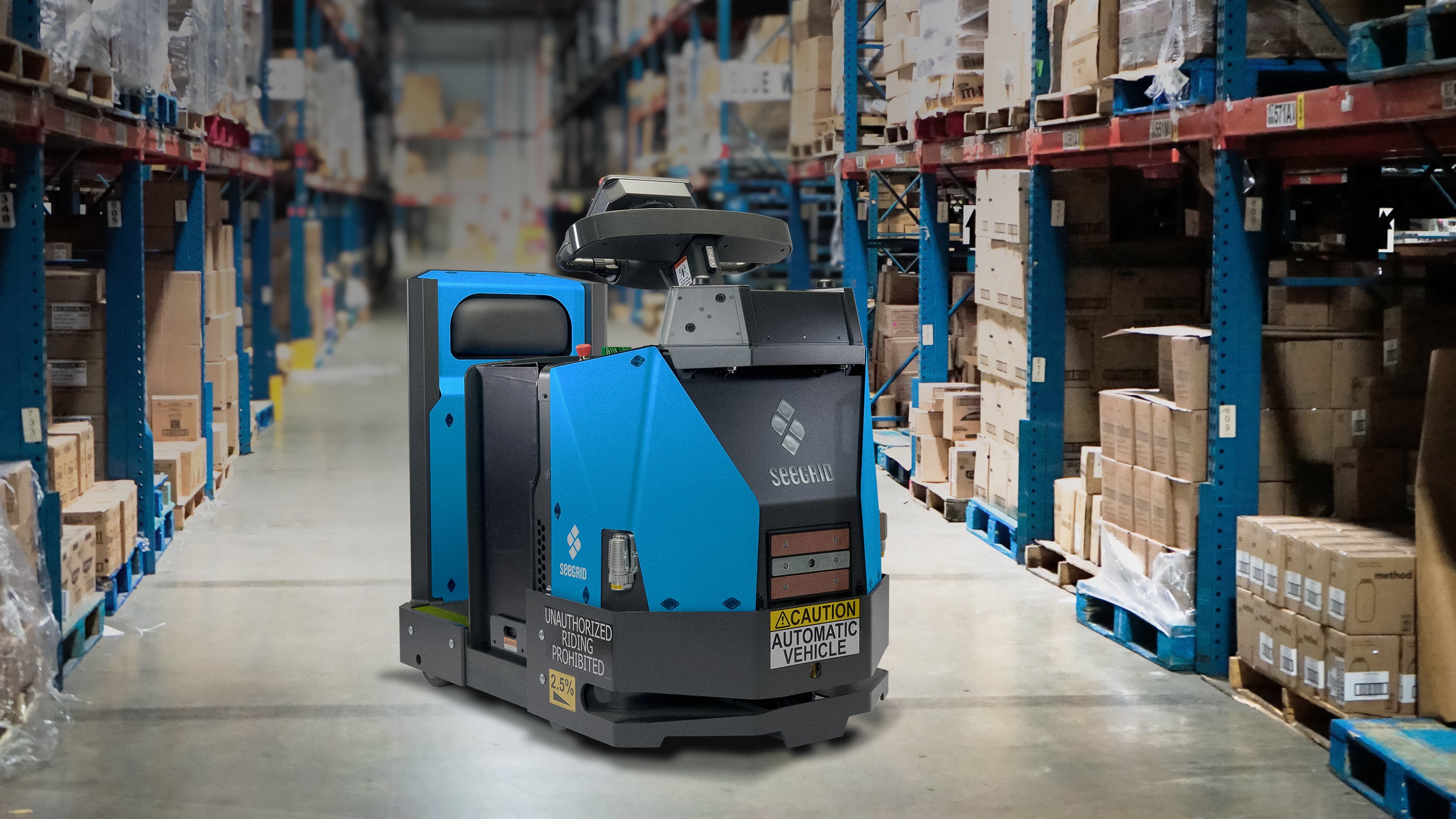
A machine that notices the crooked pallet
Founded in 2003 by Hans Moravec and Scott Friedman, Seegrid grew from the world of robotics research into the world of industrial material movement. Moravec’s name gives the company an intellectual pedigree. A warehouse manager still needs the next load delivered.
The early proposition was vision-guided navigation without installing the physical guidance infrastructure associated with older vehicle systems. A vehicle could locate itself by understanding its surroundings. That is an appealing bargain in an existing building: add autonomy while keeping the building useful.
Today’s Seegrid technology combines stereo cameras, proprietary computer vision, and 2D and 3D LiDAR. Its “Sliding Scale Autonomy” uses predictable routes for repetitive long-haul movement and more flexible planning around local pallet-handling tasks. The useful idea is that an industrial robot need not exercise the same freedom everywhere.
A schematic of the operating idea, not a floor plan.
Consider that crooked pallet again. The handling problem calls for an adjustment. The long journey across the factory calls for consistency. Give each part of the job the behavior it needs, and the apparently dull route becomes an engineering choice rather than a limitation.
Seegrid expanded its perception capabilities by acquiring Box Robotics in October 2020. The Philadelphia startup brought expertise in high-definition maps, 3D LiDAR, and deep learning. The purchase price was undisclosed. It is a concrete marker of how the company’s technology broadened beyond its original vision-led identity.
The business ran out of room before the robots did
There is a temptation to tell robotics history as a sequence of successful demonstrations. Seegrid’s includes a debt maturity date.
In summer 2014, a large portion of the original company’s debt came due. It lacked the cash to meet those obligations. According to restructuring adviser SSG, outside fundraising efforts had not produced the necessary money. All but one lender agreed to extend maturity. The company filed for Chapter 11, and the reorganization closed in January 2015.
Giant Eagle, the grocery operator, was its largest shareholder and lender. There is something pleasingly practical about a supermarket business helping to finance warehouse robots. Groceries have to move long before they can be admired on a shelf.
The documented failure was financial. That distinction is useful to anyone building hardware: technical usefulness and the ability to finance a business proceed on different clocks. A working robot cannot negotiate an extension with a creditor.
Separate announced rounds, not a lifetime funding total.
The later funding record shows a business able to attract capital again. Seegrid’s 2020 growth-equity round closed at $52 million, including an earlier $25 million tranche. In September 2024, it announced a $50 million Series D funded by Giant Eagle, G2 Venture Partners, and other existing shareholders. The stated purpose of that round was to accelerate autonomous lift-truck initiatives. October 2025 reporting described roughly $25 million raised toward a further $50 million offering goal.
The product direction became more expansive: towing remained, while lift trucks addressed vertical handling and pallet manipulation. These announcements document a broader offering. The new trucks give customers a way to automate the pickup and placement as well as the journey between them.
The waiting room is part of the factory
A factory contains spaces where work waits. A machine finishes its cycle before the next process is ready. A shipment arrives before it can leave. A pallet sits between two perfectly sensible activities, becoming everybody’s minor problem.
Seegrid’s Autonomous Buffer Management addresses that interval. Lift trucks and software coordinate the temporary storage and retrieval of pallets between processes. The applications include work-in-process buffers, cross-docking, shipping and receiving, and parts-to-line replenishment. The value sits in the connection between tasks.
This is where Fleet Central enters the story. It assigns jobs, coordinates vehicle traffic, monitors status, and manages charging. Seegrid says it integrates with existing warehouse, enterprise, and manufacturing systems. It also describes mixed-vendor orchestration through VDA 5050-compatible equipment. Compatibility is a purchasing condition, not permission to assume every robot will cooperate.
“It saves me a lot of time driving to and from the DSD area”Mike Key, forklift operator, DHL Supply Chain, quoted by Seegrid
The software has a distinctly industrial commercial detail: Fleet Central is listed as a perpetual license with a one-time fee. It runs on a dedicated server supplied by the customer or purchased from Seegrid. Calling the entire business SaaS would conceal more than it explains.
Less driving, more doing
Seegrid’s public customer material includes Whirlpool, DHL Supply Chain, Guardian Industries, and Sumitomo Drive Technologies. Boeing and Giant Eagle also appear in customer case studies. Historical Zulily material describes the usefulness of flexible automation in a changing facility. These are concrete industrial settings, rather than a promise that every warehouse wants the same robot.
Mike Key’s comment gives the proposition a human scale. Time spent traveling between areas can be returned to picking and staging. Whirlpool’s customer account similarly describes shifting employees from repetitive work toward more valuable roles. The worker’s experience is a better guide to the application than a photograph of an empty driver’s seat.
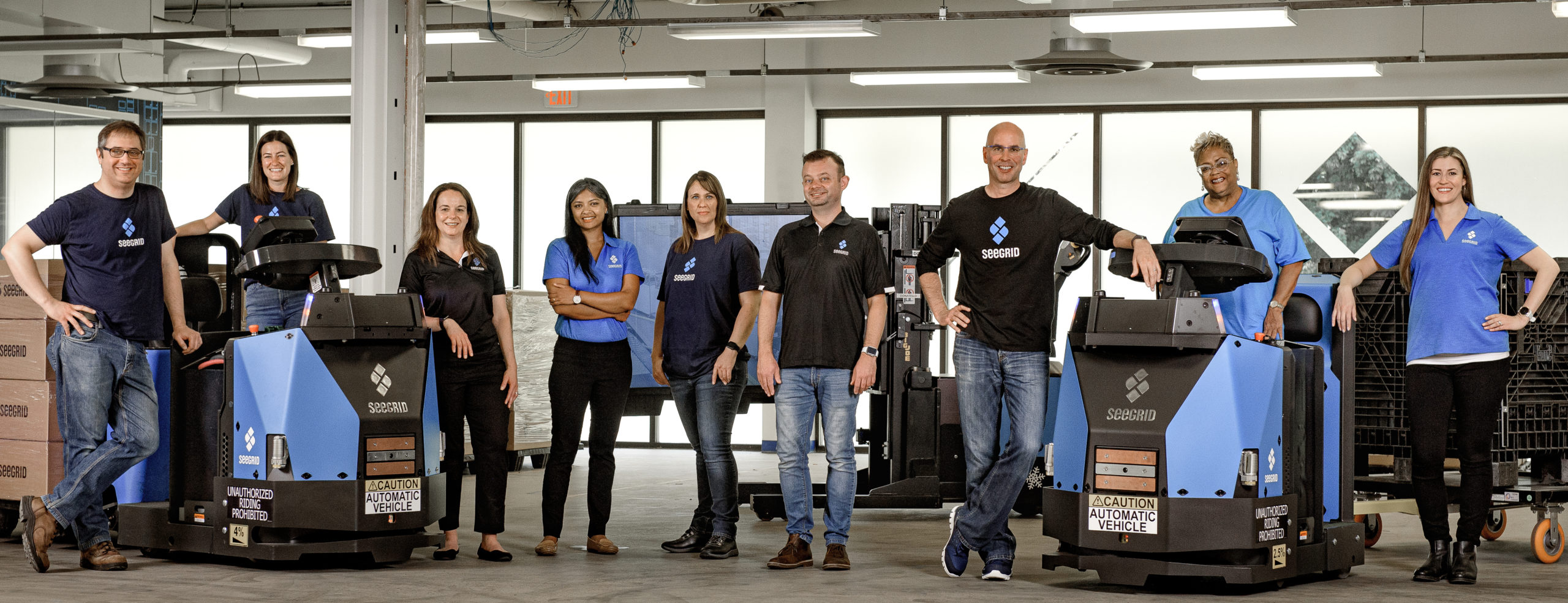
The company’s services extend through application engineering, deployment, training, and ongoing support. Those activities belong in the product discussion because a robot arriving at a loading dock is only the beginning of an automation project. People still need to agree on the job, the handoffs, and what happens when the ordinary day stops being ordinary.
Seegrid competes in a market that includes autonomous forklift suppliers such as BALYO, Vecna Robotics, AGILOX, VisionNav Robotics, and Toyota Material Handling. ABI Research includes these companies in its vendor assessment. Vision-guided autonomy alone is therefore an insufficient explanation of Seegrid’s position. Its heavy material-handling focus, hybrid operating approach, and accumulated deployment experience make the more specific case.
Buy the journey, then choose the robot
The current vehicle choices clarify that focus. The Tow Tractor S7 tows cart trains with a published 10,000-pound capacity. The Lift RS1 handles up to 3,500 pounds and lifts to six feet. The CR1 extends to 4,000 pounds and 15 feet. The compact EL1 is positioned for constrained spaces and frequent low-lift moves.
Published maximum lift heights. Payload and application requirements must also fit.
Buying one begins with the workflow. Count journeys per shift, payload variation, waiting time, charging opportunities, and the interventions a person must make. A robot capable of the required lift height may still be the wrong investment for a route with too little work or a handoff nobody has organized.
Seegrid advertises payback in six to 24 months on its CR1 page. Treat that as a vendor range to test against your own operation. In 2021 it introduced RaaS alongside purchase and leasing; its current Seegrid Capital offering promotes flexible financing. The hardware, integration, support, and utilization all belong in the arithmetic.
Recent announcements add signs of an enterprise supplier’s priorities: Chris Baker became CEO in September 2025, and Seegrid announced ISO/IEC 27001:2022 information-security certification that November. Data security matters when fleet software connects to factory systems. It answers a different question from whether a vehicle can safely acquire a load.
The reader can copy the discipline even without buying the robots: select a repeated material movement, measure it, organize the handoffs, and test improvement against completed work. Seegrid’s most interesting ambition is to make a journey so dependable that nobody tells a story about it at the end of the shift. For the person waiting on those parts, silence is a handsome result.