There is a door in Bright Machines’ newest robot cell. Open it, and the robotic arm deactivates. A person enters, follows instructions on a screen and performs an assembly step. The system checks the work and preserves the record. For a company selling automation, the door is a revealing detail: the factory must account for what happens when automation needs help.
- The job: build AI infrastructure with software-controlled assembly.
- The difference: connect the design, the robot and the production record.
- The catch: the economics depend on volume, product stability and integration.
Most of us meet AI through a text box. Bright Machines meets it through the hardware underneath: servers, racks and storage systems. Its current proposition, Bright Factory, connects digital product development, robotic assembly and production data. It is an attempt to make the route from an engineer’s design to a working machine more repeatable, and less dependent on a succession of disconnected handoffs.
The door in the robot cell
Consider what an assembly history is for. A finished unit passes inspection today. Months later, someone investigating a fault wants to know what happened during its manufacture. A final pass/fail result answers only one question. The steps before it are where an explanation may be hiding.
Bright Machines’ July 2026 Hybrid BRC announcement identifies a particular gap: taking a partly assembled unit out of an automated flow for manual work can detach that work from the production record. The new cell keeps prescribed human assistance inside the monitored environment, with checks for missed steps, incorrect installs and wrong components. The traceability stays attached to the serial number.
“AI infrastructure customers need a manufacturing partner that can keep pace when manual intervention is required without trading away data insights.”
Sviat Dulianinov, CEO · July 2026
The interesting ambition here is continuity. A product can change hands without losing its history. My reading is that this is a more useful test of an intelligent factory than whether it looks impressively empty in a photograph. Exceptions deserve a process of their own.
A factory written in recipes
The earlier Bright Machines idea was the Microfactory: a modular assembly line built from configurable robotic cells. The company dates its first deployment to 2019. Its current company history reports 130 Microfactories worldwide. Think of a row of workstations that can be arranged around an assembly task, rather than an entire building shrunk in the wash.
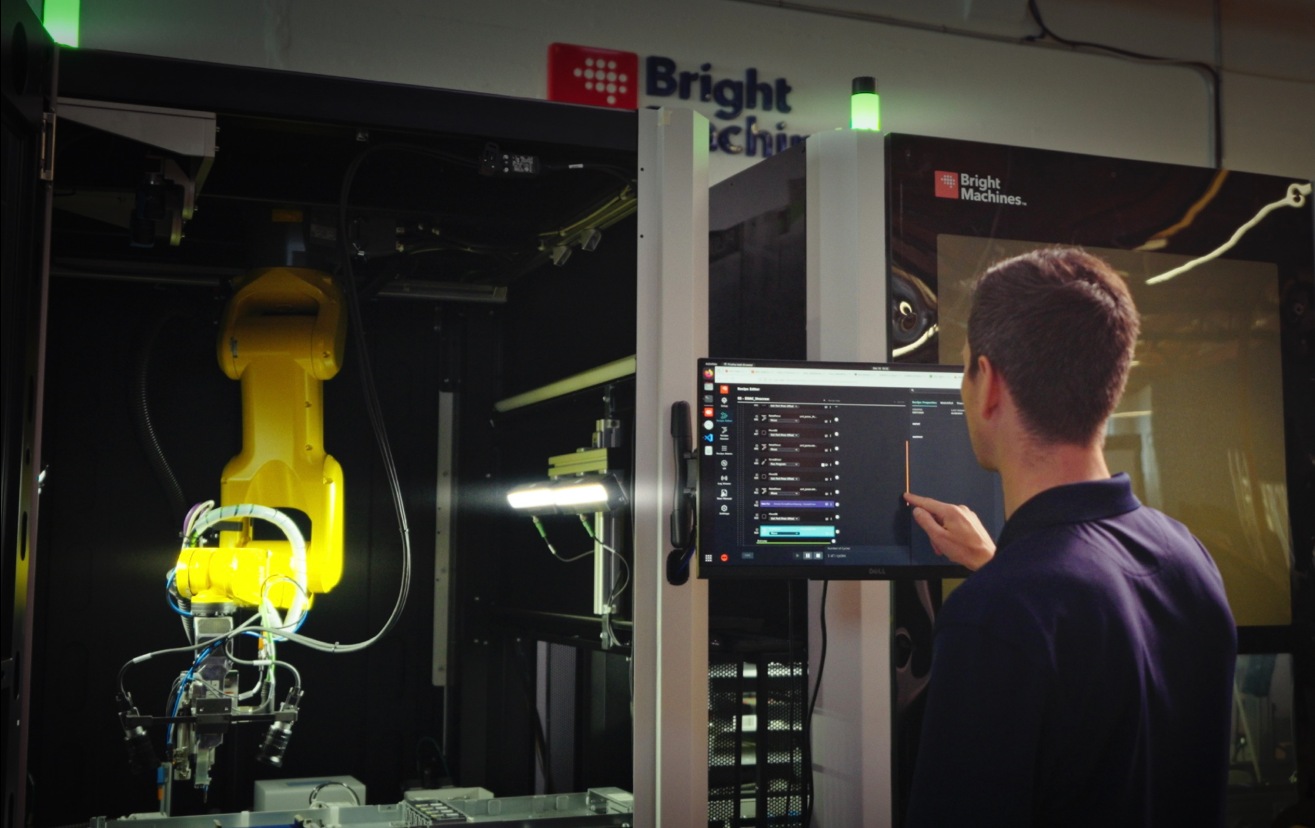
Brightware supplies the coordinating software. A 2021 regulatory filing described assembly “recipes”: high-level task logic abstracted from the particular hardware underneath. The attraction is reuse. If an assembly process changes, engineers should be able to carry forward more of what they already know, instead of rebuilding every instruction from the ground up.
Then comes the awkward fact that real parts refuse to behave like perfect drawings. Bright Machines’ Smart Skills technology uses 3D vision and force sensing to accommodate differences in position and orientation. Its machine-learning inspection examines specific regions for such problems as debris or improperly closed latches. Before and after checks help distinguish a misplaced incoming component from a step executed incorrectly.
That combination explains the company’s expertise: mechanical handling, perception, software control and the discipline of checking the result. A robot arm alone supplies only part of the answer. Someone still has to determine what it should do, how it knows it succeeded and which information survives the operation.
The robot gets a vote before the drawing is finished
A design can be perfectly sensible to its designer and thoroughly inconvenient to its assembler. Bright Machines’ design-for-automated-assembly argument is that waiting until physical prototypes exist leaves fewer economical choices. The product is already committed to details that automation may struggle to handle. The factory inherits the compromise.
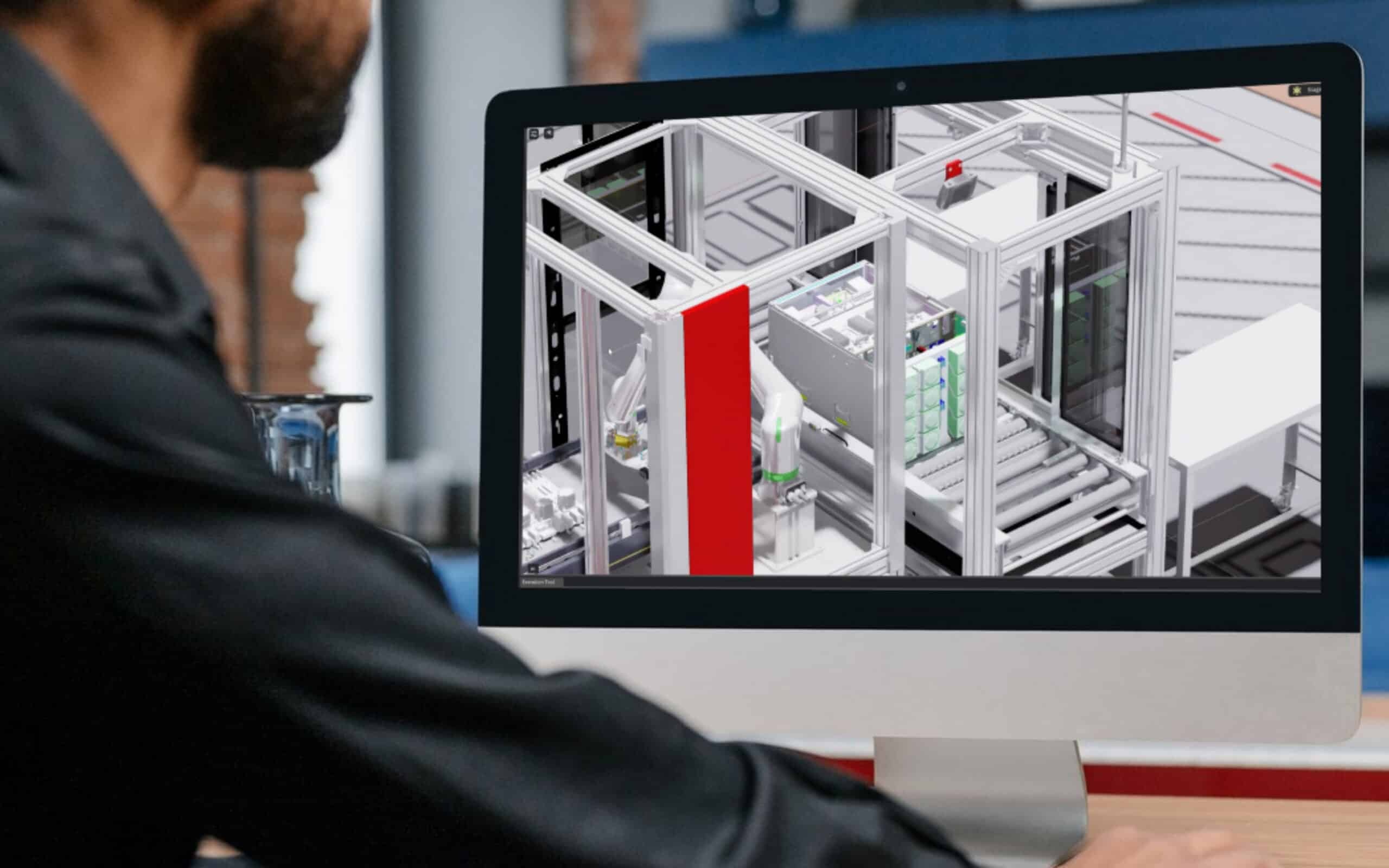
In March 2025, Bright Machines announced a private preview of Bright Designer, a web application for improving CPU- and GPU-based server designs with automated assembly in mind. NVIDIA Omniverse technologies provide simulation capabilities; Microsoft Azure supplies the cloud environment. Jabil was named as a collaborator expected to use the tool. That was a preview announcement, a distinction that matters when assessing a product’s maturity.
- 01Design
- 02Simulate
- 03Assemble
- 04Inspect
Production data returns to the next design decision.
This is the useful lesson for people who will never buy a Bright Machines line: invite manufacturing into the design review early. Ask how the part will be located, held, installed and checked. It is a rather cheap conversation compared with revising a product after production engineering has begun.
The money arrived. The listing did not.
Bright Machines was founded in 2018. Co-founder Amar Hanspal brought an enterprise-software background; co-founder Lior Susan also founded investor Eclipse. Eclipse’s launch account announced $179 million in backing. This was a company beginning with substantial capital and industrial ambitions, rather than a weekend prototype looking for its first customer.

The proposed shortcut to the public markets did not survive. In December 2021, Bright Machines and SCVX terminated their merger agreement, citing market conditions and the low likelihood of completion before the agreement’s January deadline. Hanspal stepped down that month. These are documented events; they do not establish that the manufacturing technology failed.
The company continued with private financing. Its October 2022 announcement split $132 million into $100 million of Series B equity and $32 million of debt. The June 2024 package similarly combined $106 million of equity with $20 million of venture debt. Funds and accounts managed by BlackRock led the equity, with NVIDIA, Microsoft, Eclipse, Jabil and Shinhan Securities participating.
A financing mix, not an operating result.
The capital was earmarked for product development, assembly flexibility and partner relationships. Microsoft had already announced an Azure collaboration the previous month. The present company describes itself as a manufacturer of AI infrastructure. The narrower focus gives its software-and-robotics proposition a concrete customer problem: getting complex hardware into service.
The arithmetic under the glass
What does all this cost? A historical example is more instructive than a vague promise of efficiency. A 2021 company investor presentation described software-controlled assembly of memory modules and heat sinks in networking equipment. It showed a $1.4 million investment, estimated annual savings of $1.5 million and an 11-month payback. Those were company figures for a particular case, not a current price list.
The next question is what could spoil the calculation. Bright Machines’ own automation investment discussion supplies illustrative arithmetic: a $1 million system saving $500,000 annually pays back in two years. If savings halve, payback stretches to four. If missing requirements lift the initial bill to $1.5 million, the original savings imply three years. None of these examples requires a broken robot. Changed assumptions do the damage.
Illustrative simple payback examples from the company’s January 2023 discussion. Financing and discounting excluded.
Earlier deployments also show that speed is only one reason to automate. An anonymous coffee-maker case study described operators struggling to align two components, producing a 60% yield. Company tests and projections suggested that precision handling and inspection could lift yield above 95%. The customer wanted less dependence on scarce labor; the quality problem made the intervention more interesting.
A factory close to the customer
Bright Machines occupies the space between a robotics supplier, a manufacturing-software company and a production partner. Its edge manufacturing model proposes bringing standardized production close to infrastructure deployment. The customers are businesses: hyperscalers, electronics makers and manufacturing partners. The alternatives include manual assembly and custom automation engineered for a particular line.
Commercially, that means more than a software login. The 2021 filing described equipment bundled with operating software and deployment services, support renewals, and three-year as-a-service arrangements. Today’s Bright Factory pitch emphasizes embedded manufacturing. Evaluating it requires examining the whole engagement: engineering, equipment, integration, operations and data responsibilities.
Nor does “AI-enabled” mean that a language model directs every movement. In its published physical-AI architecture, Bright Machines keeps time-sensitive motion and safety under deterministic control. AI helps interpret patterns and recurring failures. Monitoring and fallback logic matter because lighting, component lots and product revisions change. An intelligent system still needs rules for when to defer.
For a buyer, the sensible starting point is the actual constraint: repeated rework, difficult inspection, slow changeovers or missing records. Low utilization can make expensive equipment hard to justify. A design that resists automation can swallow the expected savings. A robot does not abolish those conditions; it joins them.
The part worth copying is the insistence on joining the steps. Bring assembly into design. Record the exceptions. Recalculate the return when demand changes. Then return to that small door in the cell. A factory that remembers what happened when the robot stopped has something useful to say about the machine that eventually ships.