The useful machine
A forklift has none of the vanity of a sports car. It is square because square things fit around pallets. It is heavy because the alternative is embarrassing. Its daily trick, performed millions of times without applause, is to put one object where another person needs it. This lack of romance is precisely what makes the machine an interesting test for autonomy. A driver does not merely steer. The driver judges clearances, finds a pallet pocket, notices a bent rack, corrects a crooked approach and continues while the warehouse rearranges itself in small, inconvenient ways.
Luyang “Andy” Li began on the other side of that problem, in the mathematics of seeing. At the Chinese University of Hong Kong, his research examined how mobile robots could estimate their position and follow a trajectory using cameras, inertial sensors and the visual features already present in an environment. The aim was not to make a robot admire the scenery. It was to let the machine know where it stood when GPS, a prepared map or a direct position measurement could not be trusted.
The titles of Li's early papers read like the parts list for a future company: visual servoing, trajectory tracking, omnidirectional vision, odometry, sensor fusion. One paper sent an underactuated robot across the surface of water. Another dealt with wheeled robots. Then, in 2015, Li and four colleagues published a short IEEE conference paper with an exceptionally practical noun in its title: forklift.
The paper with forks
The 2015 system used visual localization and motion control to carry out transport work in factories and warehouses. Its experiments took place in a factory, not in the frictionless kingdom of the slide deck. The author list also reads, in retrospect, like an early company photograph. It included Li; Yunhui Liu, who would become VisionNav's chairman; and Mu Fang, who would become its chief technology officer.
Li completed his PhD that year. In 2016, he co-founded VisionNav Robotics with Liu, Fang and Yujie Lu. Academic work had supplied a set of answers, but industry was about to ask ruder questions. Could the system work around imperfect pallets? Could customers install it without remaking their buildings? Could a vehicle lift high, turn tightly and survive the daily improvisations of production?
“Gradually specializing, from shallow to deep.”Andy Li on competing in demanding mobile-robot applications
Li's phrase is wonderfully free of fireworks. “Deep water,” in this business, means the cases where technical requirements accumulate: high racks, narrow aisles, irregular cargo, indoor-to-outdoor travel, trailers, multiple vehicles and schedules that cannot be settled by two robots politely taking turns. Every extra axis gives reality another chance to object.
From a clever machine to a working system
VisionNav's first public recognition arrived early. In 2017, its vision-based intelligent forklift system received a Certificate of Merit in the Hong Kong Awards for Industries. The judges named seven patented technologies, including simultaneous localization and mapping, real-time visual localization, obstacle avoidance and online path planning. More tellingly, they noted that the system detected natural features instead of relying on fixed markers. Customers did not have to rearrange a facility simply to make the robot feel clever.
There is a commercial philosophy tucked inside that engineering choice. Industrial customers rarely buy a blank sheet of paper. They own aisles, racks, conveyors, vehicles, software and habits accumulated over years. A robot that demands a perfect new world has designed itself for somebody else's budget.
The distance from one to N
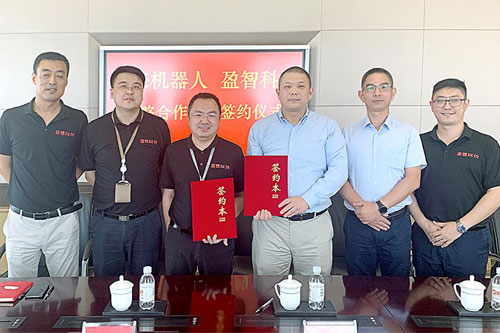
By 2020, Li was talking not only about solving a case but reproducing it. At a cooperation signing with logistics integrator Yingzhi Technology, he described an ambition to move from “1” to “N.” It is a compact description of a long operational headache. One successful installation may depend on heroic engineers and a forgiving customer. The next hundred require standard parts, predictable commissioning, support teams, training, scheduling software and an unromantic supply of replacement components.
The company began to accumulate the evidence that repetition was possible. It said it had completed more than 50 projects by September 2020. When VisionNav announced a $50 million Series C in 2021, the figure was nearly 150 delivered projects. More than 70 percent of its team, the company said, worked in research and development. The startup was adding product depth while learning the separate craft of delivery.
Capital followed. The 2021 round included ByteDance, Shunwei Capital, CICC, IDG Capital, Lenovo Ventures and Eastern Bell Capital. In April 2022, VisionNav announced a Series C extension of more than $80 million led by Meituan and 5Y Capital. TechCrunch reported the round as 500 million yuan, about $76 million at the time, and put the company's valuation above $500 million. The numbers differ by conversion and announcement, but their purpose was plain: new technology, more stable products and localized delivery for customers outside China.
Li said sales had increased tenfold between 2019 and 2021. Such figures belong to a financing announcement and deserve that context. More revealing was his diagnosis of where robotics was heading: away from novelty and toward large-scale, standardized delivery. In other words, the problem was no longer merely whether a forklift could drive itself. The problem was whether a company could make autonomy ordinary.
A factory-tested vision-guided forklift appears in Li's academic work.
Li and three co-founders establish VisionNav Robotics.
The forklift system earns a Hong Kong industry design merit award.
A Series C extension funds product work and international delivery.
VisionNav reports 800-plus deployments across more than 30 countries.
The first believer
For all the attention paid to sensors, Li's recent public writing lands on a more human mechanism: trust. Recalling VisionNav's early days in the United States, he wrote that the company had no local team and no American customer studies. Erik, the president of ducting manufacturer Nordfab, chose to become one of its first US customers. He then opened the factory for other clients to tour and endorsed the young supplier personally.
“Erik and Nordfab have taught us just how powerful trust can be,” Li wrote. It sounds almost quaint beside laser sensors and deep-learning perception, which is why it matters. A factory manager who lets an unfamiliar autonomous vehicle into production is lending more than floor space. The customer is lending uptime, credibility and the patience required to discover what the brochure neglected.
A robot earns confidence one uneventful trip at a time. A company does much the same.
That early customer also became a bridge. Prospects did not have to accept a founder's account of reliability; they could walk through an operating plant. The factory tour turned private confidence into public proof. In industrial technology, this is a useful form of storytelling: a machine completes its route while everybody watches for the moment it does not.
Research that kept its work boots
Li's academic record did not vanish when he became an executive. Tatler Asia credits him with more than 20 papers and more than 50 technology and product-design patents; in 2023 it named him to its Gen.T Leaders of Tomorrow list in Hong Kong. The published work gives his founder story unusual continuity. The 2012 researcher fusing vision and odometry, the 2015 author testing a forklift and the present-day CEO selling autonomous industrial vehicles are recognizably occupied with the same question.
The question has simply widened. A single vehicle must perceive and move. A fleet must negotiate traffic, jobs and priorities. A company must coordinate product, service, integrators and customers across borders. VisionNav now describes nine product series, including autonomous forklifts and mobile robots, joined by a central robot-control system. It reports more than 800 projects in over 30 countries and a workforce above 500. These are company-reported figures, but they mark the scale of the operating puzzle Li chose.
Its stated ambition is broader still: accessible, reliable automation that allows humans and robots to work together, while shifting repetitive, risky and physically intense tasks toward autonomous vehicles. That mission avoids the old fantasy of the immaculate lights-out factory. Real warehouses have people in them. They also have broken shrink-wrap, late trucks, damaged pallets and Tuesday afternoons. The future arrives there wearing a high-visibility vest.
Li's story is therefore less about replacing a driver than translating a body of research into dependable work. The translation runs through patents and products, certainly, but also through customer pain, field installation and the humbling discipline of doing it again. The autonomous forklift is the visible artifact. Repeatability is the actual invention.
A decade after that paper, the machine still performs the same modest miracle: lift, carry, place, return. Only now it looks around first.