The interesting thing about a warehouse robot is not that it can pick up a box. A coat hook can hold a box. The interesting thing is what happens when the box is replaced by a glossy packet, the packet by a loose shirt, and the shirt by a bottle wedged beneath something whose designer plainly never considered suction cups.
Warehouses are museums of commercial whim. Their exhibits arrive without warning and leave before anyone has learned their shape. Conventional automation copes by removing surprise: fixed products, fixed routes, fixed gestures. Covariant was founded on the opposite proposition. What if surprise were not an exception to engineer away, but the material from which the machine learned?
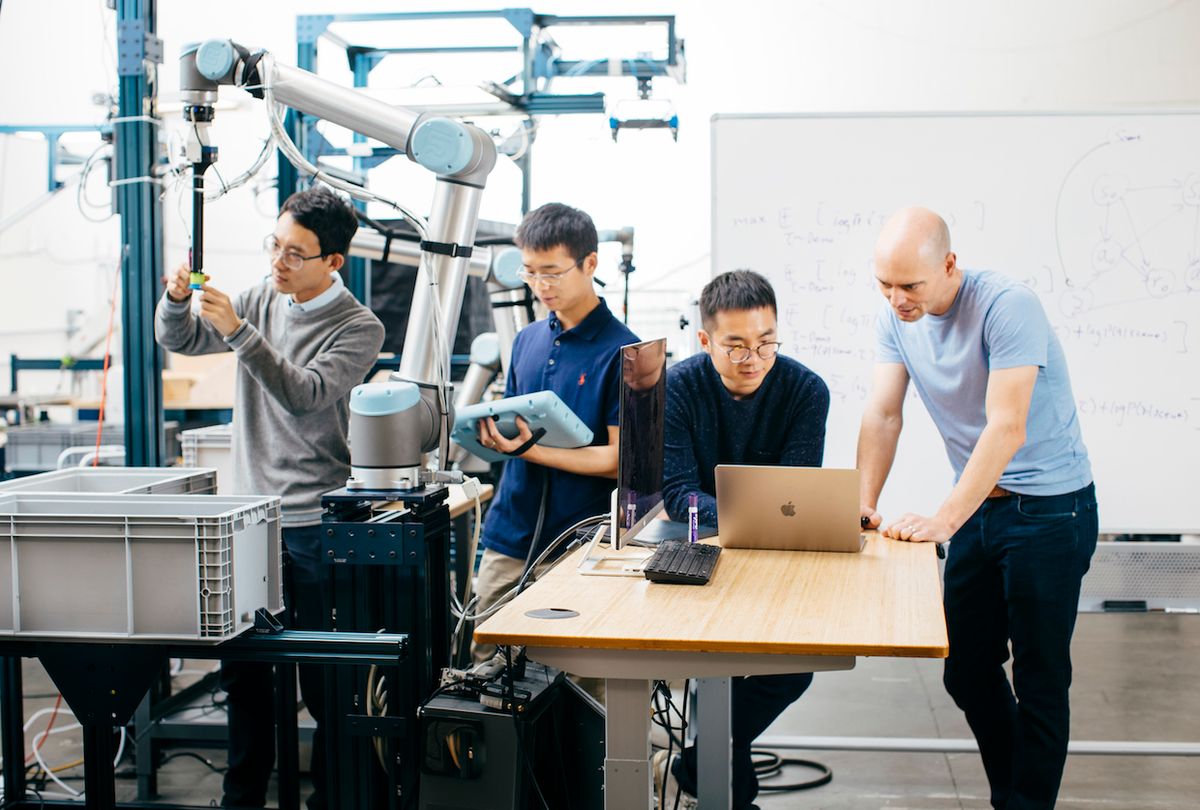
The four founders - Peter Chen, Pieter Abbeel, Rocky Duan and Tianhao Zhang - came from UC Berkeley's robot-learning world; three had also worked at OpenAI. They founded the company in 2017 as Embodied Intelligence. Their research credentials were immaculate, which was precisely the danger. A robot can appear marvellous in a laboratory where the towel is always twelve inches square and the table is always obliging. Bring home a denim jacket, and the miracle develops stage fright.
The year spent looking for a problem
The young company did a notably unfashionable thing: it asked. For almost a year its founders spoke with hundreds of businesses across manufacturing, farming, construction, healthcare, hospitality and logistics. They had a general technology and resisted pretending that this amounted to a specific customer.
Logistics won for three reasons. Warehouses had genuine labor pressure. They contained millions of changing products, an endless supply of training examples. And mistakes were survivable. A self-driving car that learns by crashing is a menace; a picking robot that misses can drop the item back into the tote and try again. Covariant had found a classroom where tuition was paid in retries.
The pressure now is on the hand part.Pieter Abbeel, on what warehouse automation had left unsolved
The warehouse, as Abbeel described it, had already automated the work of legs. Conveyors carried parcels. Mobile robots moved shelving. The stubborn frontier was the work of hands: separating, grasping, scanning, sorting and placing objects that no engineer had modelled in advance.
An ordinary arm with an immodest brain
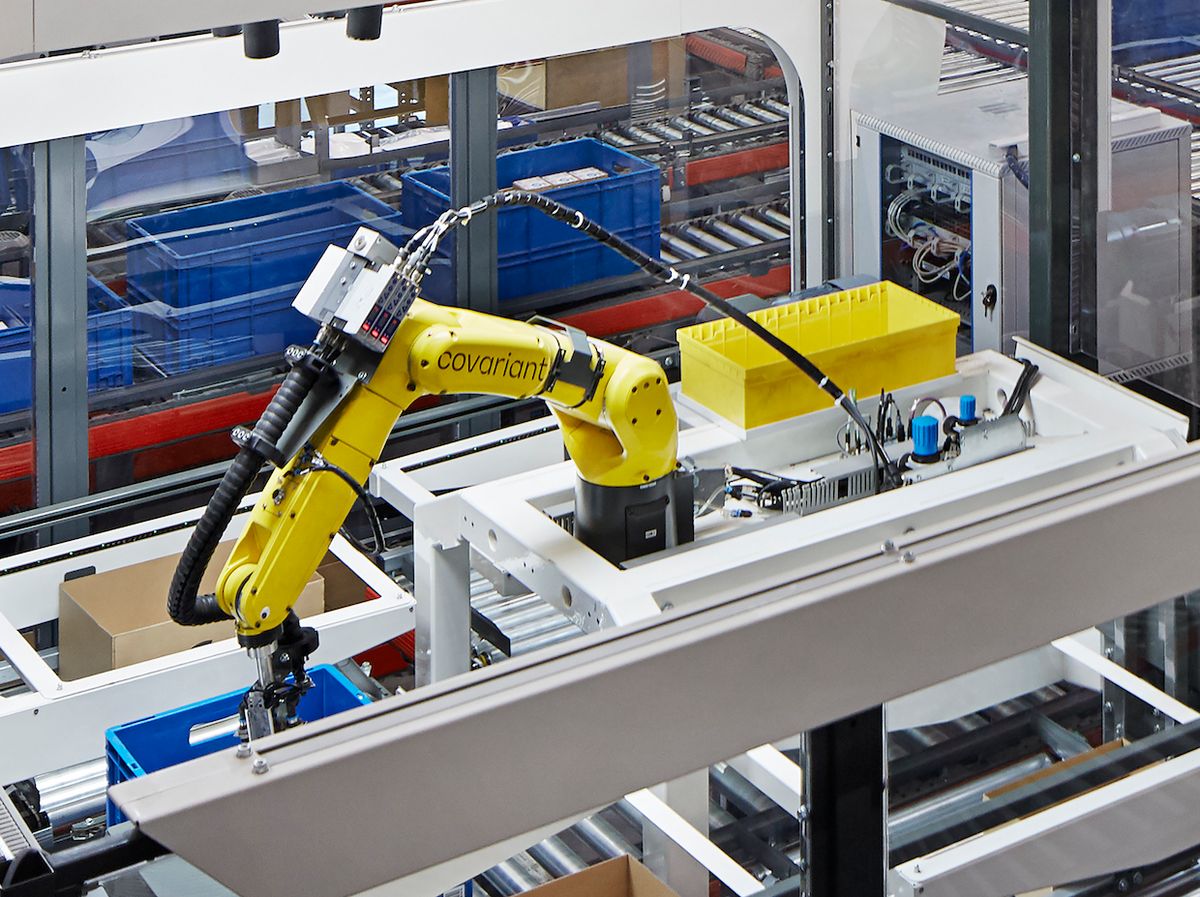
Covariant's early production setup looked almost disappointingly plain: an off-the-shelf industrial arm, a camera and a suction gripper. The product was the software joining them. The Covariant Brain combined visual perception, real-time motion planning, imitation learning and reinforcement learning in one large model. Instead of maintaining a separate program for every stock-keeping unit, it tried to infer how a new object might be grasped from experience with other objects.
This was Covariant's distinction in a crowded automation market. Competitors could also combine arms, cameras and neural networks. Covariant wanted the learning to travel - across products, grippers, stations and customer sites. Each deployed robot was both worker and correspondent. The more varied the correspondence, the more useful the common model might become.
Yet a warehouse does not pay for an elegant philosophy. It pays for completed orders. At 300 picks per hour, 99 percent success sounds handsome until one notices that it produces roughly three failures every hour. If a person needs two minutes to rescue each failure, the last decimal point determines whether that person supervises ten stations or hovers over one.
At 300 attempts per hour, one failure in a hundred means three interventions. Speed magnifies tiny error rates. In production robotics, the impressive number is not the accuracy in isolation; it is the labor and downtime left behind.
The software had to survive the conveyor belt
The first public proof came through KNAPP at Obeta, a German electrical wholesaler. The robot handled the enemies of machine vision - reflective packages, shiny surfaces and goods in plastic bags - while filling real orders. Covariant later packaged the intelligence into workflows: goods-to-person picking, induction onto conveyors, kitting and robotic putwalls that sorted mixed batches into order cubbies.
At Radial's Trade Port 2 facility, twelve U-shaped robotic putwalls were integrated with the warehouse-management and pick-to-light systems. Covariant reported about 425 placements an hour and roughly 100,000 picks per robot each month at full operation. The revealing detail is integration. The system had to scan the item, understand the order, place it in the right cubby, fit the existing footprint, train the local team and summon remote help when reality misbehaved. Artificial intelligence, once installed, becomes partly a customer-support business.
The commercial model followed that reality: large enterprise deployments combining software, robotic stations, systems integration and continuing support, sometimes sold with established automation partners. There was no consumer-style price tag. Buyers were purchasing throughput and reliability against the cost of manual work, downtime and seasonal labor. The capital behind the seller was easier to count: roughly $222 million in disclosed rounds from 2017 through 2023, including $80 million in 2021 and another $75 million in 2023.
A hundred robots, then a larger model
By 2023 KNAPP said its Covariant-powered Pick-it-Easy Robot was in use at 26 customers across Europe, North America and Australia. Otto Group announced a program beginning with more than a hundred robots in Germany and imagined hundreds across its network. The promise was not merely that every station worked, but that lessons from Haldensleben might improve a machine somewhere else.
In March 2024 Covariant unveiled RFM-1. The name - Robotics Foundation Model 1 - announced the enlarged ambition. Trained on warehouse experience plus internet data, it could accept language, images, video, actions and sensor readings, then answer in those modes. An operator might tell a robot what to pick in ordinary language. The model could generate video-like predictions of possible physical outcomes before acting.
The demonstrations were illuminating in both directions. Asked for something worn before shoes, the system found socks. Asked to return a banana to its previous location, it tried a sponge, then an apple, then other objects before succeeding. The old problem had returned in a grander costume: intelligence follows the distribution of its experience. A foundation model can generalize, but it cannot make absent examples magically present.
The unusual exit
Five months later Amazon made its move. It did not announce a conventional acquisition. It hired Chen, Abbeel, Duan and a group of researchers and engineers - roughly one-quarter of Covariant's people - and took a non-exclusive license to the robotic foundation models. Covariant said it would continue serving dozens of customers. Tianhao Zhang remained, and the company installed Ted Stinson as chief executive.
For Amazon, the attraction was obvious: a model trained on physical manipulation, a team that had endured real deployments, and the world's largest warehouse laboratory waiting outside. For Covariant, the bargain was more ambiguous. It validated the technology and moved its architects to unmatched scale, while leaving the smaller company with customers to support after much of its research center of gravity had departed. Its once-expansive public site is now a sparse holding page.
The useful lesson is smaller than the dream
Covariant's story is often told as a chapter in embodied AI. The more portable lesson is about choosing a learning environment. Start where each attempt creates data, where failure is visible and reversible, and where customers already feel enough pain to tolerate iteration. Measure the whole rescue loop, not the flattering headline metric. Use partners for the machinery and workflow knowledge you do not possess. And make every deployed unit improve something beyond itself.
- Choose a forgiving failure. A dropped item can teach; a dangerous failure ends the experiment.
- Sell the threshold, not the demo. The business begins when accuracy is high enough to reduce supervision.
- Let deployment collect the moat. Real exceptions are more valuable than pristine laboratory repetitions.
- Borrow the boring expertise. KNAPP supplied warehouse integration while Covariant concentrated on manipulation intelligence.
That play is less compelling in a stable, low-volume environment where conventional programming is cheaper, or in a safety-critical one where learning through retries is unacceptable. It also demands capital, patient customers and a stream of sufficiently related tasks. Fleet learning compounds only when the fleet's experiences have something useful to say to one another.
Covariant wanted to build a brain for billions of robots. It got far enough to make a more modest point beautifully: general intelligence becomes valuable through particular work. Sometimes the road to a universal machine begins with a suction cup, a tote of electrical fittings and three failures an hour.