At three in the morning, a warehouse becomes an honesty machine. A padded mailer folds where a box should stay square. A bottle rolls. A transparent packet confuses the camera. Yesterday's best seller disappears and an unfamiliar SKU arrives in its place. The robot does not get to explain that the demo conditions changed. It either sends the right thing to the right order, or it becomes a very expensive obstruction.
This is the world Berkshire Grey chose. The Bedford, Massachusetts company builds AI-enabled robotic systems for the repetitive, physically awkward work between inventory and delivery: finding an item in a tote, gripping it, placing it, sorting it among orders, routing a parcel and, with its newest machine, unloading freight from a trailer. These are narrow jobs compared with the general-purpose robots now crowding conference stages. They are also jobs with a buyer, a budget and a stopwatch.
01 / The jobFollow the bottleneck
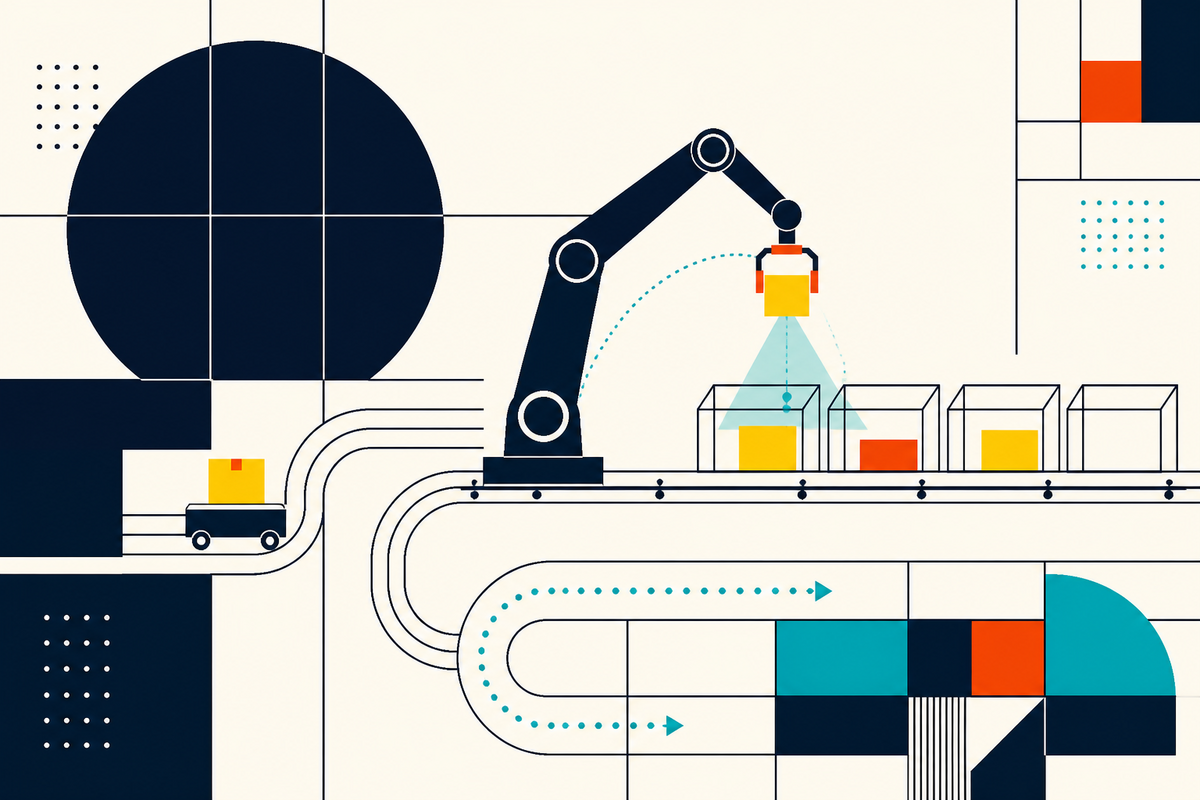
Berkshire Grey's current lineup reads like a walk through a distribution center. Core is the picking system. It combines computer vision, motion planning and the patented SpectrumGripper to handle polybags, apparel, cylinders, porous packages, glass and previously unseen items weighing as much as six kilograms. Stride is a shuttle sorter: independently controlled carriers move in parallel rather than queuing along a single conveyor path. Dispatch identifies and routes small parcels. Scoop, launched in February 2026, goes inside floor-loaded trailers and uses both selective picking and bulk induction to keep mixed freight moving.
picks
sorts
routes
unloads
The useful idea is not that one robot does everything. It is that several specialized systems share a philosophy: perceive messy goods, make a decision in real time and fit into the equipment already occupying the building. Warehouses are rarely blank sheets. Columns stand in inconvenient places. A warehouse management system contains years of peculiar rules. The old sorter cannot be retired until the new one works, and shipments cannot pause for a robotics lesson.
“Physical AI is ultimately measured by performance in the real world.”Dave Paratore, chief executive officer
02 / The buyerFixed walls, moving demand
The customers are large retailers, parcel carriers, e-commerce operators, grocers and third-party logistics companies. Berkshire Grey publicly names FedEx, Walmart, Bealls and Maersk. Others appear in case studies as a Fortune 100 off-price retailer, a top global retailer or a major beauty company - recognizable operational problems without a recognizable logo.
Their constraints rhyme. Online demand moves faster than warehouse construction. Peak season requires labor that may be unavailable for the other eleven months. Store replenishment involves less-than-case quantities across thousands of products. Parcel hubs inherit whatever shape the shipper used. A manual put wall asks a worker to scan an item, find its order cubby and walk it over, again and again. The work is tiring; the walking contributes nothing to the product.
Product figures are company-reported outcomes, not universal guarantees. Warehouse results depend on item mix, layout, upstream flow, staffing and integration.
One Bealls installation offers a more tangible picture. Working with integrator HY-Tek, Berkshire Grey placed robotic shuttle sortation in a 400,000-square-foot Texas facility serving more than 575 stores. The system went live eight months after selection and showed early productivity improvement above 33 percent, according to the companies. A separate Fortune 100 case study reported 50 percent more capacity without additional labor, a reduction of 26 full-time-equivalent positions and roughly half the footprint of the prior manual process.
03 / The differenceThe long tail is the product
A robot arm is not scarce. Reliable manipulation of the long tail is. A warehouse may present tens of thousands of items whose weight, texture, packaging and center of gravity were never entered into a robot's lesson plan. Berkshire Grey's claim to distinction is the integrated stack around that uncertainty: vision, grasp selection, sensing, proprietary end effectors, motion planning, exception handling and orchestration engineered as one system.
That integration is also the company's expertise. Its technical bench grew from manipulation research, embedded systems and industrial engineering rather than from software alone. Founder Tom Wagner previously served as iRobot's chief technology officer, and longtime chief scientist Matthew Mason led Carnegie Mellon University's Robotics Institute. In 2022, roughly three quarters of Berkshire Grey employees held technical degrees. The mix matters because a missed pick can originate in a vision model, a vacuum seal, a motion path, a tote presentation or the warehouse control software.
Core is designed to begin without a SKU teach-in. Its gripper changes suction behavior across unfamiliar objects, while software chooses a grasp point and placement. Dispatch uses Hyperscanner technology to identify parcels that are not conveniently oriented. Stride's parallel architecture avoids the single-path bottleneck of a conventional unit sorter. Scoop uses a bulk approach because emptying a collapsed wall of cartons one item at a time can make robotic precision its own bottleneck.
The more defensible asset may be accumulated failure. By June 2026, Berkshire Grey said its portfolio contained more than 1,000 granted and pending patents worldwide, with more than 700 granted. Patents do not prove that a system works. But a decade of production picks, crushed boxes and difficult integrations can turn edge cases into software updates, gripper revisions and deployment rules. Each unglamorous failure becomes a little less surprising the next time.
04 / The economicsRobots, software and the 3 a.m. phone call
Berkshire Grey sells enterprise systems, not gadgets. A project can include robotic cells, shuttles, conveyors, sensing, safety equipment, orchestration software, simulation, integration with warehouse systems and the engineering required to make the whole arrangement survive live operations. Partners such as Kardex, HY-Tek and Logistex extend that reach into storage systems, warehouse execution software and regional installation.
Then comes the recurring part. Lifecycle Services offers round-the-clock monitoring, maintenance, field service, parts, training, a customer success manager and continuing optimization. Earlier public filings also described Robotics-as-a-Service. The logic is straightforward: an automation vendor that gets paid only when the machine is installed ignores the long life after the ribbon cutting. The customer, meanwhile, buys throughput and predictability. A robot sitting still during peak season is inventory with a safety fence.
The financial record explains why execution matters. Berkshire Grey reported $65.85 million in 2022 revenue, up from $50.85 million a year earlier, but still recorded a gross loss. It had roughly 280 employees at the end of 2022, three quarters with technical degrees and about 160 with advanced degrees. The company had raised a $263 million Series B led by SoftBank in 2020, reached the public market through a SPAC in 2021 and agreed to a roughly $375 million take-private transaction with SoftBank in 2023 - far below the $2.7 billion enterprise value attached to the earlier deal.
05 / The resetAfter the public-market detour
Private ownership removed the quarterly spectacle but not the operating test. SoftBank completed the acquisition in July 2023. Berkshire Grey released a fourth generation of robotic sortation in January 2024, announced a global Kardex partnership that September and later named Dave Paratore CEO. Founder Tom Wagner became chairman. The company reworked its portfolio under the plainer Core, Stride, Dispatch and Scoop names.
The reset is also geographic. In June 2026, Berkshire Grey announced a Customer Innovation Center in Haarlem, near Amsterdam. The facility is intended for demonstrations, SKU testing, training, partner enablement and regional support. That list is revealing. Enterprise robotics is sold globally but proved locally, with the customer's actual products and software. A nearby place to test the weird bottle is more valuable than another cinematic render.
The warehouse does not reward a robot for looking intelligent. It rewards the system for making the next cutoff.
06 / The marketBetween the arm and the building
Berkshire Grey occupies a crowded middle. Piece-picking specialists such as Dexterity, RightHand Robotics, Ambi Robotics, Mujin and Nimble pursue similar manipulation problems. GreyOrange and Geek+ offer broader warehouse robotics. Symbotic, AutoStore, Dematic and KNAPP compete at the level of storage, conveyance or facility-wide automation. The most common alternative remains less glamorous: keep the old sorter, hire more people, or automate only the cleanest section.
Its position makes sense when a customer needs more than an arm but less than a new building. Berkshire Grey can attach Core to an AutoStore, an ASRS, an autobagger or an existing conveyor. Stride can be installed beside a legacy sorter, proved while shipments continue, then expanded in modules. Scoop is designed for a brownfield dock. The pitch is selective automation with an expansion path - start where pain is measurable, keep the rest of the operation standing.
That restraint is the company's most interesting answer to the humanoid moment. Warehouses contain jobs built for legs and hands, but they also contain fixed flows where a purpose-built machine can be cheaper, safer and easier to measure. Berkshire Grey is betting that physical AI earns trust one bottleneck at a time. The tote comes first. Then the sorter. Then the trailer door. Somewhere nearby, another awkward handoff is waiting.