In 2024, Oscar Brisset discovered an exotic use for paid leave: remaining at home. He used 18 of the 25 vacation days available to him at Boston Consulting Group to teach himself to code. There was YouTube for finding tools, a textbook for theory and large language models for questions. The scenery was poor. The compounding was excellent.
The point was not a promotion, at least not initially. Brisset wanted the ability to make something of his own. He had been teaching himself for years, but those 18 days turned an interest into a deliberate curriculum. The work later helped him move into an AI engineering role at BCG X, where he built machine-learning infrastructure and agentic systems for large companies. Then it helped him leave.
Before the robot, a diplomat
Brisset's first plan was diplomacy. At Magdalen College, Oxford, he studied Philosophy, Politics and Economics, the degree of prime ministers, policy wonks and people who can make the phrase “institutional incentives” survive dinner. He also rowed for a Magdalen men's crew. His public profile lists English and French at native or bilingual proficiency, plus professional Portuguese. The diplomatic route had logic.
Then GPT-3 appeared while he was a student. Brisset has said he was blown away and believed the technology would reshape the world. After graduating in 2022, he took a gap year, still carrying the idea that he would eventually found a technology company. Consulting offered a tour of industries in the meantime. He joined BCG in September 2023, beginning in its private-equity team and later working with supply-chain leaders.
“The biggest waste isn't failing. It's succeeding at something you never wanted.”Oscar Brisset
That sentence arrived after the career change, but it explains the pressure behind it. Oxford and BCG formed a ladder that many people would be pleased to keep climbing. Brisset described late nights at the office as time borrowed from the work he actually wanted to do. His answer was not a dramatic resignation followed by inspirational fog. He built the missing capability first.
The warehouse refuses to sit still
The problem Brisset and co-founder Ben Kaye chose is gloriously physical. E-commerce fulfillment warehouses do not behave like clean robotics demonstrations. Products arrive in new shapes. A client doubles its volume, then disappears. Peak season demands more hands. Plastic totes, cardboard flaps and soft packaging introduce their own tiny rebellions. A robot may be precise, but the world has not signed an agreement to be predictable.
Traditional systems often demand scale, stable inventory and a long installation. Remy AI argues that this leaves smaller third-party logistics companies outside the automation club. Its systems are meant to adapt to new stock-keeping units without a fresh programming job, fit into existing workstations and handle dexterous tasks such as packing and kitting. The company also explores picking and receiving.
The automation gap, as framed by Remy AI
The number at the center of Remy's case is 80 percent. The company says more than four out of five third-party logistics operators have no automation. Its description of the typical facility is less science-fiction laboratory than improvised city: shelves of plastic totes, cardboard boxes, perhaps a conveyor, and people supplying the adaptability that the equipment lacks. The opportunity, in Brisset's framing, lies with the long tail rather than the famous giants. Those operators want help, but they cannot build a monument every time a brand changes its shampoo bottle.
Its technical pitch replaces some mechanical rigidity with intelligence. A robot sees an object, generates a grasp and plans a trajectory. Before arriving at a customer site, Remy can recreate the environment in simulation from photographs, then refine the system with site data, domain randomization and error-recovery routines. The commercial promise is a deployment measured in days rather than months, offered through a rental model that can flex with warehouse volume.
On its site, Remy quotes a deployment of under 30 days. Installation takes one or two days, integration with a warehouse-management system roughly a week, followed by a two-to-three-week pilot with an application engineer on site. The minimum rental commitment is three months. Seasonal capacity can be added and removed. These operational details sound almost aggressively mundane beside phrases like “foundation model,” which is precisely why they matter. A robot becomes a product when someone has decided who arrives on Tuesday, what plugs into the wall and what happens when a label jams.
This is where Brisset's odd mixture of PPE, consulting and engineering becomes useful. The task is partly computer vision and robot learning. It is also economics: an automation project has to make sense for an operator with thin margins and volatile customers. And it is organizational: a machine that requires the warehouse to become a different warehouse has already lost an argument.
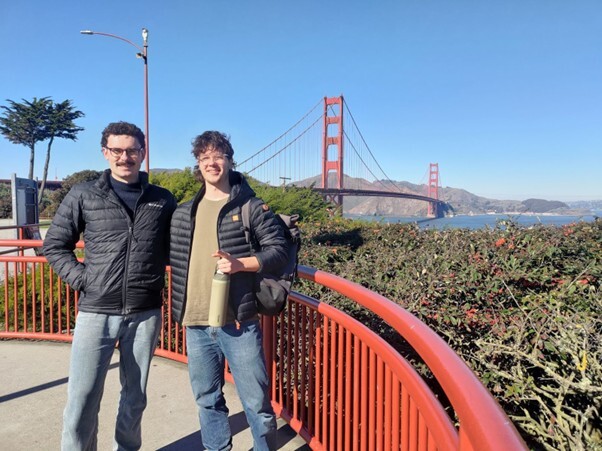
Brisset and Kaye met as Oxford undergraduates, about seven years before their YC launch. Their biographies form a neat division without being mirror images. Brisset brings supply-chain consulting, customer conversations and experience building AI systems for companies. Kaye brings an Oxford engineering background, machine-learning doctoral work and spatial-AI research. Remy's public materials assign them the conventional titles of CEO and CTO. The more interesting fact is the shared history. A robotics company produces enough disagreement between software, hardware and reality without co-founders first needing to discover how the other person thinks.
Their launch materials picture a two-armed mobile platform, a deliberate choice for tasks designed around human bodies. Packing, kitting and receiving are not one clean movement repeated forever. They involve reaching, holding, placing and recovering when an object behaves badly. Remy's bet is that a versatile body plus learned behavior can serve more of those stations than a rigid mechanism engineered for one narrow routine. It is an ambitious claim, but at least it is aimed at a specific aisle.
From private practice to public asking
Learning to code solved only the first constraint. From July 2025, Brisset shifted his weekends toward sales, contacting people on LinkedIn. He and Kaye flew to San Francisco in October, pitched investors and applied to Y Combinator. They received the invitation to its Winter 2026 batch, raised money from YC and other investors, and announced a round of about $700,000. Brisset left BCG in November.
The sequence is instructive because the activities look so different but share the same mechanism. First, Brisset repeatedly asked a computer to tell him where he was wrong. Then he repeatedly asked prospective customers and investors to do the same. Technical progress required tolerating errors. Sales required tolerating silence. Both rewarded another attempt.
“You just need to be prepared to throw yourself in the deep end.”Oscar Brisset on learning technical skills
He turned down an offer for a master's in computer science along the way. That choice does not make formal study obsolete. It does reveal his preference at that moment: use the capability in a live company, where the curriculum includes broken demos, customer objections and hardware that knows when someone important is watching.
Watch the launch videoRemy AI's two-armed robot meets the packing stationThere is another small clue to Brisset's way of thinking in an essay he published before Remy. In 2024, he wrote about Google's troubled Stadia launch, examining how a technically impressive product could misread its market and distribution. Warehouse robotics is far from cloud gaming, but the caution travels well. Engineering excellence does not repeal adoption. The customer must have a reason to change, a credible way to begin and an experience that survives contact with existing habits.
The useful bit to steal
Founder stories are often edited until the risk appears inevitable and the difficult decision looks charming. Brisset's version retains a useful piece of accounting. Eighteen vacation days. Four years of learning. Weekends redirected from code toward selling. A gap year before consulting. A resignation after funding, rather than before any evidence. The pivot was bold, but it was rehearsed.
He also carried context across each border. PPE supplied a way to think about incentives and institutions. Consulting exposed the economics and frustrations of large supply chains. AI engineering supplied technical fluency. Customer outreach tested whether the pain was real. None of those stages had to become an identity permanent enough to imprison the next one.
Remy AI remains an early company with an unforgiving job ahead. Warehouse floors care little for pedigree. A robot must work repeatedly, safely and cheaply among the boxes. Yet the company's aspiration is clear: bring adaptable AI into the physical world, beginning with fulfillment operators whose variability made earlier automation hard to justify.
Brisset once imagined representing countries. He now represents a two-person argument about machines: intelligence can make useful hardware less rigid, and that flexibility can bring automation to businesses that could not previously afford the ceremony. The setting has changed from diplomatic chambers to packing stations. The negotiation, in a way, continues - only now the other party is physics.